
USAR Tokenized Stock Explained: How to Trade USA Rare Earth as a Token in 2026

 Prefer us on Google

If you searched "USAR" and landed on a crypto exchange listing instead of a Nasdaq quote, you are not confused — you are early to a specific corner of the market. USAR is the ticker for USA Rare Earth, Inc. (Nasdaq: USAR), a U.S. rare-earth mining and magnet company. It also appears on data sites like CoinMarketCap as a tokenized asset, which is where most of the confusion starts.
This article is not another bull-versus-bear thesis on the stock — WEEX already covers that angle in depth. The job here is narrower and more practical: explain what the tokenized version of USAR actually is, how a token that tracks a rare-earth equity differs from owning the share itself, and how tokenized US stocks and stock futures are traded on WEEX, step by step. The company facts are here for context and are dated so you know how fresh they are.
Why USAR shows up as both a stock and a token
USA Rare Earth trades on Nasdaq as a conventional equity. Separately, "tokenized stock" products issued by third parties or built as derivatives aim to mirror that share price on-chain, so traders in crypto venues can get price exposure without a traditional brokerage account.
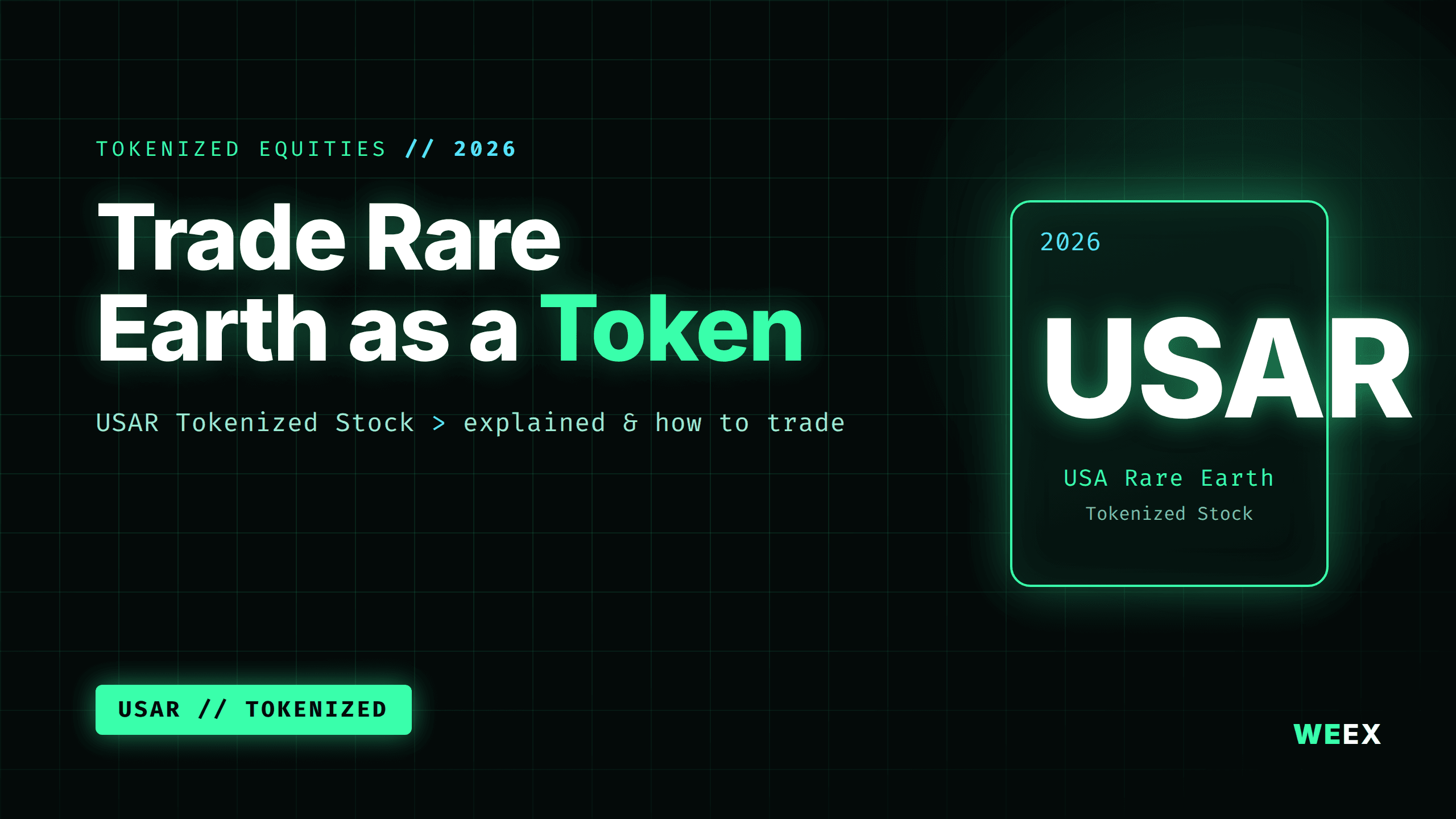
As of July 21, 2026, the underlying USAR stock closed at $15.80, up 3.74% on the day, with a market capitalization of about $3.87 billion and a 52-week range of $10.91 to $43.98 (source: stockanalysis.com). That wide range is the first thing worth internalizing: this is a high-beta name (beta ≈ 2.48) that has already round-tripped a large move in 2026. A token that tracks it inherits every bit of that volatility, plus a few risks a plain share does not carry.
The CoinMarketCap entry labeled "USA Rare Earth Inc (Derivatives)" reflects this tokenized/derivative framing. Note that as of this writing it shows negligible reported volume, which tells you the on-chain tracking product is thin and not necessarily liquid on any given venue — a critical detail returned to below.
USA Rare Earth at a glance: what you're actually buying exposure to
You do not need the full investment case to trade the token, but you should know what sits underneath it. USA Rare Earth is trying to build a vertically integrated, non-China rare-earth supply chain — from ore to separated oxides to metals to finished sintered magnets. The headline pieces:
| Item | Detail | As of |
|---|---|---|
| Stock price | $15.80 (close) | Jul 21, 2026 |
| Market cap | ~$3.87 billion | Jul 21, 2026 |
| 52-week range | $10.91 – $43.98 | Jul 2026 |
| Revenue (TTM) | ~$7.34 million | Jul 2026 |
| Net income (TTM) | ~ –$440 million | Jul 2026 |
| Beta | ~2.48 | Jul 2026 |
| Flagship deposit | Round Top, Texas (heavy rare earths) | 2026 |
| Magnet plant | Stillwater, Oklahoma | 2026 |
| Major acquisition | Serra Verde Group (Brazil), ~$2.8B agreement | Apr 2026 |
| Government backing | ~$1.6B in U.S. federal funding commitments | H1 2026 |
| Analyst avg. target | ~$38.25 (Strong Buy consensus) | Jul 2026 |
Two numbers in that table matter more than the rest for a trader: roughly $7 million in trailing revenue against a ~$3.9 billion market cap, and a net loss around $440 million. This is a story stock priced on 2028-and-beyond production, not on current cash flow. That is not a criticism — it is the reason the price can move 30% in a month in either direction.
For the deeper company breakdown — Round Top economics, the government-funding thesis, and analyst target dispersion — see WEEX's dedicated analysis: USA Rare Earth Stock (USAR): Bull Case, Risks, and the 2028 Bet.
Tokenized USAR vs. owning the real share: what you actually get
This is the part most "what is USAR" pages skip, and it is the part that decides whether the token is right for you. A tokenized stock and a real share can print the same price and still be very different instruments.
| Feature | Real USAR share (brokerage) | Tokenized USAR exposure |
|---|---|---|
| Legal ownership of equity | Yes — you own the share | Usually no — you hold a token that tracks the price |
| Shareholder voting rights | Yes | Typically none |
| Dividends / corporate actions | Direct | Depends on issuer; rare earths pay no dividend anyway |
| Trading hours | US market hours | Often 24/7, incl. weekends |
| Settlement | T+1 via broker | On-chain / exchange-internal, near-instant |
| Counterparty risk | Broker + clearing | Token issuer / exchange solvency and reserves |
| Access | Requires brokerage + KYC | Crypto account; sometimes lower minimums |
The single most important line is the first one: with most tokenized products you are buying price exposure, not the equity. Whether the token is fully backed by real shares held in custody, or is a synthetic/CFD-style contract, depends entirely on the model the issuer uses — and that determines your counterparty risk.
How tokenized US stocks actually work
There are three dominant models, and knowing which one you are trading changes the risk picture:
1. Third-party issuer, backed by real shares. A regulated issuer (the market's best-known example in 2026 is Ondo, alongside xStocks-style products from Bybit and Kraken) buys the underlying shares, holds them in custody, and mints tokens 1:1 against them. Your token is a claim on real equity held by that issuer.
2. Contract-for-difference (CFD) / synthetic. No underlying share is held. The product is a contract that pays the difference in price. This is capital-efficient and enables leverage, but your exposure is purely to the counterparty's ability to pay.
3. Licensed-broker tokenization. A brokerage (Robinhood's EU rollout is the reference case) issues tokens off its own regulated stock inventory.
WEEX's explainer walks through issuance, 24/7 trading, rights management via smart contracts, custody, and compliance across these models: What Are Tokenized US Stocks: How They Work, Models, and Future Development. Read it before you trade any tokenized equity — the model, not the ticker, is where the risk lives.
How to trade tokenized US stocks and stock futures on WEEX
WEEX runs a TradFi section offering tokenized US stocks as spot (buy and hold with USDT, no leverage) and as stock futures / perpetuals (up to 100x leverage, funding every 8 hours, tradable 24/7 including when the US market is closed). The mechanics are the same whichever underlying you choose:
| Step | Spot tokenized stock | Stock futures (perpetual) |
|---|---|---|
| 1 | Create and verify a WEEX account (KYC) | Same |
| 2 | Deposit or buy USDT | Same |
| 3 | Open the TradFi / stock market section | Same |
| 4 | Select the stock pair (e.g., a STOCK/USDT spot pair) | Select the stock perpetual contract |
| 5 | Place a market or limit order; hold | Set leverage, place order, monitor the funding rate |
Two operational notes that catch beginners. First, spot tokenized-stock orders on WEEX can start small (around 20 USDT minimum), and WEEX has promoted a 0% maker fee on parts of its stock product — but always confirm the live taker fee and spread on the order screen, because the spread is the real cost on a thin pair. Second, on perpetuals the funding rate resets every 8 hours; hold a leveraged position across several funding windows and the carry can quietly eat a correct directional call.
The full beginner walkthrough, including the difference between the spot and futures flows, is here: How to Trade Spot Stocks and Stock Futures on WEEX.
Is a USAR token actually live and liquid yet?
Be honest with yourself on this before funding anything. WEEX offers tokenized US stocks and stock futures as a product line, and names like Tesla, NVIDIA and Apple appear as spot examples. But a specific asset being tokenizable is not the same as a specific USAR/USDT pair being listed and liquid right now. The CoinMarketCap derivative entry for USAR shows negligible volume, which is a red flag for slippage.
Practical checklist before trading a USAR token anywhere:
- Confirm the exact pair exists on your chosen venue's live markets or new-listings page — do not assume from a data-aggregator entry.
- Check the order book depth, not just the last price. A thin book means your entry and exit prices can differ sharply from the quote.
- Identify the model (backed issuer vs. CFD) so you know what you actually hold.
- For a name this volatile, size the position as if it can move 30% against you, because in 2026 it already has.
If no liquid USAR pair is available, tokenized exposure to the broader rare-earth or critical-minerals theme, or simply the Nasdaq share through a broker, may be the cleaner route until a real market forms.
The risks that are specific to a tokenized rare-earth equity
Every risk of the stock is inherited by the token, and then some. The ones that actually blow up positions here:
Underlying volatility. A 52-week range of $10.91 to $43.98 is a 4x span. Leverage on a stock perpetual turns that into a liquidation engine.
Pre-revenue valuation. ~$7M revenue supporting a ~$3.9B cap means sentiment and headlines — a funding announcement, a permitting delay — drive the price more than fundamentals. In mid-2026 the stock fell sharply (roughly 23% in June) around an index-removal event, a purely technical, non-fundamental move that still hit holders.
Live litigation. In May 2026, MP Materials sued USA Rare Earth in Texas over alleged magnet trade-secret theft, naming a former engineer. Trade-secret disputes are slow and unpredictable; an adverse ruling could hit the magnet thesis directly.
Token-structure risk. If the product is a CFD or an unbacked synthetic, you are exposed to the issuer's solvency and reserve practices, not just to USAR's price. Thin volume compounds this — you may not be able to exit at a fair price.
Regulatory overhang. Tokenized US equities sit in an evolving legal grey zone in several jurisdictions; product availability can change with little notice.
FAQ
1. Is USAR a cryptocurrency?
No. USAR is the Nasdaq ticker for USA Rare Earth, a rare-earth mining and magnet company. What appears on crypto data sites is a tokenized or derivative product designed to track the stock's price, not a native cryptocurrency.
2. What was the USAR stock price in July 2026?
USA Rare Earth closed at $15.80 on July 21, 2026, with a market cap around $3.87 billion and a 52-week range of $10.91–$43.98 (source: stockanalysis.com). Prices change constantly — verify a live quote before trading.
3. Does buying a tokenized USAR give me real shares?
Usually not. Most tokenized stocks give you price exposure via a token that tracks the share, without legal ownership, voting rights, or a direct claim on the company — unless the issuer explicitly holds 1:1 backing in custody. Always check the model.
4. Can I trade USAR with leverage?
Where a stock perpetual/futures product exists, yes — WEEX offers stock futures with leverage up to 100x. Leverage on a name with USAR's volatility is high-risk and can be liquidated quickly; funding costs also apply every 8 hours.
5. How do I trade tokenized US stocks on WEEX?
Create and verify an account, deposit USDT, open the TradFi/stock section, select the pair, and place a spot or futures order. See WEEX's step-by-step guide linked above, and confirm the specific pair is live before funding.
6. Why does USAR show almost no volume on CoinMarketCap?
The tokenized/derivative entry for USAR has been thinly traded. Low volume means wide spreads and potential slippage, so treat any quoted price with caution and check real order-book depth on your venue.
Risk Warning
Tokenized stocks and stock derivatives are volatile instruments and can result in partial or total loss of capital. USAR is a pre-revenue, high-beta equity trading on sentiment and headlines; its price has swung between roughly $11 and $44 over the past year and remains exposed to active litigation (the MP Materials trade-secret suit), permitting and execution delays, and index-driven technical selling. A tokenized version adds further layers: you may hold only price exposure rather than real equity, you carry the issuer's or exchange's counterparty and reserve risk, thin liquidity can make exits costly, and leverage on stock futures can trigger liquidation and ongoing funding charges. Regulatory treatment of tokenized US equities is still evolving and product availability can change without notice. Confirm the live pair, its backing model, and order-book depth before trading, size positions for a 30%+ adverse move, and never commit funds you cannot afford to lose. This article is information, not investment advice.
Disclaimer: This content is provided for general branding and informational purposes only and doesn't constitute financial, investment, legal, or tax advice. Any events, rewards, online events, or related information mentioned herein should not be considered a recommendation, solicitation, or invitation to purchase, sell, trade, or otherwise deal in any crypto assets or to use any services. Crypto assets are highly volatile and may result in loss. WEEX services and online events may not be available in all regions and are subject to applicable laws, regulations, and eligibility requirements. You are responsible for ensuring that your use of WEEX services complies with local laws and for carefully assessing the risks before participating in any crypto-related activities.
You may also like

Is Adobe Stock a Takeover Target? What the 39% Decline From the High Tells Potential Buyers
Is Adobe Stock a Buy After Morgan Stanley Cut Its Target by 34%?

Morgan Stanley Says Micron Stock Selloff Is a Buying Opportunity: Should You Listen?
Micron Stock Has 66% Upside as Open Source AI Models Guzzle Memory: What BofA Actually Said

Microsoft Stock Before July 29 Earnings: What Azure Growth Rate Actually Needs to Show
Microsoft Stock and the AMD AI Partnership: Why Diversifying Beyond Nvidia Matters
Oil Price Above $90: What the US-Iran War Means for Your Portfolio Right Now
Mark Cuban Stock Options Philosophy: The Broadcast.com Sale That Made 300 Employees Millionaires

Mark Cuban Stock Options Philosophy: SpaceX vs Blue Origin and Why the Difference Matters

What Is a Duress Wallet Protocol and How Does It Prevent Forced On-Chain Transfers in 2026
Why Did the 2026 World Cup Become the Ultimate Catalyst for Trump's Crypto Empire
United States Water Reserve (USWR): The Contract You're Actually Buying and Whether You Can Sell It

How Did Trump's $TRUMP Meme Coin Offer VIP Access to the 2026 World Cup Final
CRCL Stock: Why Circle Crashed 70% and Where It Goes Next
United States Oil Holdings (USOH): Does This Token Really Own Oil?
How Trump Used $TRUMP Meme Coin World Cup Tickets to Reverse a 97% Crash in 2026
What else makes Robinhood Chain stand out beyond Meme coins?
Why Was Donald Trump at the 2026 World Cup Final and How Did Fans React
What Is DeXe (DEXE) Crypto and How Does Its DAO Governance Protocol Work in 2026
GOOGL Stock Forecast: Q2 2026 Earnings and AI Growth Outlook
Tesla Stock Forecast After Q2 2026 Earnings: Will TSLA Rally or Pull Back?
Tesla Stock Is Down 17% in 2026: What Q2 Earnings Need to Deliver to Turn the Story Around
What Is Mark Cuban's Stock Options Philosophy? How SpaceX Turned Welders Into Millionaires
SPCX Stock Price and the $25 Billion Short Position: Is a Short Squeeze Coming?
Is SPCX Stock Price a Buy? What Uber, Airbnb and Rivian's IPO Crashes Tell Investors
SPCX Stock Price Hits All Time Low: What Investors Should Do Right Now
How Will the CLARITY Act and Bank-Grade Stablecoin KYC Rules Change Crypto Trading in 2026
Why Is BitMine Buying Millions of Ethereum Tokens and Staking $9 Billion in ETH in 2026
How to Protect Your Bitcoin from Physical Attacks: Lessons From the NYC Crypto Torture Case in 2026
What Is the NYC Crypto Kidnapping Case? The Soho Bitcoin Attack Explained — 2026 Case Analysis
Is Adobe Stock a Takeover Target? What the 39% Decline From the High Tells Potential Buyers
Is Adobe Stock a Buy After Morgan Stanley Cut Its Target by 34%?
Morgan Stanley Says Micron Stock Selloff Is a Buying Opportunity: Should You Listen?
Micron Stock Has 66% Upside as Open Source AI Models Guzzle Memory: What BofA Actually Said
Microsoft Stock Before July 29 Earnings: What Azure Growth Rate Actually Needs to Show
Microsoft Stock and the AMD AI Partnership: Why Diversifying Beyond Nvidia Matters
Contents
Popular coins
Latest articles




