
Mark Cuban Stock Options Philosophy: The Broadcast.com Sale That Made 300 Employees Millionaires

 Prefer us on Google


Mark Cuban's stock options philosophy did not begin as a theory about income inequality or as a political argument about corporate tax rates. It began as an outcome that Cuban witnessed with his own eyes when he sold Broadcast.com to Yahoo and watched 300 of his employees become millionaires overnight. That personal experience is what makes Mark Cuban's stock options philosophy different from most arguments about worker compensation, because it is not built on what Cuban thinks should happen in theory but on what he has seen happen in practice. Understanding Mark Cuban's stock options philosophy therefore requires understanding Broadcast.com first, because the sale that created 300 millionaires is not an illustration of the philosophy. It is the origin of it.
The difference between a theory and an origin story is the difference between advocacy and conviction, and Cuban's decades of consistent advocacy on this topic reflects the conviction of someone who has seen the outcome rather than the advocacy of someone who has only imagined it.
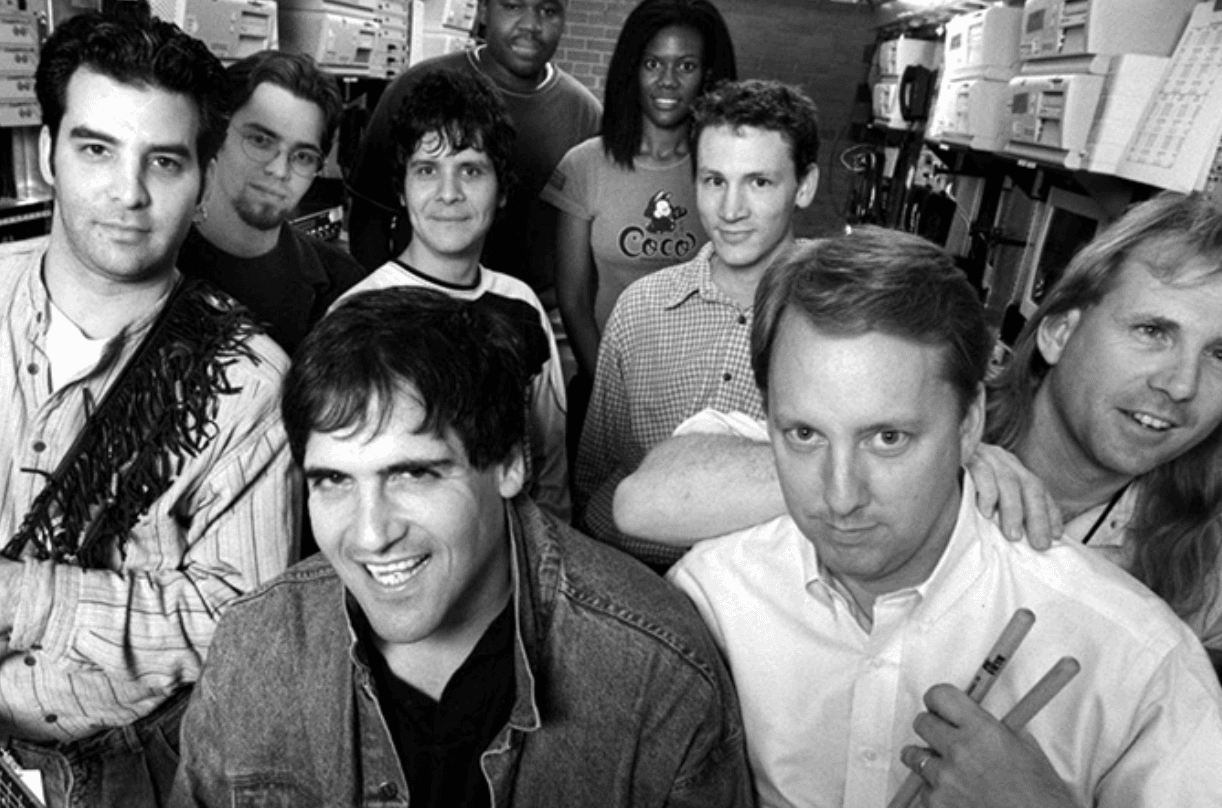
What Broadcast.com Was and Why It Mattered
Broadcast.com was an internet radio and streaming company that Cuban co-founded with Todd Wagner in 1995 under the original name AudioNet. The company allowed users to listen to radio stations, sports events, and other audio content over the internet at a time when streaming audio was a genuinely novel technology rather than an expectation.
The timing placed Broadcast.com at the center of the first internet boom, and the company grew rapidly from its Dallas, Texas base into one of the most recognizable names in early internet media. Cuban and Wagner took the company public in 1998 in an IPO that was one of the largest single-day percentage gains in stock market history at that point, with shares rising dramatically from the offering price on the first day of trading.
The specific detail about Broadcast.com that is most relevant to understanding Cuban's stock options philosophy is how he structured employee compensation from the beginning. Cuban gave equity to employees at every level of the organization, not just to the senior executives and engineers who typically receive stock options at technology companies. Administrative staff, customer service workers, and other employees whose roles were not traditionally considered equity-worthy at other companies received shares in the business alongside the technical and leadership team.
That decision to give equity broadly rather than narrowly was not standard practice in the technology industry in the mid-1990s, and it was not required by any investor or board mandate. It was a deliberate choice by Cuban and Wagner based on their belief that the people who built the company deserved to own a piece of it regardless of what their job title said about their conventional market value.
The Yahoo Sale That Changed 300 Lives
Yahoo acquired Broadcast.com in 1999 for approximately $5.7 billion in Yahoo stock, which was one of the largest internet acquisitions of the era and arrived at the peak of the first internet bubble when Yahoo's own stock was trading at extraordinary valuations.
The specific financial outcome for Broadcast.com employees when the Yahoo acquisition closed is what transformed Cuban's personal experience into the philosophy he has been articulating ever since. Of the 330 Broadcast.com employees who held company shares, approximately 300 became millionaires from the transaction.
That number deserves repetition because its specificity is what makes it credible rather than rhetorical. It was not that some employees did well or that the founding team became wealthy while ordinary workers received modest bonuses. It was that 300 out of 330 equity-holding employees crossed the millionaire threshold from a single corporate transaction. The 30 who did not become millionaires either held fewer shares or had joined the company too recently to have accumulated significant equity before the sale.
The wealth created for those 300 employees was not a function of exceptional performance in financial roles or of being present at the founding. It was a function of the equity distribution policy that Cuban implemented from the beginning, which treated every employee's contribution as worthy of ownership rather than merely worthy of wages.
What Cuban Took From the Broadcast.com Outcome
The Broadcast.com sale did not teach Cuban that employee equity is theoretically valuable. He already believed that before the acquisition. What it showed him in concrete and specific terms was the magnitude of the wealth transformation that genuine equity sharing produces when an exit occurs.
Cuban has described the experience of watching employees whose financial lives were permanently changed by the Yahoo acquisition as the most compelling evidence he has that his approach to equity distribution is correct. An employee who joined Broadcast.com as a receptionist or a customer service representative and became a millionaire from the Yahoo acquisition did not achieve that outcome through exceptional negotiating skill or through understanding of options pricing mechanics. They achieved it because the founder they worked for believed they deserved to own part of what they helped build.
The specific contrast that the Broadcast.com outcome creates with conventional corporate equity distribution is stark. Most technology companies in 1999, as in 2026, reserved meaningful equity stakes for senior engineers, executives, and early employees. The administrative, operational, and support staff who make a company function received salaries and perhaps modest bonuses but not equity that would transform their financial position in the event of a major corporate transaction.
Cuban's deliberate deviation from that convention at Broadcast.com is what produced 300 millionaires rather than the dozen or two that a conventional equity distribution policy would have created from the same $5.7 billion sale.

The Policy Proposal That the Broadcast.com Experience Motivated
Cuban's subsequent advocacy for mandatory employee equity through tax policy is a direct attempt to replicate the Broadcast.com outcome at scale rather than leaving it as an exceptional case produced by an unusually equity minded founder.
The specific policy Cuban has proposed ties the corporate tax rate to equity distribution behavior. Companies that give every employee stock options at the same percentage of their compensation as they give to the CEO retain the standard corporate tax rate. Companies that concentrate equity among executives and senior employees face higher tax rates as a consequence of that concentration.
The mechanism is designed to make the Broadcast.com approach the rational choice for every company rather than the exceptional choice of founders who happen to share Cuban's philosophy. A CEO who would not otherwise give equity to the receptionist, the warehouse worker, or the customer service representative becomes financially incentivized to do so when the alternative is a higher corporate tax rate that costs the company more than the equity dilution would.
Cuban has explicitly connected this policy proposal to the Broadcast.com experience in multiple interviews. He is not proposing something he has only theorized about. He is proposing that other companies be given the incentive to do what he did, because he has seen with his own eyes what that approach produces for ordinary workers when the exit arrives.
Why the Broadcast.com Story Is More Relevant Now Than in 1999
The Broadcast.com sale happened in 1999 during the first internet bubble, which might suggest that the lesson it produced is specific to an era of extraordinary valuations that cannot be replicated. The SpaceX IPO in June 2026 demonstrates that it can.
SpaceX's IPO created at least 4,400 millionaires, a number thirteen times larger than the 300 Broadcast.com millionaires, from a company that similarly gave equity to employees at every level of the organization. The SpaceX welder who joined in 2015 for an hourly wage and emerged from the IPO with shares worth approximately $880,000 is the 2026 version of the Broadcast.com receptionist who became a millionaire from the Yahoo sale.
The specific connection between the two outcomes is not coincidental. Both were produced by founders who made deliberate choices to give equity broadly rather than narrowly, in direct contrast to the conventional corporate practice of concentrating equity among executives and technical leaders. Both produced wealth transformation for workers who would never have achieved millionaire status through wages alone regardless of how long they worked or how well they performed.
The Broadcast.com story is more relevant now than in 1999 not because the internet bubble conditions have returned but because the SpaceX outcome has confirmed that the Broadcast.com result was not bubble-specific. It was equity-distribution-specific. Companies that give equity broadly produce broad wealth when successful exits occur. Companies that concentrate equity narrowly produce narrow wealth for the same exits.
What the 30 Who Did Not Become Millionaires Tell You
The 30 Broadcast.com equity holders who did not become millionaires from the Yahoo sale are worth examining alongside the 300 who did, because they provide important context for what Cuban's philosophy requires to produce its intended outcome.
The 30 non-millionaires among the equity holders were primarily employees who had joined the company shortly before the Yahoo acquisition and had not yet accumulated sufficient shares through their vesting schedule to reach the millionaire threshold at the sale price. The issue was not the equity distribution policy but the timing of when they joined relative to when the exit occurred.
This timing dimension is the most honest limitation of Cuban's philosophy as a guaranteed wealth-building mechanism for every worker. An employee who joins a company six months before it is acquired receives equity on the same proportional terms as an employee who joined six years earlier, but the six-month employee has accumulated far fewer shares through vesting and has had far less time for the equity to appreciate. The proportional policy is fair. The outcome is still timing-dependent in ways that the policy cannot fully address.
Cuban's acknowledgment of this limitation is implicit in his response to critics who note that stock options are worthless until the company has a successful exit. He agrees that they are worth nothing if the company fails or if the worker leaves before the exit. His argument is that the upside when exits do occur is sufficiently transformative to justify the policy even accounting for the cases where the timing does not favor every worker equally.
The Cost Plus Drugs Chapter That Shows the Philosophy Continues
Cuban's application of his equity philosophy did not end with Broadcast.com. Cost Plus Drugs, the pharmaceutical company Cuban founded in 2022 to sell generic medications without pharmacy benefit manager markups, represents his most recent implementation of the same principles.
Cost Plus Drugs was structured from the beginning with equity distribution that reflects Cuban's philosophy rather than conventional pharmaceutical startup practices. The company's mission, selling medications at cost plus a modest markup to make them affordable for patients who cannot afford brand-name prices, attracted employees who were motivated by the mission alongside the compensation.
The specific equity structure of Cost Plus Drugs has not been disclosed in the same detail as Broadcast.com because the company has not yet had a major liquidity event. But Cuban's consistent advocacy for his philosophy across more than two decades, combined with his documented application of it at Broadcast.com, makes it reasonable to expect that when Cost Plus Drugs reaches its exit, the outcome for employees will reflect the same principles that produced 300 millionaires from the Yahoo acquisition.
For workers and investors trying to understand how equity distribution affects wealth creation across different types of companies and markets, having access to the right tools and platforms matters. WEEX offers crypto and stock trading products, covering major global markets including US stocks and digital assets.
Conclusion
Mark Cuban's stock options philosophy is rooted in a specific and documented outcome rather than in theory. Three hundred Broadcast.com employees became millionaires from the Yahoo acquisition because Cuban gave equity to everyone who worked for him, not just to the executives and engineers who conventionally receive meaningful stakes. That outcome has driven his advocacy for mandatory proportional equity distribution for more than two decades and has been confirmed as replicable by the SpaceX IPO that created at least 4,400 millionaires using the same approach.
The Broadcast.com story matters in 2026 not as historical trivia about the first internet boom but as the origin of a philosophy that is being tested in real time across the technology industry. SpaceX implemented it and produced thousands of millionaires. Blue Origin is imitating it with a clawback clause that undermines the fundamental premise. Cuban is proposing to make it standard through tax policy that gives every company the incentive to do what he did rather than leaving genuine equity sharing as an exceptional choice of unusually equity-minded founders.
The 300 Broadcast.com millionaires are the reason Cuban talks about this. The 4,400 SpaceX millionaires are the reason the rest of us are listening.
FAQ
1. What was the Broadcast.com sale and how did it make 300 employees millionaires?
Mark Cuban co-founded Broadcast.com, an internet radio and streaming company, and sold it to Yahoo for approximately $5.7 billion in 1999. Because Cuban gave equity to employees at every level of the organization rather than concentrating it among executives and senior engineers, approximately 300 of the 330 equity-holding employees became millionaires when the acquisition closed.
2. How does the Broadcast.com outcome connect to Mark Cuban's stock options philosophy?
The Broadcast.com sale is the origin story of Cuban's philosophy rather than an illustration of it. Cuban witnessed firsthand that giving equity broadly rather than narrowly produced wealth transformation for ordinary workers when the exit arrived. His subsequent decades of advocacy for mandatory proportional equity distribution through tax policy is a direct attempt to replicate that outcome at scale rather than leaving it as an exceptional case.
3. Why did 30 Broadcast.com equity holders not become millionaires?
The 30 non-millionaires among the equity holders were primarily employees who had joined the company shortly before the Yahoo acquisition and had not accumulated sufficient shares through vesting to reach the millionaire threshold at the sale price. The timing of when they joined relative to the exit, rather than the equity distribution policy itself, determined that their outcome differed from the 300 who became millionaires.
4. How does the Broadcast.com story connect to SpaceX in 2026?
SpaceX's June 2026 IPO created at least 4,400 millionaires including a welder who joined for an hourly wage in 2015, using the same approach Cuban implemented at Broadcast.com. Both outcomes were produced by founders who gave equity broadly to employees at every level rather than concentrating it among executives. The SpaceX result confirms that the Broadcast.com outcome was equity-distribution-specific rather than internet-bubble-specific.
5. Has Cuban applied his stock options philosophy beyond Broadcast.com?
Cuban has applied the same equity distribution philosophy at subsequent ventures including Cost Plus Drugs, the pharmaceutical company he founded in 2022 to sell generic medications at cost plus a modest markup. The company has not yet had a major liquidity event, but Cuban's consistent application of proportional equity distribution across more than two decades of company building suggests the Cost Plus Drugs equity structure reflects the same principles that produced 300 millionaires from the Yahoo acquisition.
Disclaimer: This content is provided for general branding and informational purposes only and doesn't constitute financial, investment, legal, or tax advice. Any events, rewards, online events, or related information mentioned herein should not be considered a recommendation, solicitation, or invitation to purchase, sell, trade, or otherwise deal in any crypto assets or to use any services. Crypto assets are highly volatile and may result in loss. WEEX services and online events may not be available in all regions and are subject to applicable laws, regulations, and eligibility requirements. You are responsible for ensuring that your use of WEEX services complies with local laws and for carefully assessing the risks before participating in any crypto-related activities.
You may also like

Is Adobe Stock a Takeover Target? What the 39% Decline From the High Tells Potential Buyers

Is Adobe Stock a Buy After Morgan Stanley Cut Its Target by 34%?

Morgan Stanley Says Micron Stock Selloff Is a Buying Opportunity: Should You Listen?

Micron Stock Has 66% Upside as Open Source AI Models Guzzle Memory: What BofA Actually Said

Microsoft Stock Before July 29 Earnings: What Azure Growth Rate Actually Needs to Show
Microsoft Stock and the AMD AI Partnership: Why Diversifying Beyond Nvidia Matters

Oil Price Above $90: What the US-Iran War Means for Your Portfolio Right Now

Mark Cuban Stock Options Philosophy: SpaceX vs Blue Origin and Why the Difference Matters

What Is a Duress Wallet Protocol and How Does It Prevent Forced On-Chain Transfers in 2026
Why Did the 2026 World Cup Become the Ultimate Catalyst for Trump's Crypto Empire
United States Water Reserve (USWR): The Contract You're Actually Buying and Whether You Can Sell It

How Did Trump's $TRUMP Meme Coin Offer VIP Access to the 2026 World Cup Final

CRCL Stock: Why Circle Crashed 70% and Where It Goes Next
United States Oil Holdings (USOH): Does This Token Really Own Oil?
USAR Tokenized Stock Explained: How to Trade USA Rare Earth as a Token in 2026
How Trump Used $TRUMP Meme Coin World Cup Tickets to Reverse a 97% Crash in 2026
What else makes Robinhood Chain stand out beyond Meme coins?

Why Was Donald Trump at the 2026 World Cup Final and How Did Fans React
What Is DeXe (DEXE) Crypto and How Does Its DAO Governance Protocol Work in 2026
GOOGL Stock Forecast: Q2 2026 Earnings and AI Growth Outlook
Tesla Stock Forecast After Q2 2026 Earnings: Will TSLA Rally or Pull Back?
Tesla Stock Is Down 17% in 2026: What Q2 Earnings Need to Deliver to Turn the Story Around
What Is Mark Cuban's Stock Options Philosophy? How SpaceX Turned Welders Into Millionaires
SPCX Stock Price and the $25 Billion Short Position: Is a Short Squeeze Coming?
Is SPCX Stock Price a Buy? What Uber, Airbnb and Rivian's IPO Crashes Tell Investors
SPCX Stock Price Hits All Time Low: What Investors Should Do Right Now
How Will the CLARITY Act and Bank-Grade Stablecoin KYC Rules Change Crypto Trading in 2026
Why Is BitMine Buying Millions of Ethereum Tokens and Staking $9 Billion in ETH in 2026
How to Protect Your Bitcoin from Physical Attacks: Lessons From the NYC Crypto Torture Case in 2026
What Is the NYC Crypto Kidnapping Case? The Soho Bitcoin Attack Explained — 2026 Case Analysis
Is Adobe Stock a Takeover Target? What the 39% Decline From the High Tells Potential Buyers
Is Adobe Stock a Buy After Morgan Stanley Cut Its Target by 34%?
Morgan Stanley Says Micron Stock Selloff Is a Buying Opportunity: Should You Listen?
Micron Stock Has 66% Upside as Open Source AI Models Guzzle Memory: What BofA Actually Said
Microsoft Stock Before July 29 Earnings: What Azure Growth Rate Actually Needs to Show
Microsoft Stock and the AMD AI Partnership: Why Diversifying Beyond Nvidia Matters
Contents
Popular coins
Latest articles


