
CRCL Stock: Why Circle Crashed 70% and Where It Goes Next

 Prefer us on Google

Circle Internet Group (NYSE: CRCL) closed at $71.08 on July 21, 2026 — down roughly 70% from the $231.88 high it printed after its June 2025 IPO. The company behind the USDC stablecoin is still growing revenue, yet the stock has been one of the most violent large-cap moves of the year. This piece explains what CRCL stock actually is, why it fell so hard, what 25 analysts now expect, and how traders outside a US brokerage are getting price exposure to Circle.
The short version: CRCL is not really a "stablecoin play." It is a bet on how much interest income Circle can keep earning on the Treasuries that back USDC — and that single revenue stream is now under direct attack.
CRCL stock at a glance (as of July 21, 2026)
| Metric | Value | Source / date |
|---|---|---|
| Share price | $71.08 | NYSE close, Jul 21 2026 |
| Market cap | ~$17.7B | Jul 21 2026 |
| 52-week range | $49.90 – $231.88 | Trailing 52 weeks |
| Shares outstanding | 248.6M | Jul 2026 |
| Revenue (TTM) | $2.86B (+51.5% YoY) | Trailing twelve months |
| Net income (TTM) | –$14.3M (EPS –$0.07) | Trailing twelve months |
| Avg analyst target | ~$121 (25 analysts) | Jul 2026 |
Two numbers matter most here. Revenue is up more than 50% year on year, but the company still posted a trailing net loss. A stock that trades on future profitability, not current profit, is a stock that moves hard on anything that threatens the profit path.
Why CRCL stock crashed from $231 to $71
Circle went public in June 2025 near $31, spiked toward $300 intraday in the weeks after listing, and has been grinding lower ever since as the initial euphoria drained out. The sharpest single leg down came on June 30, 2026, when the shares fell about 18% in a day.
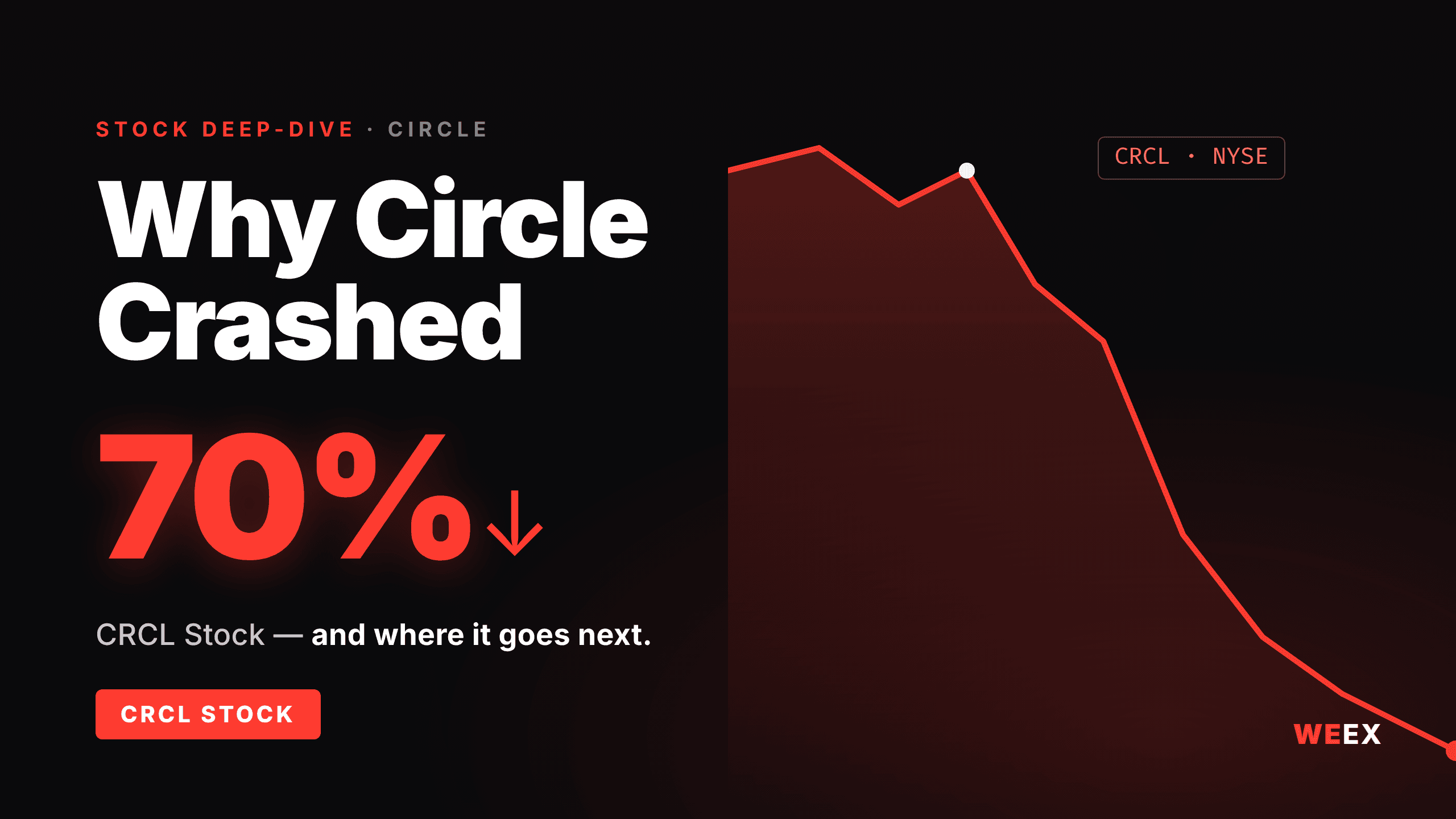
Two things hit at once. A 140-firm consortium — reportedly including Stripe, Visa, Mastercard, BlackRock, BNY Mellon and Coinbase — launched a rival stablecoin, Open USD (OUSD). On the same day, FTSE Russell removed Circle from several growth indexes, which forces index-tracking funds to sell mechanically regardless of view. The index removal supplied the fuel; the competitive headline lit it.
The market's fear is specific, not vague. OUSD is designed to charge no minting or redemption fees, set no volume caps, and pass most of the reserve yield back to its partners. Several of those partners already work with Circle. If a coin backed by that roster can undercut USDC on economics, Circle's moat looks thinner than the 2025 IPO price assumed.
The real risk: Circle earns money essentially one way
This is the part generic price pages skip, and it is the core of the CRCL thesis. Circle makes almost all of its money from interest earned on the Treasury reserves that back USDC. USDC holders don't get that yield; Circle does. It is a genuinely good business when short-term rates are high and USDC is growing — and a fragile one when either of those reverses.
Both pressures are now live. In Q1 2026, Circle's revenue fell sequentially from about $770 million to $694 million even as transaction volume surged 263%. Volume up, revenue down is the tell: the money is in the rate, not the transactions. Two forces squeeze that rate — Federal Reserve rate cuts lower the yield on the reserves, and yield-sharing competitors like OUSD force Circle to give more away to keep partners. USDC circulation of roughly $73 billion (up 28% year over year) is healthy, but circulation growth doesn't help much if each dollar earns less.
The better way to read CRCL, then, is as a leveraged position on US interest rates and stablecoin competitive intensity, dressed up as a fintech growth stock. That framing explains the volatility that a simple "USDC is winning" story cannot.
CRCL stock forecast: what analysts expect for 2026
Wall Street is split down the middle, which is itself information. Of 25 analysts, roughly 11 rate CRCL a Strong Buy and 11 a Hold, with the average 12-month target near $121 — implying meaningful upside from $71, but with a spread wide enough to drive a truck through.
| Scenario | 12-month target | What it assumes |
|---|---|---|
| Bull | ~$243 (Street high) | USDC keeps share, rates stay elevated, OUSD adoption stalls |
| Base | ~$121 (avg of 25) | Slower growth, some yield compression, no share collapse |
| Bear | ~$50 (Mizuho, Jul 14 2026) | Rate cuts plus fee war crush reserve income |
The recent analyst actions lean cautious: J.P. Morgan cut its target from $155 to $120 on July 16, 2026, and Mizuho downgraded CRCL to Sell with a $50 target on July 14. When the high target is nearly 5x the low target, the "average" is close to meaningless — the real question is which regime you think plays out.
Is CRCL stock a buy at $71?
There is no clean answer, and anyone who gives you one is selling something. The bull case is that USDC is a regulated, growing stablecoin with a $73 billion float and improving US legislative clarity, and that a 70% drawdown has already repriced a lot of bad news. The bear case is that Circle's one revenue engine faces simultaneous rate-cut and fee-war pressure, and that consortium rivals with Visa- and BlackRock-scale distribution are exactly the threat a single-revenue business can't shrug off.
The next two dates will settle more of the argument than any analyst note: the Coinbase distribution agreement is up for renewal around August 2026, and Q2 2026 earnings land on August 18. Circle's deal with Coinbase already routes a large share of USDC yield to Coinbase, so the renewed terms are effectively a live readout of Circle's pricing power. Position sizing before those catalysts matters more than the entry price.
How to trade Circle exposure without a US brokerage
Not everyone can buy CRCL equity directly — many non-US traders can't access NYSE listings at all. That gap is why tokenized versions of Circle now trade on crypto venues. On WEEX, the Circle tokenized stock (CRCLX) tracks the equity's price on-chain and traded around $70.68 with about $23.1M in 24-hour volume as of July 22, 2026 — close to the NYSE mark, but available around the clock rather than only in US market hours.
The trade-off is real and worth understanding before you use it. A tokenized stock gives you price exposure, not ownership: no shareholder voting, and dividend or corporate-action treatment differs from holding the actual share.
| CRCL equity (NYSE) | CRCLX tokenized stock | |
|---|---|---|
| Access | US brokerage, market hours | Global, 24/7 |
| What you own | Actual Circle shares | Price exposure only |
| Settlement | USD, T+1 | USDT, on-chain |
| Leverage | Margin (broker rules) | Spot, or futures where offered |
If you're weighing the routes, WEEX's guide on what to do if you can't buy CRCL stock directly compares the alternatives, and its walkthrough on trading spot stocks and stock futures on WEEX covers the mechanics and the funding-rate risk on leveraged positions. For a deeper look at on-chain Circle exposure, WEEX's explainer on the Circle tokenized stock (CRCLon) breaks down how the Ondo-issued version works.
What matters most
If you remember one thing about CRCL stock, make it this: the price tracks Circle's ability to keep earning yield on USDC reserves, and that ability is being tested from two sides at once. Growth in USDC supply is the good news the bulls point to; compression in what each dollar earns is the risk the bears price in. Watch the August earnings and the Coinbase renewal, not the daily tape.
Frequently asked questions
1. Why is CRCL stock down so much?
CRCL fell about 70% from its 2025 high, with the sharpest drop on June 30, 2026, when a large-consortium rival stablecoin (Open USD) launched and FTSE Russell removed Circle from growth indexes, triggering index-fund selling. The deeper concern is competitive pressure on Circle's reserve-yield revenue.
2. Is Circle (CRCL) profitable?
Not on a trailing basis. Circle posted $2.86 billion in revenue over the trailing twelve months (up 51.5%) but a net loss of about $14.3 million, or –$0.07 EPS, as of mid-2026. Analysts model a return to positive EPS, which is part of why the stock is volatile.
3. What is the CRCL stock price forecast for 2026?
The average 12-month target from 25 analysts is roughly $121, versus a July 21, 2026 price of $71.08. Targets range from about $50 (bear) to $243 (bull), reflecting deep disagreement over whether rate cuts and fee competition will crush Circle's margins.
4. How can I trade Circle if I can't buy CRCL on the NYSE?
Tokenized versions such as CRCLX (xStock) and CRCLon track Circle's price on-chain and trade 24/7 on crypto exchanges like WEEX, settling in USDT. They give price exposure only, not share ownership or voting rights.
5. What is the difference between USDC and CRCL stock?
USDC is Circle's dollar-pegged stablecoin, designed to stay at $1. CRCL is equity in the company that issues USDC, and its price swings with Circle's profitability and competitive position — the two are related but move very differently.
Risk Warning
CRCL stock has moved from roughly $50 to $232 within a single 52-week window, and tokenized versions inherit that volatility. Circle's business is concentrated in reserve-interest income, which exposes it to Federal Reserve rate cuts, yield-sharing competitors, and regulatory shifts around stablecoins — any of which can move the stock sharply. Tokenized stocks like CRCLX carry additional layers of risk: they provide price exposure without shareholder rights, depend on the issuer's collateral and redemption process, and leveraged futures on them can be liquidated in full during a fast move. Crypto and tokenized-equity assets are volatile and can result in partial or total loss of capital. Nothing here is investment advice; size positions to what you can afford to lose and confirm current prices before trading.
Disclaimer: This content is provided for general branding and informational purposes only and doesn't constitute financial, investment, legal, or tax advice. Any events, rewards, online events, or related information mentioned herein should not be considered a recommendation, solicitation, or invitation to purchase, sell, trade, or otherwise deal in any crypto assets or to use any services. Crypto assets are highly volatile and may result in loss. WEEX services and online events may not be available in all regions and are subject to applicable laws, regulations, and eligibility requirements. You are responsible for ensuring that your use of WEEX services complies with local laws and for carefully assessing the risks before participating in any crypto-related activities.
You may also like

Is Adobe Stock a Takeover Target? What the 39% Decline From the High Tells Potential Buyers
Is Adobe Stock a Buy After Morgan Stanley Cut Its Target by 34%?

Morgan Stanley Says Micron Stock Selloff Is a Buying Opportunity: Should You Listen?

Micron Stock Has 66% Upside as Open Source AI Models Guzzle Memory: What BofA Actually Said

Microsoft Stock Before July 29 Earnings: What Azure Growth Rate Actually Needs to Show
Microsoft Stock and the AMD AI Partnership: Why Diversifying Beyond Nvidia Matters

Oil Price Above $90: What the US-Iran War Means for Your Portfolio Right Now
Mark Cuban Stock Options Philosophy: The Broadcast.com Sale That Made 300 Employees Millionaires

Mark Cuban Stock Options Philosophy: SpaceX vs Blue Origin and Why the Difference Matters

What Is a Duress Wallet Protocol and How Does It Prevent Forced On-Chain Transfers in 2026
Why Did the 2026 World Cup Become the Ultimate Catalyst for Trump's Crypto Empire
United States Water Reserve (USWR): The Contract You're Actually Buying and Whether You Can Sell It

How Did Trump's $TRUMP Meme Coin Offer VIP Access to the 2026 World Cup Final
United States Oil Holdings (USOH): Does This Token Really Own Oil?
USAR Tokenized Stock Explained: How to Trade USA Rare Earth as a Token in 2026

How Trump Used $TRUMP Meme Coin World Cup Tickets to Reverse a 97% Crash in 2026
What else makes Robinhood Chain stand out beyond Meme coins?

Why Was Donald Trump at the 2026 World Cup Final and How Did Fans React
What Is DeXe (DEXE) Crypto and How Does Its DAO Governance Protocol Work in 2026
GOOGL Stock Forecast: Q2 2026 Earnings and AI Growth Outlook
Tesla Stock Forecast After Q2 2026 Earnings: Will TSLA Rally or Pull Back?
Tesla Stock Is Down 17% in 2026: What Q2 Earnings Need to Deliver to Turn the Story Around
What Is Mark Cuban's Stock Options Philosophy? How SpaceX Turned Welders Into Millionaires
SPCX Stock Price and the $25 Billion Short Position: Is a Short Squeeze Coming?
Is SPCX Stock Price a Buy? What Uber, Airbnb and Rivian's IPO Crashes Tell Investors
SPCX Stock Price Hits All Time Low: What Investors Should Do Right Now
How Will the CLARITY Act and Bank-Grade Stablecoin KYC Rules Change Crypto Trading in 2026
Why Is BitMine Buying Millions of Ethereum Tokens and Staking $9 Billion in ETH in 2026
How to Protect Your Bitcoin from Physical Attacks: Lessons From the NYC Crypto Torture Case in 2026
What Is the NYC Crypto Kidnapping Case? The Soho Bitcoin Attack Explained — 2026 Case Analysis
Is Adobe Stock a Takeover Target? What the 39% Decline From the High Tells Potential Buyers
Is Adobe Stock a Buy After Morgan Stanley Cut Its Target by 34%?
Morgan Stanley Says Micron Stock Selloff Is a Buying Opportunity: Should You Listen?
Micron Stock Has 66% Upside as Open Source AI Models Guzzle Memory: What BofA Actually Said
Microsoft Stock Before July 29 Earnings: What Azure Growth Rate Actually Needs to Show
Microsoft Stock and the AMD AI Partnership: Why Diversifying Beyond Nvidia Matters
Contents
Popular coins
Latest articles




