
CXMT Pre-IPO Perpetual: How to Trade Hyperliquid's Chip Bet

 Prefer us on Google


Trade.xyz has listed a CXMT pre-IPO perpetual on Hyperliquid, giving global traders synthetic exposure to Chinese memory-chip maker ChangXin Memory Technologies days before its Shanghai debut. The contract lets you take a long or short view on CXMT's expected share price without touching the A-share market — but it is a derivative, not stock, and it launched trading at a valuation more than five times the official IPO price. This guide explains what the CXMT pre-IPO perpetual is, how it was built on Hyperliquid, why it trades at such a premium, how to trade it, and where the real risks sit.
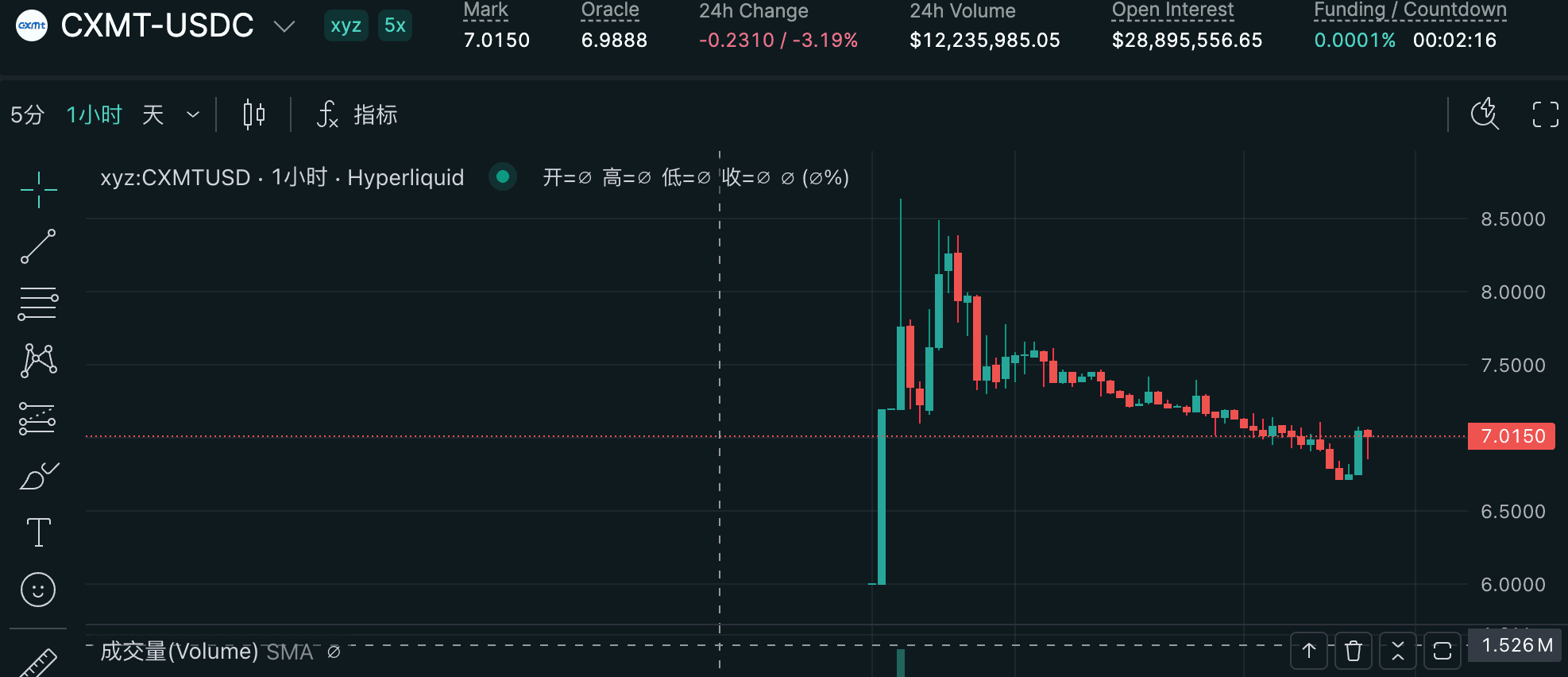
What is the CXMT pre-IPO perpetual?
The CXMT pre-IPO perpetual is a perpetual futures contract, deployed by Trade.xyz on the Hyperliquid blockchain, that tracks the expected share price of ChangXin Memory Technologies (CXMT) ahead of its Shanghai STAR Market listing scheduled for July 27, 2026. It trades under the ticker $CXMT.
The key distinction: this is a synthetic derivative, not a tokenized share. Holding the contract gives you price exposure only — no ownership, no dividends, and no voting rights in the Shanghai-listed company. Trades, execution, and settlement are handled on-chain by Hyperliquid's validator set, so positions, funding, and liquidations are all auditable on the ledger.
CXMT itself is the reason the market exists. Founded in 2016, it is China's largest memory-semiconductor company and its leading DRAM producer, with a global DRAM share around 7.7% — fourth worldwide behind Samsung, SK Hynix, and Micron. Its IPO is set to be the largest A-share chip offering on record, which is exactly the kind of scarce, hard-to-access name that draws pre-listing speculation.
| CXMT pre-IPO perpetual | Detail |
|---|---|
| Underlying | ChangXin Memory Technologies (CXMT) expected share price |
| Deployer | Trade.xyz (via Hyperliquid HIP-3) |
| Venue | Hyperliquid, on-chain settlement |
| Contract type | Pre-IPO perpetual (IPOP), cash-style, no share delivery |
| Ownership rights | None — no equity, dividends, or votes |
| IPO listing date | July 27, 2026 (Shanghai STAR Market) |
How Trade.xyz built the CXMT market on Hyperliquid
The contract runs on HIP-3, a Hyperliquid framework that lets outside builders deploy and operate their own perpetual markets — including ones tied to assets beyond crypto, such as equities, commodities, and pre-IPO names. To launch the market, the $CXMT ticker was acquired for 500 HYPE (roughly $32,625 at the time), the deployment fee Hyperliquid charges builders in its native HYPE token.
Trade.xyz was the first HIP-3 deployer and remains the largest, accounting for roughly 95% of Hyperliquid's pre-IPO perpetual volume. Its pre-IPO product line (branded IPOP) has already run markets for names like Cerebras and SpaceX before the CXMT launch.
Pricing is the part traders most often misread. Because there is no public market price to reference before listing, the CXMT perpetual uses a Hyperp-style mechanism: instead of an external oracle, the reference price is derived from the market itself, and funding is calculated from a moving average of the previous day's mark prices. In plain terms, the contract keeps itself anchored to its own recent trading rather than to a live stock quote — which makes funding, not an oracle, the main force pulling longs and shorts back toward balance.
For a broader primer on how these stock-tracking contracts work, WEEX's guide to TradeFi perpetual contracts covers the same mechanics applied to equities, commodities, and pre-IPO exposure.
Why the CXMT perpetual trades at a 526% premium
Here is the headline number that has drawn attention: on July 15, the contract traded near $8 after opening around $6 and climbing through $7.2. Applied to CXMT's expected post-IPO share count, that price implied a valuation near $535 billion — roughly 526% above, or about six times, the company's official IPO valuation.
CXMT priced its IPO at RMB 8.66 per share, raising about RMB 57.9 billion (roughly $8.6 billion) at a valuation near RMB 579 billion (about $85 billion). So the on-chain perpetual is pricing the company at several times what onshore book-building settled on.
| Valuation reference | Implied value |
|---|---|
| Official IPO price (RMB 8.66/share) | ~$85 billion |
| CXMT perpetual, ~$8 (July 15) | ~$535 billion |
| Premium to IPO valuation | ~526% (~6x) |
The gap is less about disagreement over fair value and more about access. CXMT's Shanghai listing is largely walled off to onshore investors, and even in China, STAR Market retail access generally requires a RMB 500,000 asset threshold and two years of trading experience. Global investors who want a position simply cannot buy the A-share easily. A thin, permissionless synthetic market with heavy demand and little natural short supply can therefore detach sharply from the underlying — the premium reflects scarcity and speculative appetite as much as any real forecast of CXMT's worth. The more important point for traders: a 526% premium is a statement about who can access the trade, not a price target you should anchor to.
How to trade the CXMT pre-IPO perpetual
At a mechanical level, trading the CXMT perpetual works like any other perp on an on-chain order-book venue. You connect a wallet to Hyperliquid, post margin, and open a long or short with leverage, with orders matched in the book and risk managed by the exchange's liquidation engine. If you are new to the venue itself, WEEX's explainer on how Hyperliquid works walks through the order book, funding, and liquidation design.
Three things make the CXMT contract different from a standard crypto perp:
First, funding is the tether. With no external oracle, you pay or receive funding based on which side is crowded. In a market this one-sidedly long, funding can quietly erode a long position even if the mark price holds.
Second, there is no share to deliver. This is a cash-style bet on price, so your P&L comes from mark-price moves and funding, not from converting into CXMT equity at listing.
Third, convergence risk arrives on a known date. Once CXMT lists on July 27 and a real reference price exists, a contract trading at six times the IPO valuation has a long way to fall if it is repriced toward the cash market. Early open interest and volume have been small (open interest around a couple of million dollars in the first sessions), which means slippage and gap risk are elevated.
Risks traders miss in pre-IPO perpetuals
Pre-IPO perpetuals compress several hard problems into one instrument. The blow-up points are specific and worth naming.
| Risk | Why it bites |
|---|---|
| Premium collapse | A ~6x premium can reprice fast once a real listing price appears |
| Funding drag | Crowded-long markets make longs pay continuous funding |
| Thin liquidity | Small open interest means wide slippage and violent gaps |
| Leverage | Liquidations cluster when books thin out during volatility |
| Reference/oracle model | Self-referential pricing can stay dislocated longer than expected |
| No equity backstop | The contract never converts to stock, so there is no floor from ownership |
The trap experienced traders watch for is the combination of a rich premium and a countdown. Shorting an obvious overvaluation feels easy, but funding and squeeze risk can bleed a short before the IPO ever arrives; going long into a 526% premium bets that scarcity persists right up to listing. Neither side is a free trade, and the July 27 date turns this into an event position, not a buy-and-hold. Track open interest and funding daily — in a market this young, both can shift faster than the mark price.
The bottom line on the CXMT pre-IPO perpetual
The CXMT pre-IPO perpetual is a genuinely novel way to express a view on one of 2026's biggest chip listings without onshore access — but it is a leveraged, cash-settled derivative trading at roughly six times the IPO valuation, with a hard catalyst on July 27. Treat it as an event trade with defined risk, size it for gaps and funding, and remember that the premium reflects who can access CXMT, not a promise of where the stock will open. If you want regulated, stock-tracking exposure with clearer mechanics, WEEX offers TradeFi and futures markets you can explore before committing capital to a thin pre-IPO book.
FAQ
1. What is the CXMT pre-IPO perpetual?
It is a perpetual futures contract deployed by Trade.xyz on Hyperliquid that tracks ChangXin Memory Technologies' expected share price ahead of its July 27, 2026 Shanghai listing. It is a synthetic derivative, not a tokenized share.
2. Does the CXMT perpetual give me real shares in the company?
No. The contract provides price exposure only. It carries no ownership, dividends, or voting rights, and it does not convert into CXMT equity at the IPO.
3. Why does the CXMT perpetual trade so far above the IPO price?
Around July 15 it traded near $8, implying roughly a $535 billion valuation — about 526% above the ~$85 billion IPO valuation. The premium mainly reflects restricted access to CXMT's A-share and heavy speculative demand in a thin market.
4. How is the CXMT perpetual priced without a stock quote?
It uses a Hyperp-style mechanism with a market-derived reference price instead of an external oracle, and funding is based on a moving average of the prior day's mark prices. Funding, not an oracle, keeps longs and shorts in balance.
5. What happens to the contract after CXMT lists on July 27?
Once a real listing price exists, the perpetual can reprice toward the cash market. A contract trading at several times the IPO valuation carries significant convergence and gap risk around the listing date.
6. Is trading the CXMT pre-IPO perpetual risky?
Yes. It combines high premium, leverage, funding drag, thin liquidity, and event risk on a fixed date. It should be treated as a defined-risk event trade, not a long-term hold.
Risk Warning
Crypto assets and on-chain derivatives are highly volatile and can result in partial or total loss of capital. The CXMT pre-IPO perpetual carries specific risks: a large premium to the IPO valuation that can collapse on listing, continuous funding costs on crowded positions, thin liquidity that widens slippage and gaps, leverage that accelerates liquidations, a self-referential pricing model that can stay dislocated, and no equity backstop since the contract never converts to shares. Regulatory treatment of pre-IPO synthetic markets is uncertain and access may be restricted in some regions. Nothing here is investment advice — size positions conservatively, understand funding and liquidation rules, and never risk more than you can afford to lose.
Disclaimer: This content is provided for general branding and informational purposes only and doesn't constitute financial, investment, legal, or tax advice. Any events, rewards, online events, or related information mentioned herein should not be considered a recommendation, solicitation, or invitation to purchase, sell, trade, or otherwise deal in any crypto assets or to use any services. Crypto assets are highly volatile and may result in loss. WEEX services and online events may not be available in all regions and are subject to applicable laws, regulations, and eligibility requirements. You are responsible for ensuring that your use of WEEX services complies with local laws and for carefully assessing the risks before participating in any crypto-related activities.
You may also like

How Will the CLARITY Act and Bank-Grade Stablecoin KYC Rules Change Crypto Trading in 2026

Why Is BitMine Buying Millions of Ethereum Tokens and Staking $9 Billion in ETH in 2026

How to Protect Your Bitcoin from Physical Attacks: Lessons From the NYC Crypto Torture Case in 2026

What Is the NYC Crypto Kidnapping Case? The Soho Bitcoin Attack Explained — 2026 Case Analysis

SpaceX Stock (SPCX): Now Public, and Back Where It Started

USA Rare Earth (USAR): What It Is and How to Trade the Token
NVIDIA Stock in 2026: Real Shares, Tokenized NVDA, and Perpetuals Compared
How to Buy USAR Coin: Buying Tokenized USA Rare Earth Stock the Right Way
WEEX Poker Party Series 4: Draw Cards to Split a $1M USDT Pool
Prediction Markets Are the Future of Finance or Just Gambling?

Why Prediction Markets Are So Hard to Regulate: The CFTC vs SEC Debate

Are Prediction Markets Legal? CFTC vs SEC Regulation Explained

Why Is TSMC Stock Down After a 77% Profit Jump? What Wall Street Is Actually Worried About
Is Samsung Stock a Buy at Its Lowest Level Since the AI Boom Began?
Samsung Stock and the KOSPI Bear Market: What the 30% Decline From Peak Tells Investors
Oil Price Above $90: What the US-Iran War Means for Your Portfolio Right Now
Iran War and Bitcoin: Why Crypto Is Not Acting Like a Safe Haven at $90 Oil
KOSPI Stock Market Enters Bear Market: What a 25% Drop From the Peak Means for Investors
KOSPI Stock Bear Market: What It Means for Samsung, SK Hynix and Korean Chip Stocks
Is the KOSPI Stock Market a Buy After Entering Bear Market Territory?
SK Hynix Leveraged ETFs SKHL SKHX SKHZ: What Each One Does and Who Should Use Them
Barclays Sees 70% Upside for SK Hynix Stock: What the Overweight Rating Means
Is SK Hynix Stock a Buy Now? What the 52 Week Low and IPO Price Break Tell Investors
Is This Really Messi's Last World Cup? What the 2026 Final Means for His Legacy
Who Is Ferran Torres? The Substitute Who Won the 2026 World Cup for Spain
2026 FIFA World Cup Winner: Spain Beats Argentina to Claim Second World Title
SK Hynix Stock: SKHY's Wild Nasdaq Debut and What Comes Next
JEPQ Stock in 2026: Price, Monthly Dividend, and Real Risks
FIFA World Cup 2026 Final Winner: Spain Beat Argentina 1-0 in Extra Time
Cathie Wood AMD Stock Sale: Why ARK Keeps Trimming a 140% Winner
How Will the CLARITY Act and Bank-Grade Stablecoin KYC Rules Change Crypto Trading in 2026
Why Is BitMine Buying Millions of Ethereum Tokens and Staking $9 Billion in ETH in 2026
How to Protect Your Bitcoin from Physical Attacks: Lessons From the NYC Crypto Torture Case in 2026
What Is the NYC Crypto Kidnapping Case? The Soho Bitcoin Attack Explained — 2026 Case Analysis
SpaceX Stock (SPCX): Now Public, and Back Where It Started
USA Rare Earth (USAR): What It Is and How to Trade the Token
Contents
Popular coins
Latest articles



