
With a $1 billion valuation, why couldn't Farcaster pull off a "decentralized" Twitter?


Original Article Title: "A 10 Billion Valuation and Five Years of Exploration, Why Did It 'Throw in the Towel'?"
Original Article Author: Bootly, via Bitpush News
After five years of establishment, raising approximately $180 million in total funding, and once reaching a valuation close to $10 billion, Farcaster has officially admitted that the path of Web3 social has not panned out.
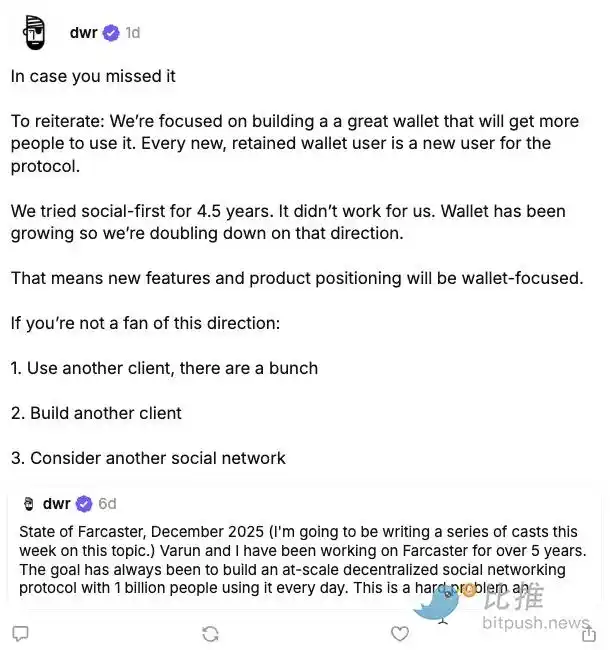
Recently, Farcaster co-founder Dan Romero posted consecutively on the platform, announcing that the team will abandon the "social-first" product strategy and instead fully focus on the wallet direction. In his statement, this was not seen as a proactive upgrade but rather a choice made after a long period of attempts, compelled by reality.
"We tried for 4.5 years to put social first, but it didn't work."
This assessment not only signifies Farcaster's transformation but also once again shines a spotlight on the structural challenges of Web3 social.
The Gap Between Ideal and Reality: Why Farcaster Couldn't Become "Decentralized Twitter"
Farcaster emerged in 2020, amidst the rising narrative of Web3. It attempted to address three core issues of Web2 social platforms:
· Platform Monopoly and Censorship
· User Data Not Owned by Oneself
· Creators Unable to Monetize Directly
Its design concept was quite idealistic:
· Protocol Layer Decentralization
· Clients Can Freely Build
· Social Relationships On-Chain and Migratable
Among the many "decentralized social" projects, Farcaster was once seen as the product closest to Product-Market Fit (PMF). Especially after the 2023 Warpcast, numerous Key Opinion Leaders (KOLs) joined Crypto Twitter, making it seem like the prototype of the next-generation social network.
However, problems soon surfaced.
According to Farcaster Monthly Active Users (MAU) data on Dune Analytics, Farcaster's user growth trajectory revealed a very clear but not optimistic pattern:
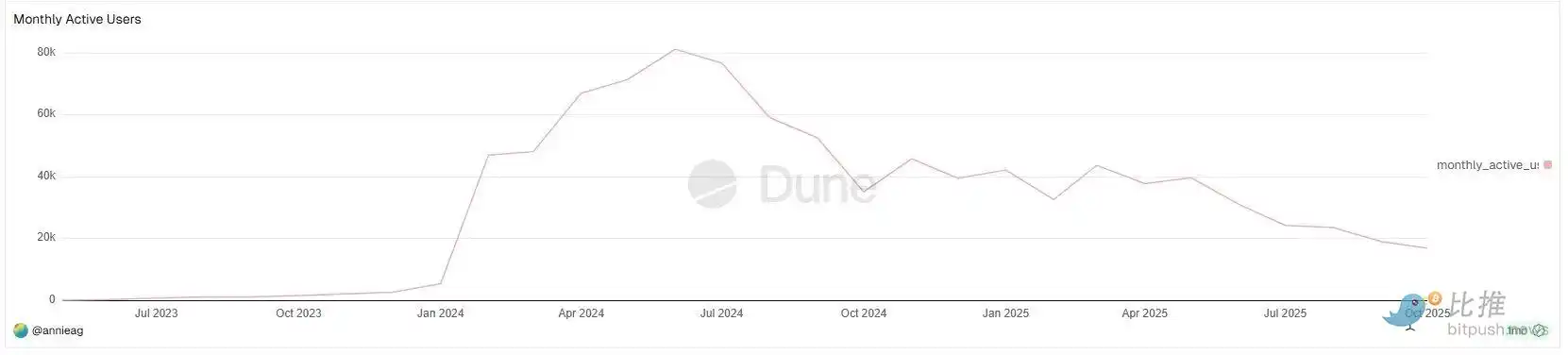
Throughout most of 2023, Farcaster's monthly active users (MAU) were almost negligible;
The true inflection point in growth occurred in early 2024, with MAU rapidly rising from low thousands to approximately 40,000–50,000 in a short period of time, peaking at nearly 80,000 MAU in mid-2024.
This was the only truly significant scaling window for Farcaster since its inception. Particularly noteworthy is that this growth did not occur during a bear market, but rather during a phase of high Base ecosystem activity and intense SocialFi narratives.
However, this window did not last long.
Starting in the latter half of 2024, MAU data showed a noticeable decline, presenting a fluctuating downward trend over the following year:
· MAU rebounded multiple times, but the peaks trended lower
· By the second half of 2025, MAU had dropped to less than 20,000
In reality, Farcaster's growth has always been unable to "break the circle," with its user base highly homogeneous:
· Crypto industry professionals
· VCs
· Builders
· Crypto-native users
For the average user:
· The registration threshold is high
· Social content is heavily "in-group"
· The user experience is not superior to X/Instagram
This has led Farcaster to consistently fail to generate true network effects.
DeFi KOL Ignas on X (@DeFiIgnas) bluntly stated that Farcaster "simply acknowledged what everyone had been feeling for a long time":
The network effect intensity of X (formerly Twitter) is almost impossible to be positively breached.
This is not an issue of crypto narratives but a structural barrier of social products. From a product perspective, the social aspect of Farcaster's issues is quite typical:
· User growth has always been locked within the crypto-native crowd
· Content is highly self-referential, making overflow difficult
· Creator Monetization and User Retention Did Not Form a Positive Feedback Loop
This is also why Ignas succinctly summarized Farcaster's new strategy in one sentence:
"It's easier to add social to a wallet than to add a wallet to a social product."
This assessment fundamentally acknowledges that "social is not Web3's primary need."
"Bubbles Are Comfortable, but Numbers Are Harsh"
If MAU data answers "How is Farcaster doing," another question is: How big is this market itself?
Crypto creator Wiimee provided a set of impactful comparative data on X.

Following an "accidental breakout from the crypto content circle," Wiimee created content for the general audience for four consecutive days. The analysis data showed that within approximately 100 hours, he gained 2.7 million impressions, more than double the total views of all his crypto content in a year.
He remarked: "Crypto Twitter is a bubble, and it's small. Speaking to the general public for four days is more impactful than speaking to insiders for four years."
This is not a direct critique of Farcaster but reveals a more underlying issue: crypto social is inherently a highly self-referential ecosystem with weak external outreach capabilities. When content, relationships, and followers are all limited to the same group of native users, even the most sophisticated protocol design struggles to break through the market's size limit.
Thus, the challenge Farcaster faces is not "the product is not good enough" but rather "there are not enough people in the space."
Wallet, Unexpectedly Achieving PMF
What truly altered Farcaster's internal judgment was not a reflection on social but an unexpected validation of the wallet.
Earlier in 2024, Farcaster introduced a built-in wallet in the app, originally intended as a supplement to the social experience. However, from the usage data, the wallet's growth rate, usage frequency, and retention performance were notably different from the social module.
Dan Romero emphasized in a public response: "Every new wallet user and retained user is a new user for the protocol."
This sentence itself has revealed the core logic of the roadmap adjustment. The wallet is not facing "expressiveness," but the real, rigid on-chain operational needs: transfer, transaction, signature, and interaction with new applications.
In October, Farcaster acquired the AI Agent-driven token issuance tool Clanker and gradually integrated it into the wallet system. This move was also seen as the team's clear commitment to the "wallet-first" path.
From a business perspective, this direction has obvious advantages:
· Higher frequency of use
· Clearer monetization path
· Closer integration with on-chain ecosystem
In contrast, social features are more like icing on the cake rather than the growth-driving engine.
Although the wallet strategy is data-driven, community controversy has followed.
Several long-time users have made it clear that they are not against the wallet itself but feel uncomfortable with the accompanying cultural shift: from "users" being redefined as "traders," from "co-builders" being labeled as the "old guard."
This exposes a practical issue: when the product direction changes, community emotions are often harder to migrate than the roadmap. Farcaster's protocol layer remains decentralized, but the decision-making power regarding product direction still lies largely with the team. This tension is amplified during the transition.
Romero later admitted communication issues but also made it clear that the team has made a choice.

This is not arrogance but a common reality check for a late-stage startup project. In this sense, Farcaster has not abandoned the social ideal but has let go of the fantasy of scaling it.
Perhaps as an observer said, "First make users stay for the tool, then there is room for social interaction."
Farcaster's choice may not be the most romantic, but it may be the closest to reality, diving deep into integrating native financial tools (wallet, transaction, issuance), which is the practical path to transforming into sustainable business value.
You may also like

Bitcoin Trading Guide 2026: Strategies for Experienced Traders

What Is XAUT and PAXG? Why Tokenized Gold Is Booming in 2026

Cryptocurrency CEXs are flocking to sell US stocks, and traditional brokerages are facing an "uninvited guest."

Will the SpaceX IPO Hurt Bitcoin? Here's What Traders Are Watching
Foreign selling in the South Korean stock market accelerates, with cumulative net sales reportedly reaching $75 billion this year
On June 9, The Kobeissi Letter, citing Goldman Sachs data, reported that global investors are selling South Korean stocks at an unusually rapid pace. In the latest trading session, foreign investors sold about $801 million worth of Kospi constituent stocks again; total foreign outflows last week reached about $10 billion, and the market has been in net foreign selling on nearly every trading day over the past month. According to the data cited in the report, foreign investors have sold about $75 billion worth of South Korean stocks so far this year. Meanwhile, South Korean retail and institutional investors together recorded roughly $69 billion in net buying over the same period, suggesting that the market’s main buying support has come from domestic capital rather than returning overseas funds. The information currently disclosed still mainly comes from The Kobeissi Letter’s retelling and Goldman Sachs data summaries, while public details on the statistical period and the specific definition of “selling” remain relatively limited.

Fortune Warns of Strategy’s Financing Structure Risks as Bitcoin Premium Narrows
Fortune warned that Strategy’s Bitcoin treasury model faces growing financing risks as MSTR’s net asset premium narrows and preferred stock dividend pressure increases.

Ferrari Challenge Le Mans: Carl Moon to Dominate in WEEX Livery

Sahara AI Responds to SAHARA’s Sharp Drop: No Contract or Product Security Issues Found, Internal Investigation Underway
Sahara AI responded to SAHARA’s 60% price drop, saying no token contract or product security issues have been found and an internal investigation is underway.

WEEX Deposit/Withdrawal Dynamic Island: Your Asset Status, Always in Sight

Scaling Crypto Derivatives: The Digital Asset Infrastructure Behind High-Volume Trading
In the fast-moving digital asset ecosystem, derivatives platforms face an extreme architectural test. High-leverage futures markets demand more than just standard security—they require absolute operational precision, zero-latency matching engines, and ironclad structural scalability, all while navigating intense market volatility.
As global platforms scale to meet these demands, the industry is shifting away from rigid, monolithic setups toward a more agile, "decoupled" infrastructure philosophy.
The Blueprint for High-Volume Copy TradingFor elite global exchanges like WEEX (founded in 2018), this architectural choice becomes critical when scaling high-volume retail features like social copy trading. When thousands of users automatically mirror the real-time strategies of elite traders simultaneously, it triggers sudden, monumental spikes in concurrent transactional volume.
To prevent execution latency or settlement bottlenecks during these peak volatility events, a platform's primary engine must remain entirely dedicated to risk management, copy-trade synchronization, and order matching.
The Architectural Rule: New-generation platforms must separate front-end user execution engines from heavy backend infrastructural overhead to eliminate operational friction.
By separating these layers, platforms can maintain complete sovereignty over their trading environments and user experiences while strategically aligning with institutional-grade infrastructure ecosystems. This strategic framework allows modern exchanges to leverage advanced Digital Asset Custody infrastructure such as Cobo’s behind the scenes, ensuring that backend wallet management scales elastically alongside trading spikes.
Capitalizing on Market Momentum and 400× LeverageIn a derivatives arena where platforms offer up to 400× leverage on perpetual contracts, capital efficiency and market agility are core business metrics. To capture market momentum, an exchange needs the ability to rapidly expand its asset offerings, supporting everything from legacy crypto assets to sudden, trending altcoins across a massive library of trading pairs.
Adopting a flexible, scalable Wallet-as-a-Service (WaaS) solution such as Cobo’s could completely rewrite the development timeline for high-growth exchanges. Instead of spending months of engineering capital building out custom backend wallet architectures for every new blockchain network, platforms can deploy localized infrastructure in days.
This agility allows platforms to instantly scale their listings to over a thousand trading pairs without compromising security or delaying time-to-market. It mirrors the exact operational advantages seen during high-velocity market events, similar to how advanced wallet infrastructure empowers platforms during sudden asset surges; allowing exchanges to pass that speed and liquidity directly to their global user base.
A Mature Foundation for GrowthThe synergy between trusted infrastructure ecosystems and global trading platforms represents the natural evolution of a maturing crypto market. As WEEX continues to scale its global spot and derivatives offerings for over 6 million users, adopting robust backend paradigms proves that platforms no longer have to compromise between cutting-edge trading velocity and uncompromised structural security.

Morning Report | BitMine increased its holdings by 126,971 ETH last week; trader Eugene announced his exit from the crypto market

Wang Chuan: How can one not feel anxious after the neighbor Old Wang made thirty times profit by investing in storage stocks? (Seven) - A quarter-century cycle

Get Paid to Onboard? Try WEEX’s New Homepage with Rewards for Registration, Deposit & Trade

WEEX Custom Layout: Build Your Perfect Trading Workspace in Seconds

See “Buy Walls” & “Sell Walls” Instantly: WEEX Launches the Depth Chart for Smarter Trades

What Is Quick Trade on WEEX? 2 Ways WEEX Ends Chart-Panel Jumping
Morning News | Five major virtual asset platforms in South Korea have experienced 57 incidents of hacking and system failures in six years; Grayscale submits registration application for Canton ETF
Should we escape the peak? The principle of the tail-end market in the stock market
Bitcoin Trading Guide 2026: Strategies for Experienced Traders
What Is XAUT and PAXG? Why Tokenized Gold Is Booming in 2026
Cryptocurrency CEXs are flocking to sell US stocks, and traditional brokerages are facing an "uninvited guest."
Will the SpaceX IPO Hurt Bitcoin? Here's What Traders Are Watching
Foreign selling in the South Korean stock market accelerates, with cumulative net sales reportedly reaching $75 billion this year
On June 9, The Kobeissi Letter, citing Goldman Sachs data, reported that global investors are selling South Korean stocks at an unusually rapid pace. In the latest trading session, foreign investors sold about $801 million worth of Kospi constituent stocks again; total foreign outflows last week reached about $10 billion, and the market has been in net foreign selling on nearly every trading day over the past month. According to the data cited in the report, foreign investors have sold about $75 billion worth of South Korean stocks so far this year. Meanwhile, South Korean retail and institutional investors together recorded roughly $69 billion in net buying over the same period, suggesting that the market’s main buying support has come from domestic capital rather than returning overseas funds. The information currently disclosed still mainly comes from The Kobeissi Letter’s retelling and Goldman Sachs data summaries, while public details on the statistical period and the specific definition of “selling” remain relatively limited.
Fortune Warns of Strategy’s Financing Structure Risks as Bitcoin Premium Narrows
Fortune warned that Strategy’s Bitcoin treasury model faces growing financing risks as MSTR’s net asset premium narrows and preferred stock dividend pressure increases.


