
Tutorial | How to Find KOL's Transaction Address? Includes a File of One Hundred KOL Addresses


Original Author: Zibu, Crypto KOL
Due to their influence, KOLs can have a certain impact on projects through their actions. Typically, a project's KOL would first buy in themselves, then share in the community, and finally post publicly on channels like Twitter. If we have the KOL's address, we can know immediately what they bought, when they added to their position, and when they took profits or stopped losses.
This article shares some methods for finding KOL addresses and how to use these addresses.
1. Using gmgn
gmgn is a comprehensive platform with features such as trading, data analysis, and monitoring, and its founder is Chicken Brother @haze0x.
On gmgn, users can link Twitter accounts with addresses, allowing us to find KOL addresses using this feature.
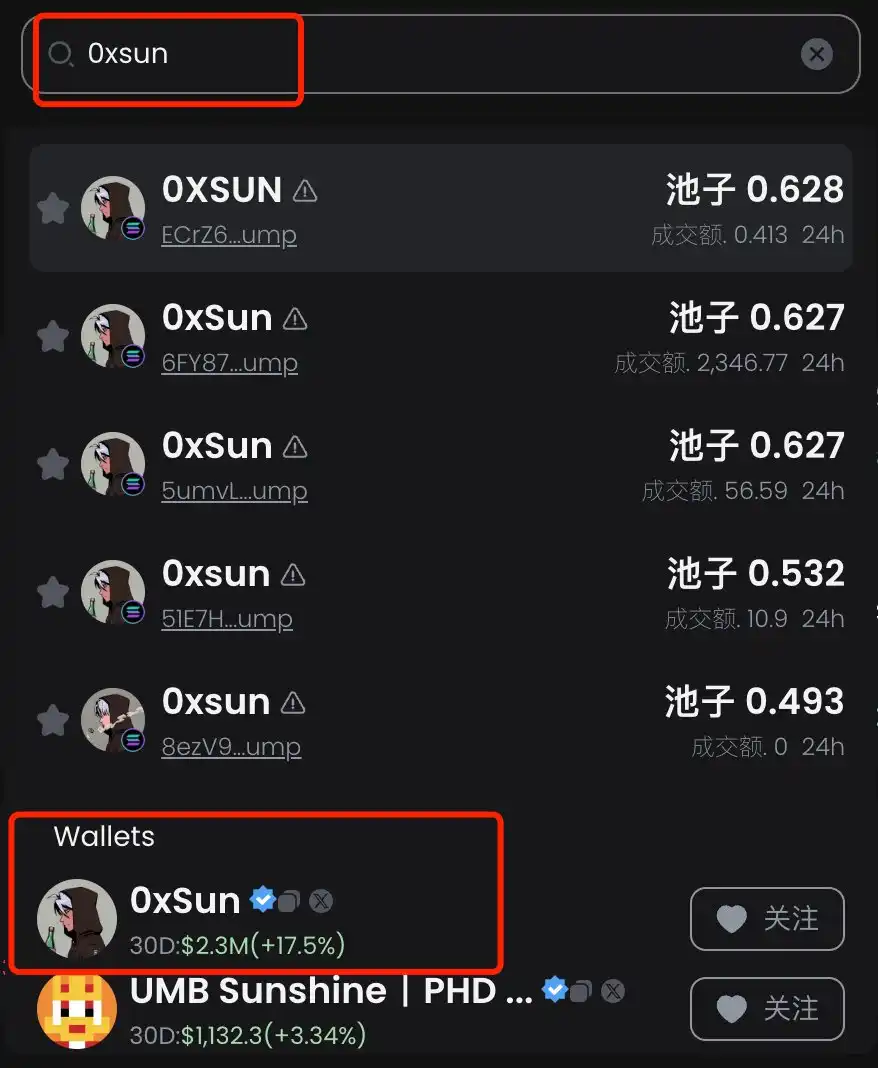
For example, if we want to know 0xsun's address, we can enter "0xsun" in the search bar, and at the bottom of the search results, 0xsun's address will appear, as shown below:
By clicking on the address in the search results, we can see detailed information about 0xsun's address, as shown. We can see his Twitter follower count, with a clickable link to Twitter; we can see his win rate; and we can see his 7-day P&L, with a 7-day profit of $2.3 million.
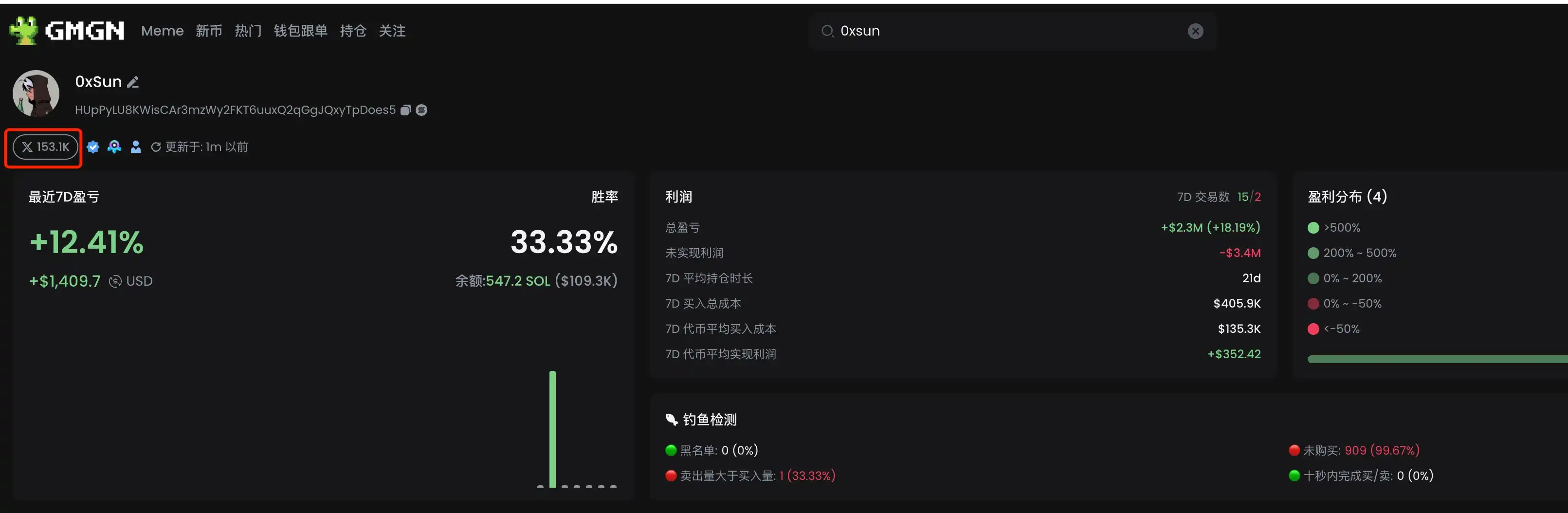
Therefore, when we want to know the address of a KOL, we can search on gmgn to see if they have linked their address. If they have, we can find it there.
2. Using chain.fm
chain.fm is an on-chain monitoring platform where users have uploaded many smart contract addresses, including those of many KOLs. The founder is @zen913.
Before the new year, chain.fm launched a search feature supporting keyword searches, allowing us to use this feature to find KOL addresses.
I have mentioned this method in my tweet https://x.com/0x_zibu/status/1882345639218118884. There are two methods to find KOL addresses using chain.fm:
1. Directly Search for a Specific KOL Name
Let's continue using 0xsun as an example. Enter "0xsun" in the input field, and you will see several addresses appear, as shown in the image below.
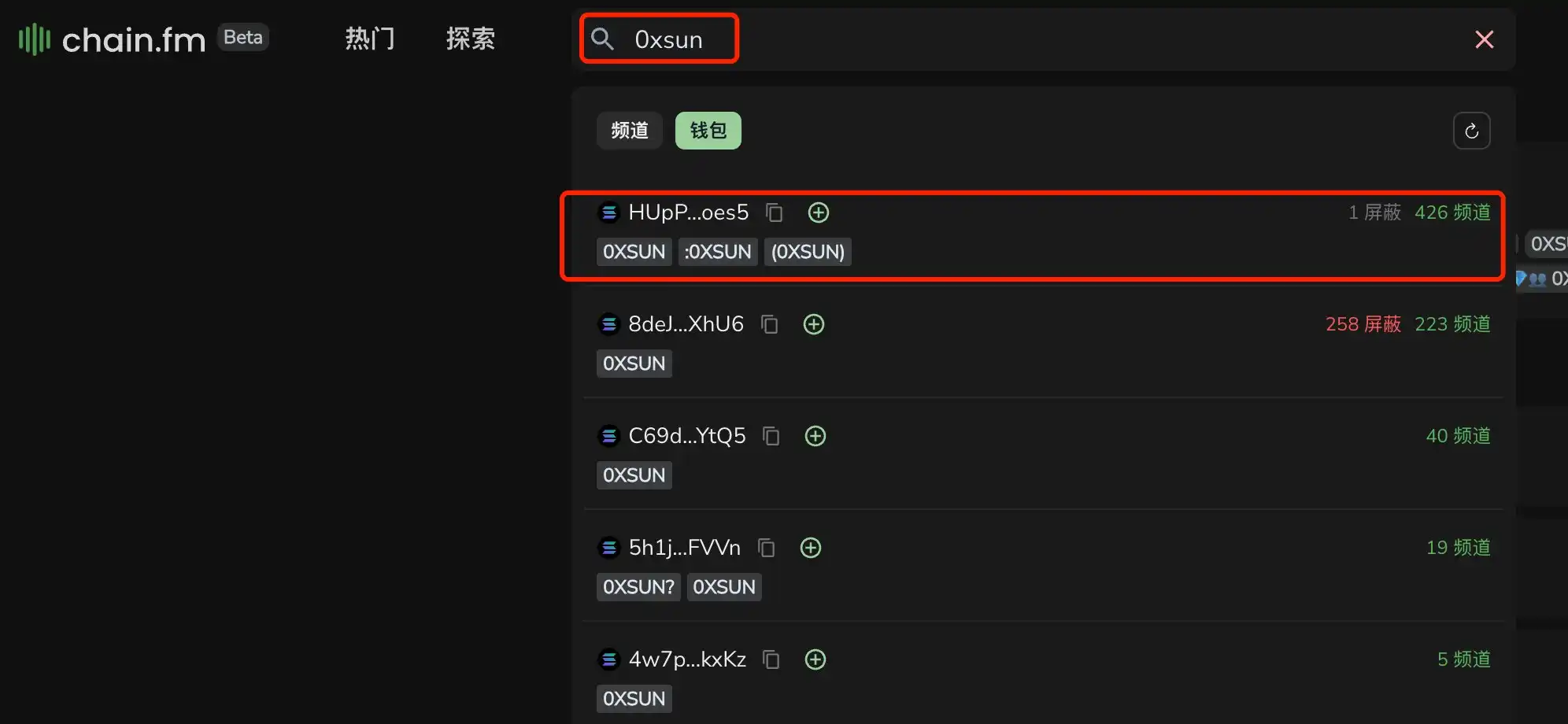
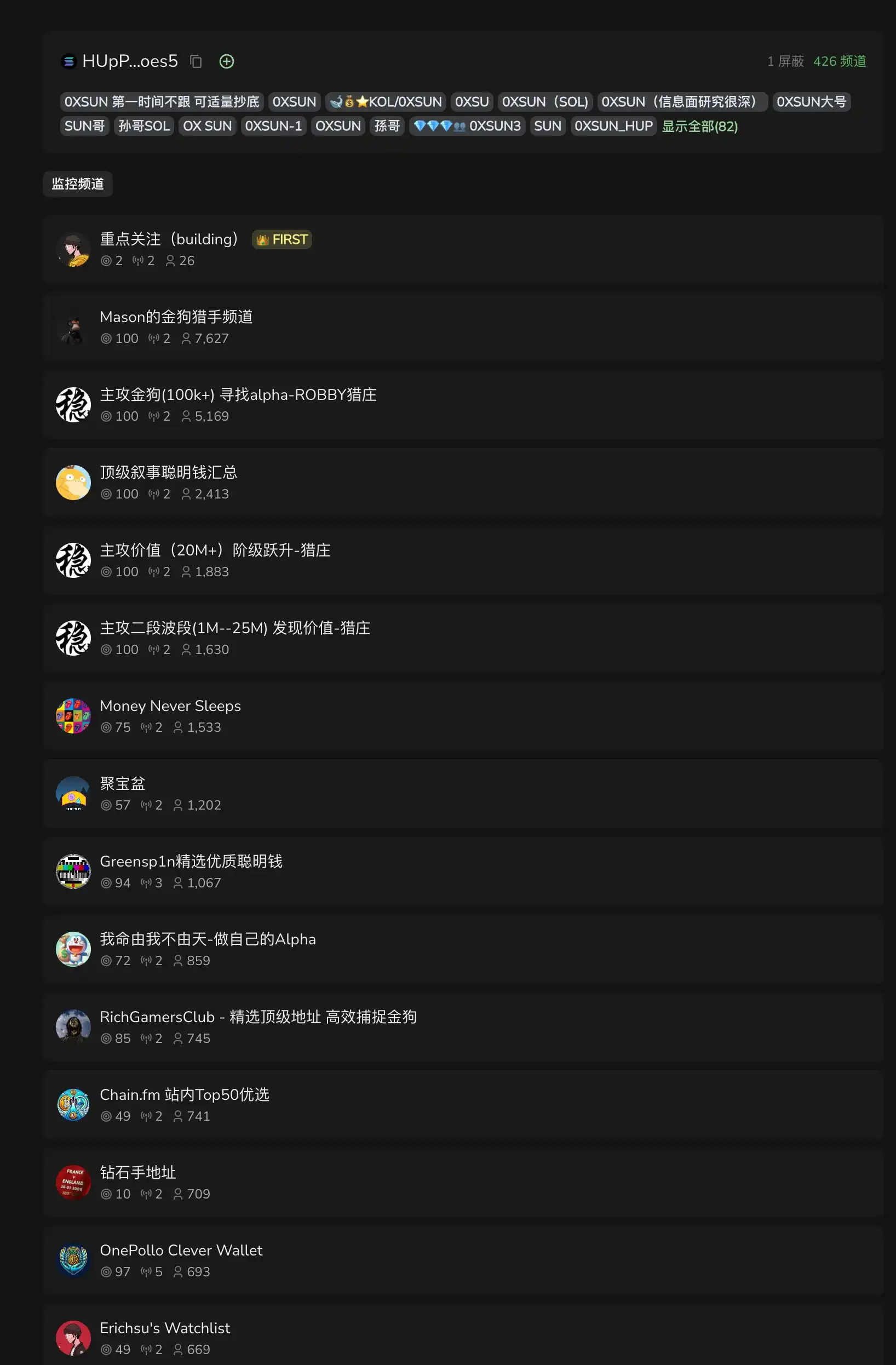
The first address in the search results is listed in 426 channels, indicating a high probability that it is 0xsun's address. You can also verify this address on gmgn to see if 0xsun has authenticated it.
2. Search Using the Keyword "KOL"
You can also enter the keyword "KOL" to search for all relevant information on chain.fm, as shown below.
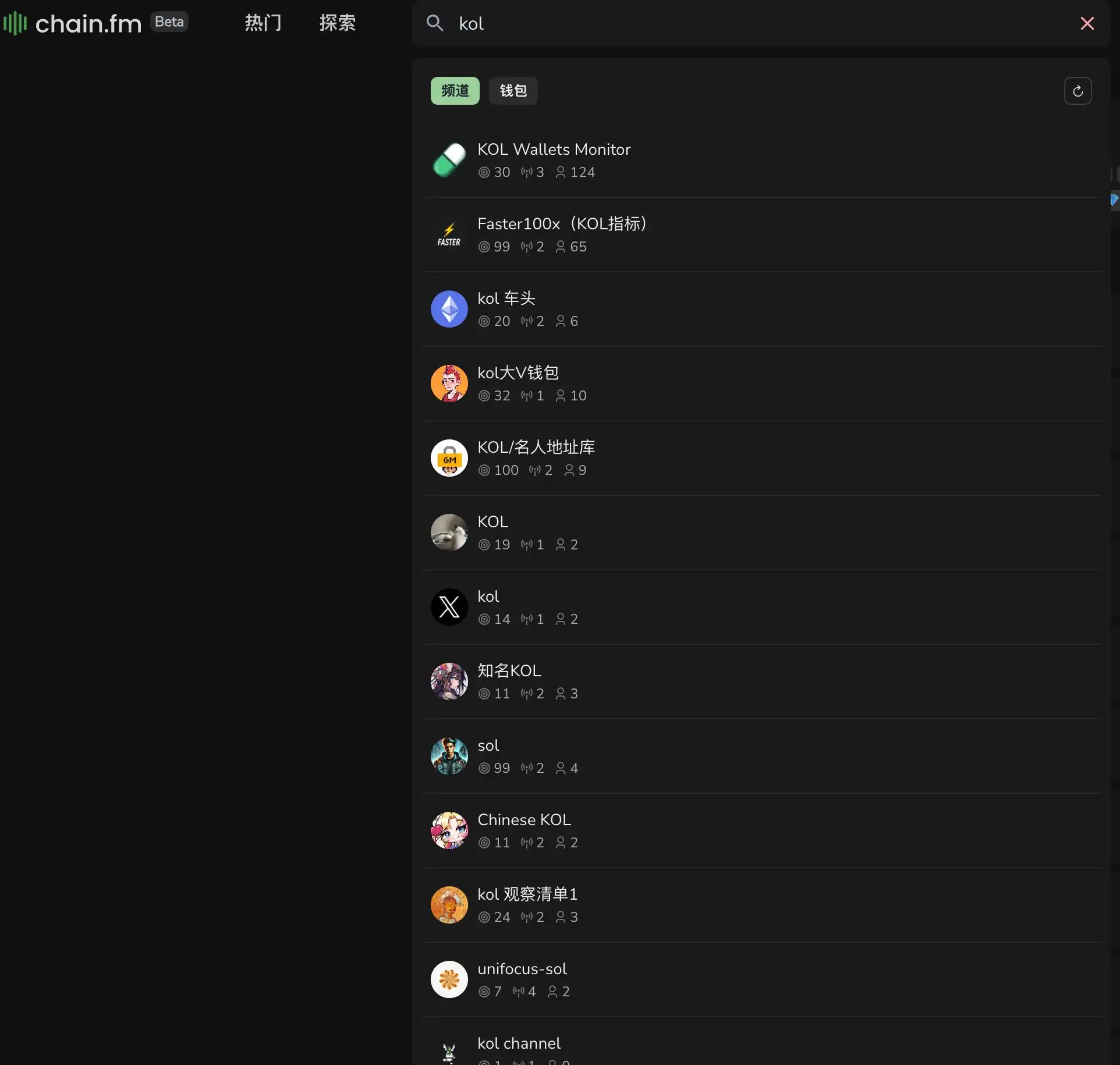
When you enter "KOL," all relevant channels will be displayed. These channels contain curated KOL addresses, and you only need to verify their authenticity.
Under the wallet option, using the keyword "KOL" will also display addresses containing this information, as shown below.

The addresses found through chain.fm are based on uploads by channel owners and cannot be guaranteed to be 100% accurate. It is necessary to cross-validate through gmgn, Twitter, or other channels.
III. Twitter-Based Forensic Analysis
The above two methods are relatively simple and can be found with some time and effort. However, some KOLs do not publicly disclose their addresses. In such cases, other methods must be used to find them.
1. Specific Display of Transactions
Some KOLs will display transactions in their tweets, including specific transaction information such as transaction time, buy or sell, transaction amount, and the quantity of the coin. It is easy to find addresses for these types of transactions as they provide specific transaction details for filtering.
For filtering such transactions, it is recommended to use DEX Screener (https://dexscreener.com/). You can filter based on transaction time, transaction type (buy or sell), transaction amount, and coin quantity, as shown in the image.

DEX Screener is one of the tools I have used with the most comprehensive manual filtering features. Unlike other tools where filtering features are superficial, I doubt even the PM uses them.
However, the drawback of TokenView is that it cannot retrieve transactions that use aggregation routes, such as those on OKX. For these transactions, you will need to check OKX's website (https://www.okx.com/en/web3) for information.
2. Vague Information
Sometimes, Key Opinion Leaders (KOL) on Twitter may not directly share their trades but instead mention entering a certain coin at a specific market cap. In such cases, the information provided is limited. Relying solely on one tweet may only give you a rough idea, and you may need to combine multiple tweets to pinpoint the exact transaction.
For example, yesterday, Cycle Bull shared Burder's address details as shown in the image. How can we identify this address?
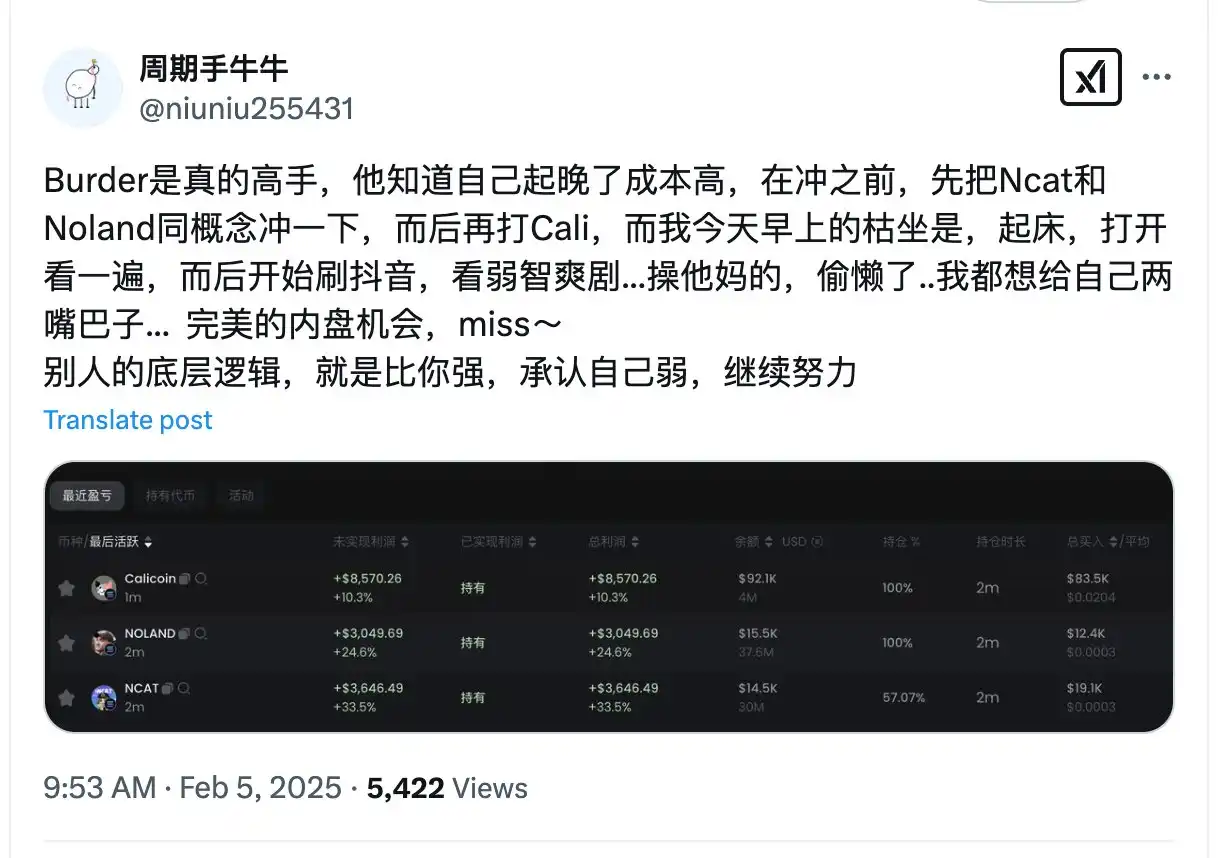
Let's first gather all the relevant information:
(1) The tweet was posted at 9:53 on 2.5
(2) Based on the tweet, Burder first bought $Ncat and $Noland, followed by a purchase of $Calicoin
(3) The image in the tweet provides rich information, as follows:
a. The holding of $Calicoin is 4M
b. The holding of $Noland is 37.6M
c. The holding of $Ncat is 30M, but it accounts for only 57% of the total holding
d. At the time of the screenshot, their holdings were only 2 minutes old
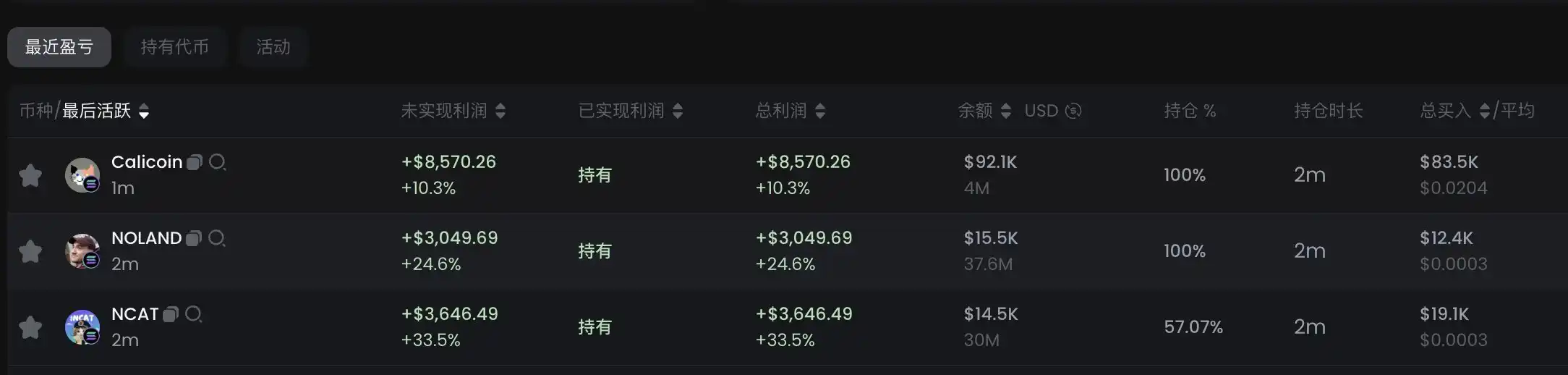
(4) The opening time for $Calicoin was 8:23 on 2.5
From the above information, we can deduce that Burder's transaction occurred between 8:23 and 9:53, with a holding duration of 2 minutes as seen in the image. Therefore, the latest possible transaction time is 9:51. If Burder mentioned being late in the tweet, the earliest transaction time would be sometime after the opening but without specific details, so we can only start filtering from 8:23.
With this information, here's what we can do:
a. Write a script to fetch transaction data
Retrieve all buy transactions for the three coins between 8:23 and 9:53, and identify the address that made simultaneous purchases of these three coins in this timeframe, matching the order and quantity according to the collected information above.
b. Query Using Dune (https://dune.com/)
Compared to writing your own script to fetch transaction data, data on Dune is readily available. At this point, you can use AI assistance to write a Dune query statement, filter out addresses, and then manually verify them.
Four, Analyze Address Transaction Style and Win Rate
Once you have identified the KOL's address, you need to conduct a detailed analysis of this address. Look at their transaction style to see if they prefer playing in the primary market or the secondary market, whether they prefer chasing highs or setting ambushes, how they approach take-profit and stop-loss, what their win rate is, and what their overall profit and loss situation is.
For address analysis, platforms such as GMGN and Debot are currently quite effective.
1. GMGN
GMGN has done a great job in data analysis, covering various indicators.
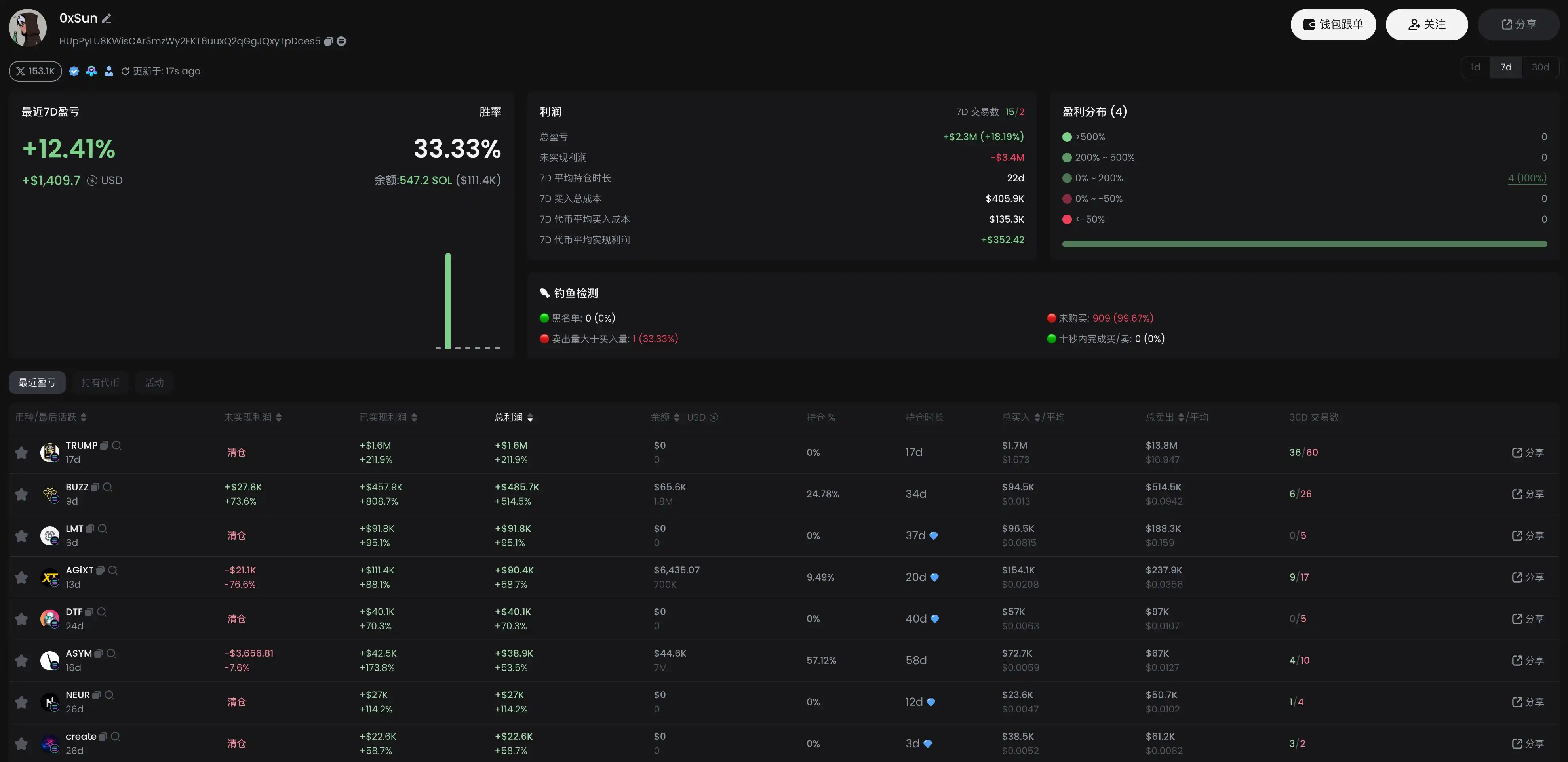
For example, looking at the address of 0xsun, we can see their profit and loss, win rate, and total profit and loss for 1 day, 7 days, and 30 days. In recent profits and losses, we can see the trading pairs for the last 30 days, sort by various indicators, and click on a specific coin to see detailed transaction records. As shown in the image
2. Debot
Debot has implemented the same functions as GMGN, but the algorithms used are somewhat different, resulting in some discrepancies in the displayed data. Data for the address 0xsun on Debot, as shown in the image, can be compared with GMGN.
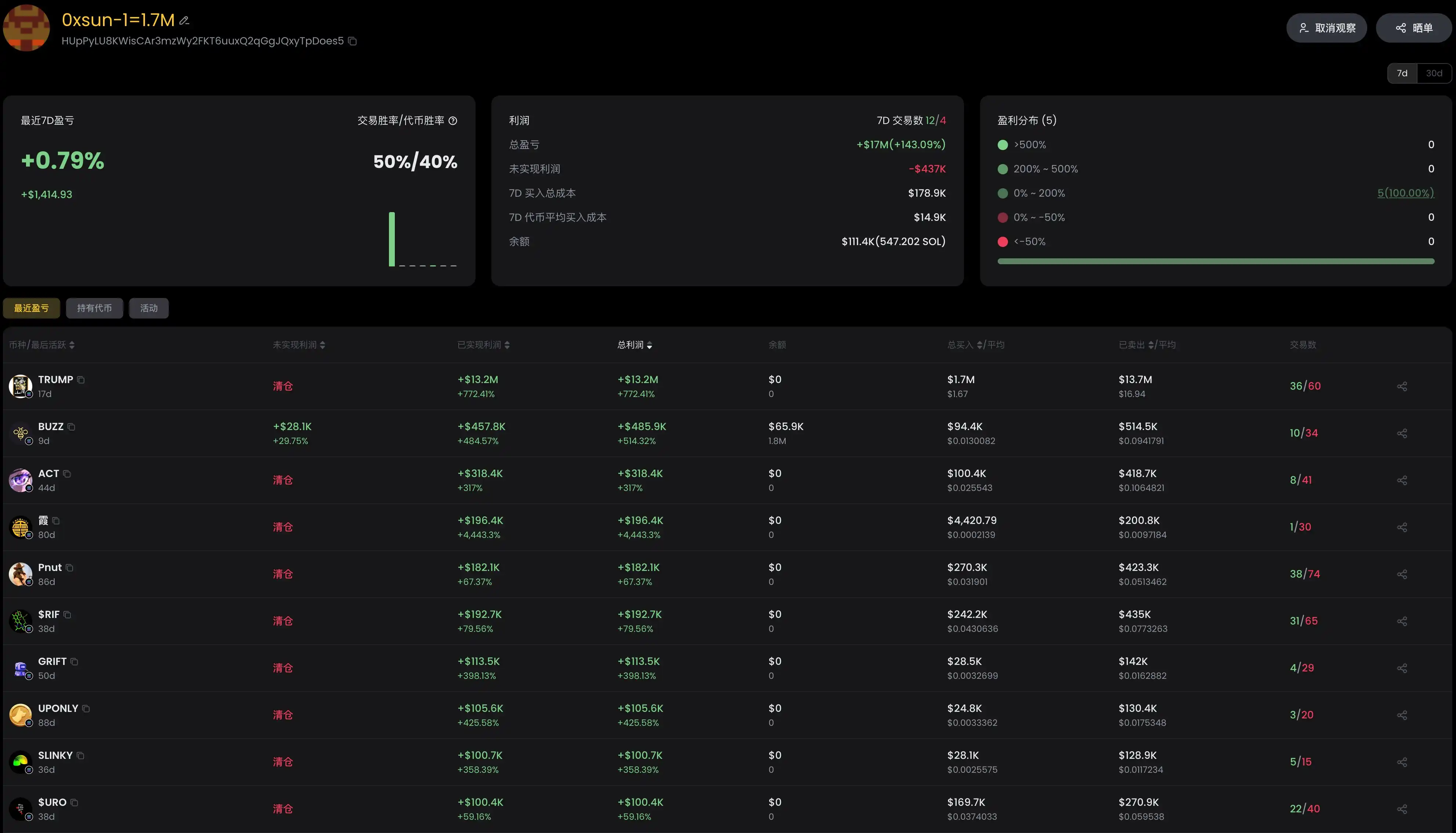
As for whether GMGN or Debot is better, my suggestion is to use both together, cross-reference them, and guard against data omissions or errors from a single tool affecting the analysis.
Five, Monitoring
After identifying the KOL's addresses and conducting data analysis, we need to categorize each address with tags and then use tools to monitor these addresses. This way, when they have transactions, we can know immediately, ahead of social media and Twitter.
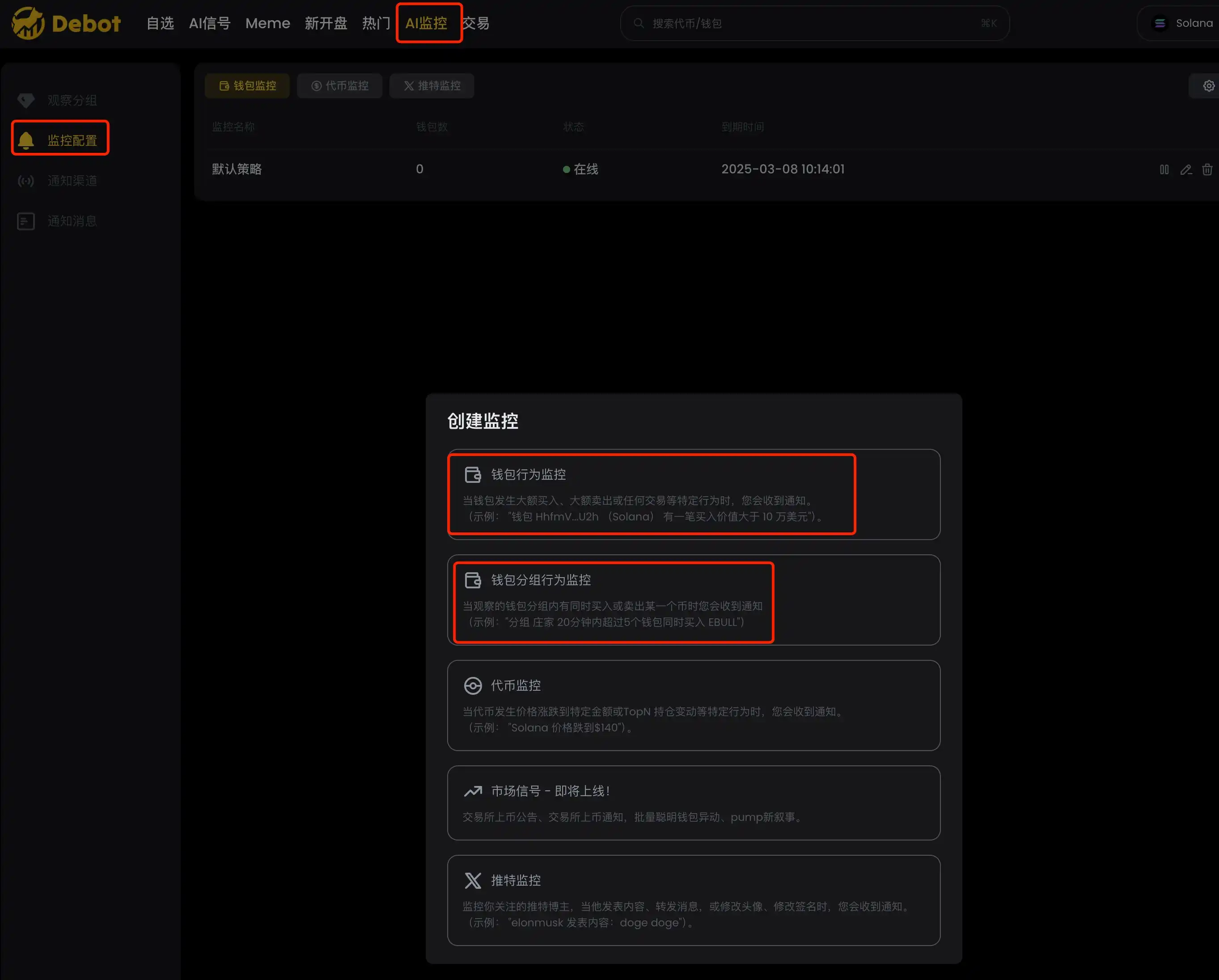
For monitoring, Debot is highly recommended. Debot is currently the most feature-rich and detailed monitoring product I have used, with strong AI signals and smooth transactions.
Debot's wallet monitoring is divided into two types: wallet behavior monitoring and wallet group behavior monitoring, as shown in the image
1. Wallet Behavior Monitoring
This monitoring is a common feature in all tools. However, in other tools, all addresses are pushed to a single Telegram group. The advantage of debot is that it can group addresses and then push notifications to different Telegram groups based on the grouping, as shown in the image.
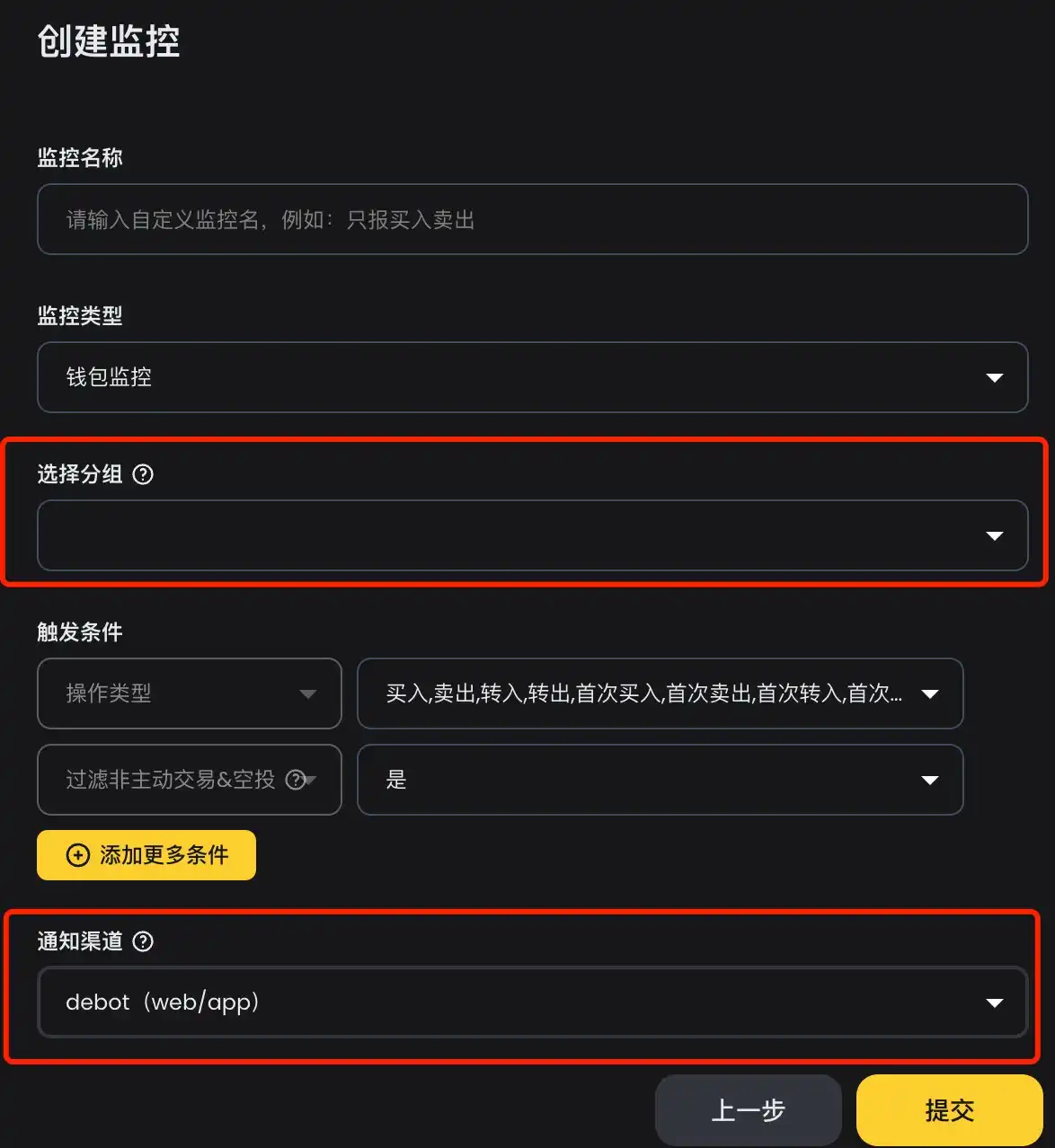
This allows for the establishment of different Telegram groups for monitoring based on tagging, such as addresses from internal exchange users, external exchange users, or addresses of special interest. A tool that can classify monitoring information is a good tool. When I used abot for monitoring before, to achieve grouped notifications, I had to tag the addresses first, and then the Telegram group would receive the monitoring messages, which required additional development to distribute them based on the tags. Now, with debot, I no longer need to do additional development.
2. Wallet Group Behavior Monitoring
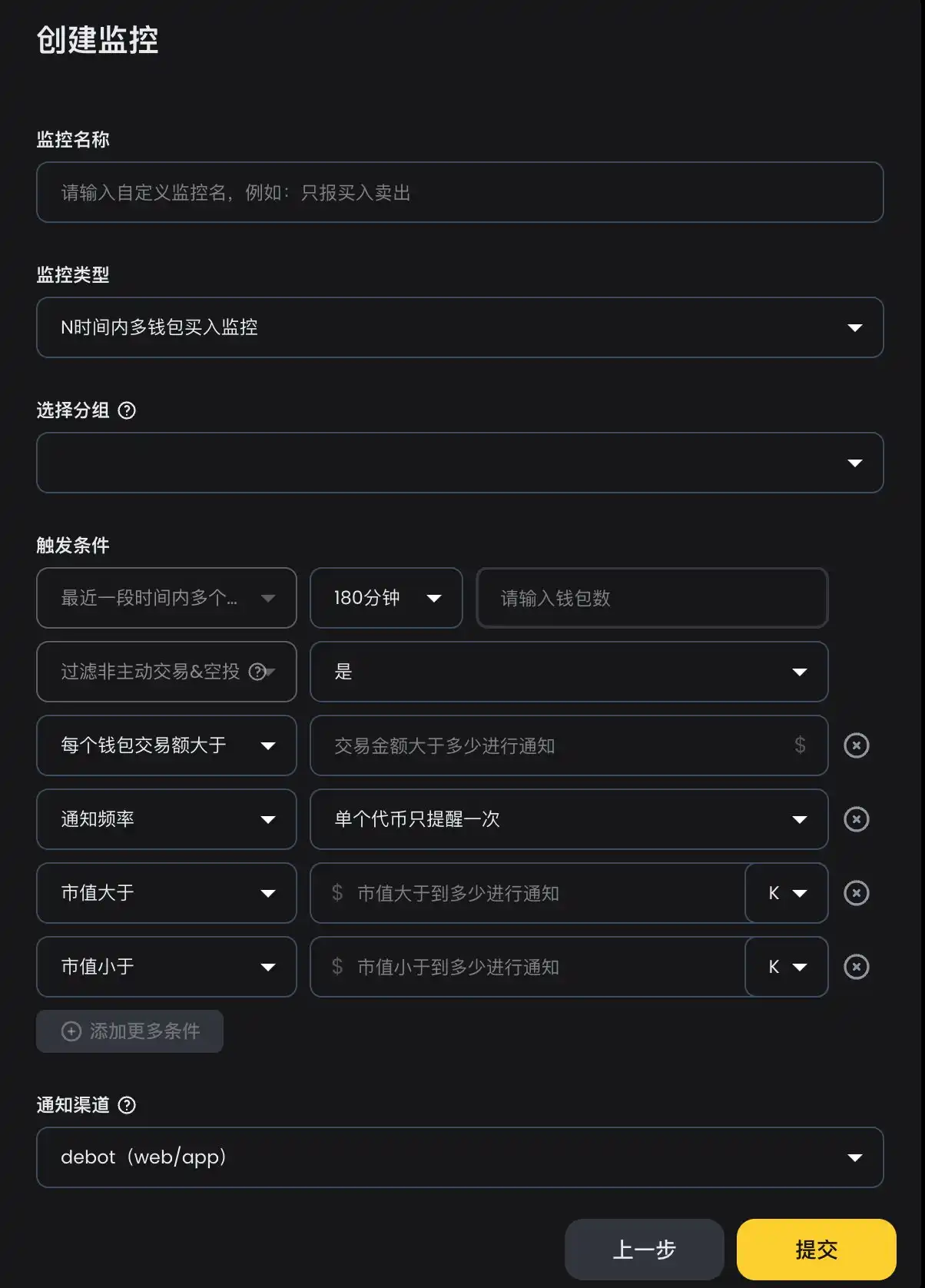
If we are monitoring a large number of addresses, we face an unavoidable issue: excessive notifications. When there are too many messages, it can overwhelm the human brain and lead to information overload, defeating the purpose of monitoring. To address this issue, my previous strategy was to develop notifications further by setting criteria such as only sending notifications when a certain number of different addresses have made transactions within a specific time frame, for example, if 5 different addresses have made purchases within 30 minutes, then send a notification. I used this strategy for about a year, and it was very effective in reducing unnecessary messages while ensuring important updates were not missed.
debot's wallet group behavior monitoring perfectly implements the strategy I mentioned above, but in a more refined way with finer granularity, as shown in the image. We can monitor based on buying and selling, set monitoring time frames, transaction amounts, notification frequencies, and market cap sizes. This feature can fully meet various monitoring needs, and I highly recommend it.
VI. List of Top 100 KOL Addresses
Using the method mentioned above, I have compiled a list of nearly 100 KOL addresses, as shown in the image.
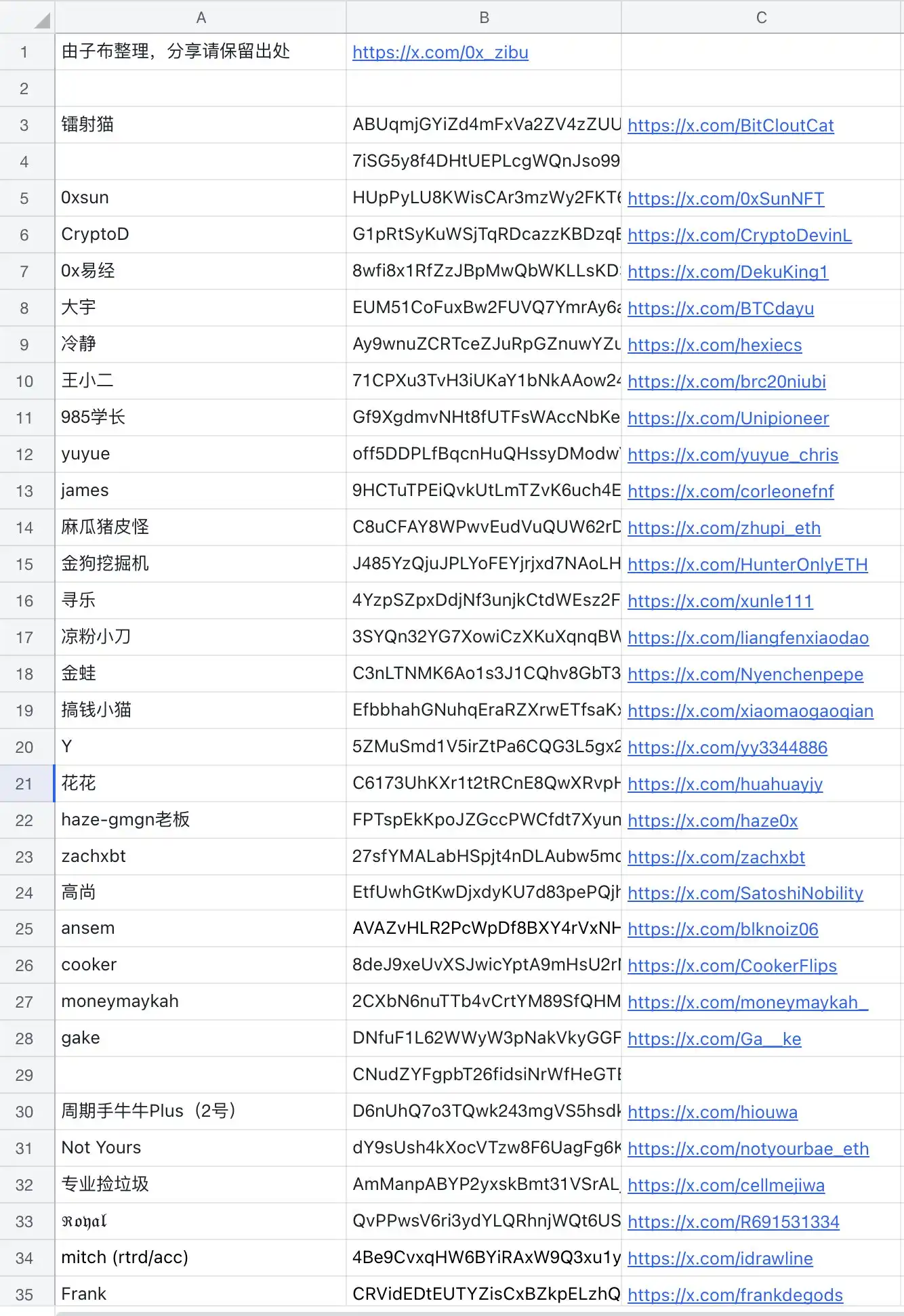
Everyone can analyze and tag each address based on the method described in the fourth section to identify addresses that align with their preferences for monitoring.
The file is uploaded on my Telegram channel and can be downloaded here: https://t.me/zibutalk/79
When sharing this file, please remember to give credit!
7. Summary
The above content introduced the method of finding KOL addresses, and also explained how to analyze and monitor addresses. For KOL addresses that are not included in the file, everyone can use the method above to find them. In addition, the address KOL presents publicly is just one of the addresses they use. Each person has multiple addresses, so you can find their associated addresses based on the above address and collect them to enrich your address database.
Each KOL has a different style, and some KOLs may even rug pull. Everyone should not blindly trust a KOL's address but should choose the one that suits them.
You may also like

Cryptocurrency CEXs are flocking to sell US stocks, and traditional brokerages are facing an "uninvited guest."

Will the SpaceX IPO Hurt Bitcoin? Here's What Traders Are Watching
Foreign selling in the South Korean stock market accelerates, with cumulative net sales reportedly reaching $75 billion this year
On June 9, The Kobeissi Letter, citing Goldman Sachs data, reported that global investors are selling South Korean stocks at an unusually rapid pace. In the latest trading session, foreign investors sold about $801 million worth of Kospi constituent stocks again; total foreign outflows last week reached about $10 billion, and the market has been in net foreign selling on nearly every trading day over the past month. According to the data cited in the report, foreign investors have sold about $75 billion worth of South Korean stocks so far this year. Meanwhile, South Korean retail and institutional investors together recorded roughly $69 billion in net buying over the same period, suggesting that the market’s main buying support has come from domestic capital rather than returning overseas funds. The information currently disclosed still mainly comes from The Kobeissi Letter’s retelling and Goldman Sachs data summaries, while public details on the statistical period and the specific definition of “selling” remain relatively limited.

Fortune Warns of Strategy’s Financing Structure Risks as Bitcoin Premium Narrows
Fortune warned that Strategy’s Bitcoin treasury model faces growing financing risks as MSTR’s net asset premium narrows and preferred stock dividend pressure increases.

Ferrari Challenge Le Mans: Carl Moon to Dominate in WEEX Livery

Sahara AI Responds to SAHARA’s Sharp Drop: No Contract or Product Security Issues Found, Internal Investigation Underway
Sahara AI responded to SAHARA’s 60% price drop, saying no token contract or product security issues have been found and an internal investigation is underway.

WEEX Deposit/Withdrawal Dynamic Island: Your Asset Status, Always in Sight

Scaling Crypto Derivatives: The Digital Asset Infrastructure Behind High-Volume Trading
In the fast-moving digital asset ecosystem, derivatives platforms face an extreme architectural test. High-leverage futures markets demand more than just standard security—they require absolute operational precision, zero-latency matching engines, and ironclad structural scalability, all while navigating intense market volatility.
As global platforms scale to meet these demands, the industry is shifting away from rigid, monolithic setups toward a more agile, "decoupled" infrastructure philosophy.
The Blueprint for High-Volume Copy TradingFor elite global exchanges like WEEX (founded in 2018), this architectural choice becomes critical when scaling high-volume retail features like social copy trading. When thousands of users automatically mirror the real-time strategies of elite traders simultaneously, it triggers sudden, monumental spikes in concurrent transactional volume.
To prevent execution latency or settlement bottlenecks during these peak volatility events, a platform's primary engine must remain entirely dedicated to risk management, copy-trade synchronization, and order matching.
The Architectural Rule: New-generation platforms must separate front-end user execution engines from heavy backend infrastructural overhead to eliminate operational friction.
By separating these layers, platforms can maintain complete sovereignty over their trading environments and user experiences while strategically aligning with institutional-grade infrastructure ecosystems. This strategic framework allows modern exchanges to leverage advanced Digital Asset Custody infrastructure such as Cobo’s behind the scenes, ensuring that backend wallet management scales elastically alongside trading spikes.
Capitalizing on Market Momentum and 400× LeverageIn a derivatives arena where platforms offer up to 400× leverage on perpetual contracts, capital efficiency and market agility are core business metrics. To capture market momentum, an exchange needs the ability to rapidly expand its asset offerings, supporting everything from legacy crypto assets to sudden, trending altcoins across a massive library of trading pairs.
Adopting a flexible, scalable Wallet-as-a-Service (WaaS) solution such as Cobo’s could completely rewrite the development timeline for high-growth exchanges. Instead of spending months of engineering capital building out custom backend wallet architectures for every new blockchain network, platforms can deploy localized infrastructure in days.
This agility allows platforms to instantly scale their listings to over a thousand trading pairs without compromising security or delaying time-to-market. It mirrors the exact operational advantages seen during high-velocity market events, similar to how advanced wallet infrastructure empowers platforms during sudden asset surges; allowing exchanges to pass that speed and liquidity directly to their global user base.
A Mature Foundation for GrowthThe synergy between trusted infrastructure ecosystems and global trading platforms represents the natural evolution of a maturing crypto market. As WEEX continues to scale its global spot and derivatives offerings for over 6 million users, adopting robust backend paradigms proves that platforms no longer have to compromise between cutting-edge trading velocity and uncompromised structural security.

Morning Report | BitMine increased its holdings by 126,971 ETH last week; trader Eugene announced his exit from the crypto market

Wang Chuan: How can one not feel anxious after the neighbor Old Wang made thirty times profit by investing in storage stocks? (Seven) - A quarter-century cycle

Get Paid to Onboard? Try WEEX’s New Homepage with Rewards for Registration, Deposit & Trade

WEEX Custom Layout: Build Your Perfect Trading Workspace in Seconds

See “Buy Walls” & “Sell Walls” Instantly: WEEX Launches the Depth Chart for Smarter Trades

What Is Quick Trade on WEEX? 2 Ways WEEX Ends Chart-Panel Jumping
Morning News | Five major virtual asset platforms in South Korea have experienced 57 incidents of hacking and system failures in six years; Grayscale submits registration application for Canton ETF

Should we escape the peak? The principle of the tail-end market in the stock market

RootData: May 2026 Cryptocurrency Exchange Transparency Research Report

Founder of Baixing.com: My Experience with Claude Code in Fourteen Points
Cryptocurrency CEXs are flocking to sell US stocks, and traditional brokerages are facing an "uninvited guest."
Will the SpaceX IPO Hurt Bitcoin? Here's What Traders Are Watching
Foreign selling in the South Korean stock market accelerates, with cumulative net sales reportedly reaching $75 billion this year
On June 9, The Kobeissi Letter, citing Goldman Sachs data, reported that global investors are selling South Korean stocks at an unusually rapid pace. In the latest trading session, foreign investors sold about $801 million worth of Kospi constituent stocks again; total foreign outflows last week reached about $10 billion, and the market has been in net foreign selling on nearly every trading day over the past month. According to the data cited in the report, foreign investors have sold about $75 billion worth of South Korean stocks so far this year. Meanwhile, South Korean retail and institutional investors together recorded roughly $69 billion in net buying over the same period, suggesting that the market’s main buying support has come from domestic capital rather than returning overseas funds. The information currently disclosed still mainly comes from The Kobeissi Letter’s retelling and Goldman Sachs data summaries, while public details on the statistical period and the specific definition of “selling” remain relatively limited.
Fortune Warns of Strategy’s Financing Structure Risks as Bitcoin Premium Narrows
Fortune warned that Strategy’s Bitcoin treasury model faces growing financing risks as MSTR’s net asset premium narrows and preferred stock dividend pressure increases.
Ferrari Challenge Le Mans: Carl Moon to Dominate in WEEX Livery
Sahara AI Responds to SAHARA’s Sharp Drop: No Contract or Product Security Issues Found, Internal Investigation Underway
Sahara AI responded to SAHARA’s 60% price drop, saying no token contract or product security issues have been found and an internal investigation is underway.


