
South Korea's Crypto Exodus: Capital, Businesses, and Talent Drain


Original Title: Korea Exodus: The Migration of Capital, Talent, and Companies
Original Authors: Jay Jo, Yoon Lee, Tiger Research
Original Translation: Luffy, Foresight News
Key Points
· South Korea's cryptocurrency trading volume remains high, attracting global attention, but unclear regulation and a lack of guidance hinder industry development.
· The government prohibits opening cryptocurrency exchange real-name accounts for businesses. This restriction, coupled with a vague regulatory framework, has led to the outflow of talent, capital, and companies, weakening the competitiveness of the Web3 ecosystem.
· With the global Web3 industry poised for rapid growth under the Trump administration, South Korea must reform its regulatory policies to ensure the long-term sustainability of the industry.
1. Introduction
The inauguration of the "crypto-friendly president" Trump and the establishment of the Crypto 2.0 Task Force by the U.S. Securities and Exchange Commission (SEC) will accelerate the structural transformation of the global Web3 market. This is a key turning point. Talent, capital, and companies may migrate to countries with sound regulatory frameworks, while the outflow from jurisdictions with regulatory uncertainty will intensify.
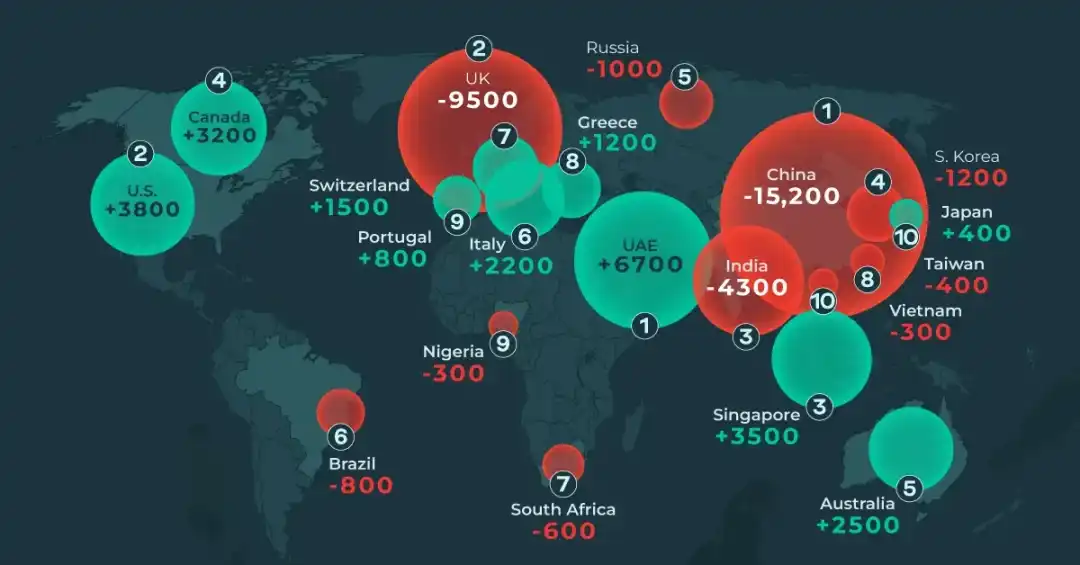
2024 Global Fund Flows, Source: Henry & Partners
South Korea is also part of this trend. The Henry & Partners' "2024 Private Wealth Migration Report" shows that South Korea leads in high-net-worth individual migration in Asia. Economic, social, and cultural factors are driving this migration wave. Although not directly related to the Web3 industry, these individuals often serve as canaries in the coal mine, signaling changes in a country's business environment.
Against this backdrop, it is crucial to reexamine South Korea's Web3 industry. This report explores the movement of capital, companies, and talent in the South Korean Web3 market, as well as the key challenges this industry must address.
2. Capital Flight: Offshore Exchanges and Accelerated On-Chain Transfers
The cryptocurrency market in Korea has been rapidly growing. With 15.6 million cryptocurrency investors holding assets worth $73 billion, the daily trading volume of cryptocurrency exchanges now rivals the combined trading volume of the Korea Composite Stock Price Index (KOSPI) and the Korea Securities Dealers Automated Quotations (KOSDAQ). This reflects Korean investors' enthusiasm for crypto assets, driven by low stock market returns and politically related unrest.
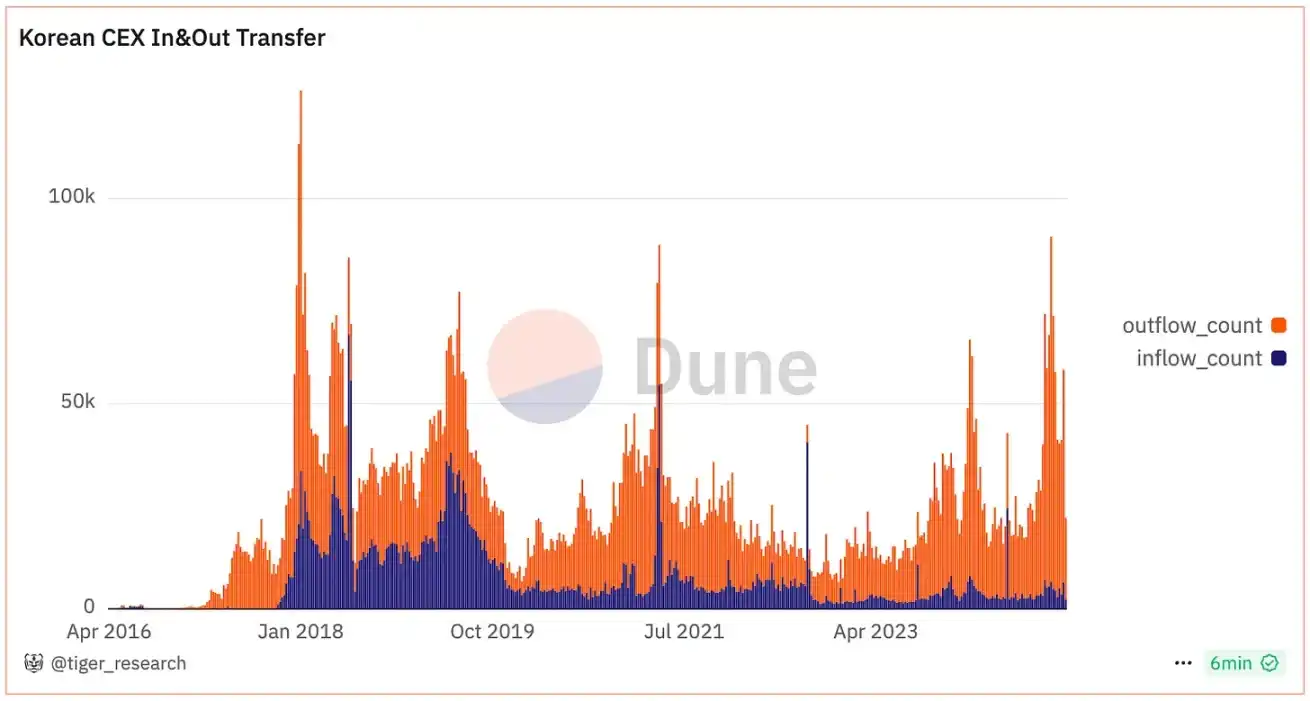
However, cryptocurrency outflows have reached concerning levels recently. During times of unrest, service disruptions at major local exchanges undermined people's trust in the stability of these platforms. Meanwhile, foreign exchanges and the diverse investment opportunities offered by decentralized finance (DeFi) have further fueled capital migration.
A survey by the Financial Services Commission of Korea in the first half of 2024 on Virtual Asset Service Providers (VASPs) revealed a 2.3-fold year-on-year increase in funds transferred to overseas VASP wallets. On-chain data confirms this trend, indicating a continuous rise in asset migration from local exchanges to foreign platforms.
In the long run, capital flight may harm Korea's Web3 industry. Transaction fees and service revenues flowing abroad erode the competitiveness of the local ecosystem and diminish investor protection. This has also raised concerns about declining demand for the Korean won and increased volatility in its value.
3. Migration Wave: Relocating Headquarters to Crypto-Friendly Countries
Korea's Web3 companies are accelerating their offshore migration. In 2024, Nexon's blockchain division Nexpace, as well as Klaytn and Line Finschia's Kaia Foundation, moved to Abu Dhabi. WeMade's Wemix relocated to Dubai. The Web3 industry is swiftly shifting to countries with clearer and more favorable regulations.
Korea faces numerous obstacles in promoting Web3-related businesses. Companies are unable to open corporate accounts for cryptocurrency transactions, making the use of crypto assets challenging. This complexity hinders the monetization of crypto assets and creates issues in accounting, taxation, and business operations. For example, in a cryptocurrency payment business, Company A may receive crypto assets from a consumer and need to settle payments with the seller in Korean won. Without a corporate account, cashing out assets becomes nearly impossible.
While Korea has established a regulatory framework, the lack of specific guidance on stablecoins, DeFi, and Web3 gaming restricts industry growth. The country's proactive regulatory approach limits unlicensed activities. In contrast, the global market benefits from regulatory sandboxes supporting various pilot projects.
The Trump administration's stance on cryptocurrency may highlight this difference, and a favorable regulatory environment overseas is accelerating the migration of Web3 companies from Korea.
4. Brain Drain: Weakening the Technical Competitiveness of the Web3 Industry
The migration of Korean Web3 companies abroad may have a negative impact on the domestic Web3 talent pool. As companies move to countries with clearer and more favorable regulations, domestic employment opportunities may decrease, leading to a brain drain. This could hinder the development of the domestic Web3 ecosystem.
Talent migration is not just a problem for the Web3 industry in Korea. Korea is one of the countries with the highest proportion of key talent migrating to the United States, especially those with master's and doctoral degrees. This trend is particularly pronounced in the technology-dependent Web3 industry and could undermine the industry's competitiveness.
In contrast, countries like the United States and the UAE are promoting their Web3 industry development through clear regulations and supportive policies. Korea's unclear regulatory environment is accelerating talent outflow, posing a long-term threat to Korea's technological competitiveness and industry ecosystem.
5. Challenges and Opportunities for the Korean Web3 Market in 2025: Regulatory Reform and Industry Growth
Korea has received global attention due to its cryptocurrency trading volume. However, this trading volume has not promoted industry development, making the country a liquidity conduit for global traders. This structure is not conducive to sustainable growth. Korea urgently needs to make progress in business and technology to strengthen the Web3 ecosystem.

Source: Arthur Hayes
Due to a lack of local innovation and regulatory uncertainty, Korea is on the edge of the global Web3 development. This overreliance on trading volume rather than ecosystem development has led to a "Korea discount" in the international market.
By 2025, with a new government in place, significant changes are expected in the global industry. In these changes, Korea stands at a critical crossroads. Positive steps include allowing cryptocurrency operators to open corporate accounts, establishing stablecoin regulatory guidelines, and advancing cryptocurrency legislation. However, these efforts only scratch the surface.
To make progress, Korea must address risks, analyze global policy shifts, and develop a regulatory framework tailored to domestic conditions. Korea must shift from a focus solely on trading volume to establishing a sustainable innovation hub characterized by outstanding business and technical leadership.
You may also like

Scaling Crypto Derivatives: The Digital Asset Infrastructure Behind High-Volume Trading
In the fast-moving digital asset ecosystem, derivatives platforms face an extreme architectural test. High-leverage futures markets demand more than just standard security—they require absolute operational precision, zero-latency matching engines, and ironclad structural scalability, all while navigating intense market volatility.
As global platforms scale to meet these demands, the industry is shifting away from rigid, monolithic setups toward a more agile, "decoupled" infrastructure philosophy.
The Blueprint for High-Volume Copy TradingFor elite global exchanges like WEEX (founded in 2018), this architectural choice becomes critical when scaling high-volume retail features like social copy trading. When thousands of users automatically mirror the real-time strategies of elite traders simultaneously, it triggers sudden, monumental spikes in concurrent transactional volume.
To prevent execution latency or settlement bottlenecks during these peak volatility events, a platform's primary engine must remain entirely dedicated to risk management, copy-trade synchronization, and order matching.
The Architectural Rule: New-generation platforms must separate front-end user execution engines from heavy backend infrastructural overhead to eliminate operational friction.
By separating these layers, platforms can maintain complete sovereignty over their trading environments and user experiences while strategically aligning with institutional-grade infrastructure ecosystems. This strategic framework allows modern exchanges to leverage advanced Digital Asset Custody infrastructure such as Cobo’s behind the scenes, ensuring that backend wallet management scales elastically alongside trading spikes.
Capitalizing on Market Momentum and 400× LeverageIn a derivatives arena where platforms offer up to 400× leverage on perpetual contracts, capital efficiency and market agility are core business metrics. To capture market momentum, an exchange needs the ability to rapidly expand its asset offerings, supporting everything from legacy crypto assets to sudden, trending altcoins across a massive library of trading pairs.
Adopting a flexible, scalable Wallet-as-a-Service (WaaS) solution such as Cobo’s could completely rewrite the development timeline for high-growth exchanges. Instead of spending months of engineering capital building out custom backend wallet architectures for every new blockchain network, platforms can deploy localized infrastructure in days.
This agility allows platforms to instantly scale their listings to over a thousand trading pairs without compromising security or delaying time-to-market. It mirrors the exact operational advantages seen during high-velocity market events, similar to how advanced wallet infrastructure empowers platforms during sudden asset surges; allowing exchanges to pass that speed and liquidity directly to their global user base.
A Mature Foundation for GrowthThe synergy between trusted infrastructure ecosystems and global trading platforms represents the natural evolution of a maturing crypto market. As WEEX continues to scale its global spot and derivatives offerings for over 6 million users, adopting robust backend paradigms proves that platforms no longer have to compromise between cutting-edge trading velocity and uncompromised structural security.

Morning Report | BitMine increased its holdings by 126,971 ETH last week; trader Eugene announced his exit from the crypto market

Wang Chuan: How can one not feel anxious after the neighbor Old Wang made thirty times profit by investing in storage stocks? (Seven) - A quarter-century cycle

Get Paid to Onboard? Try WEEX’s New Homepage with Rewards for Registration, Deposit & Trade

WEEX Custom Layout: Build Your Perfect Trading Workspace in Seconds

See “Buy Walls” & “Sell Walls” Instantly: WEEX Launches the Depth Chart for Smarter Trades

What Is Quick Trade on WEEX? 2 Ways WEEX Ends Chart-Panel Jumping
Morning News | Five major virtual asset platforms in South Korea have experienced 57 incidents of hacking and system failures in six years; Grayscale submits registration application for Canton ETF

Should we escape the peak? The principle of the tail-end market in the stock market

RootData: May 2026 Cryptocurrency Exchange Transparency Research Report

Founder of Baixing.com: My Experience with Claude Code in Fourteen Points

Yang Ge Gary: Agent Economics and AI Microeconomics
When reasoning becomes a scarce resource, who captures its value?

Jensen Huang dramatically "rescues" the South Korean stock market

Stablecoins vs Deposit Tokens: On the surface, they seem like opposing sides, but in reality, they are interconnected

Bitcoin Crash to $50,000 or Bear Trap Before $100,000? Deep Dive for WEEX Traders
How Could the SpaceX IPO Affect Bitcoin, Altcoins season, and Crypto Liquidity?

The ambitions of Kalshi, MTS, and a16z
Scaling Crypto Derivatives: The Digital Asset Infrastructure Behind High-Volume Trading
In the fast-moving digital asset ecosystem, derivatives platforms face an extreme architectural test. High-leverage futures markets demand more than just standard security—they require absolute operational precision, zero-latency matching engines, and ironclad structural scalability, all while navigating intense market volatility.
As global platforms scale to meet these demands, the industry is shifting away from rigid, monolithic setups toward a more agile, "decoupled" infrastructure philosophy.
The Blueprint for High-Volume Copy TradingFor elite global exchanges like WEEX (founded in 2018), this architectural choice becomes critical when scaling high-volume retail features like social copy trading. When thousands of users automatically mirror the real-time strategies of elite traders simultaneously, it triggers sudden, monumental spikes in concurrent transactional volume.
To prevent execution latency or settlement bottlenecks during these peak volatility events, a platform's primary engine must remain entirely dedicated to risk management, copy-trade synchronization, and order matching.
The Architectural Rule: New-generation platforms must separate front-end user execution engines from heavy backend infrastructural overhead to eliminate operational friction.
By separating these layers, platforms can maintain complete sovereignty over their trading environments and user experiences while strategically aligning with institutional-grade infrastructure ecosystems. This strategic framework allows modern exchanges to leverage advanced Digital Asset Custody infrastructure such as Cobo’s behind the scenes, ensuring that backend wallet management scales elastically alongside trading spikes.
Capitalizing on Market Momentum and 400× LeverageIn a derivatives arena where platforms offer up to 400× leverage on perpetual contracts, capital efficiency and market agility are core business metrics. To capture market momentum, an exchange needs the ability to rapidly expand its asset offerings, supporting everything from legacy crypto assets to sudden, trending altcoins across a massive library of trading pairs.
Adopting a flexible, scalable Wallet-as-a-Service (WaaS) solution such as Cobo’s could completely rewrite the development timeline for high-growth exchanges. Instead of spending months of engineering capital building out custom backend wallet architectures for every new blockchain network, platforms can deploy localized infrastructure in days.
This agility allows platforms to instantly scale their listings to over a thousand trading pairs without compromising security or delaying time-to-market. It mirrors the exact operational advantages seen during high-velocity market events, similar to how advanced wallet infrastructure empowers platforms during sudden asset surges; allowing exchanges to pass that speed and liquidity directly to their global user base.
A Mature Foundation for GrowthThe synergy between trusted infrastructure ecosystems and global trading platforms represents the natural evolution of a maturing crypto market. As WEEX continues to scale its global spot and derivatives offerings for over 6 million users, adopting robust backend paradigms proves that platforms no longer have to compromise between cutting-edge trading velocity and uncompromised structural security.
Morning Report | BitMine increased its holdings by 126,971 ETH last week; trader Eugene announced his exit from the crypto market
Wang Chuan: How can one not feel anxious after the neighbor Old Wang made thirty times profit by investing in storage stocks? (Seven) - A quarter-century cycle
Get Paid to Onboard? Try WEEX’s New Homepage with Rewards for Registration, Deposit & Trade
WEEX Custom Layout: Build Your Perfect Trading Workspace in Seconds
See “Buy Walls” & “Sell Walls” Instantly: WEEX Launches the Depth Chart for Smarter Trades


