
Hyperbeat, to launch a "bank" on Hyperliquid




Original Title: "Hyperbeat: The Person Behind the 'Bank' on Hyperliquid"
Original Author: Sanqing, Foresight News
On April 8, the Hyperliquid native protocol Hyperbeat launched Liquid Banking, deploying a self-managed "bank" on HyperEVM, integrating stablecoin deposits, VISA card spending, perpetual contract trading, and multi-currency fiat transactions into a single on-chain smart wallet.
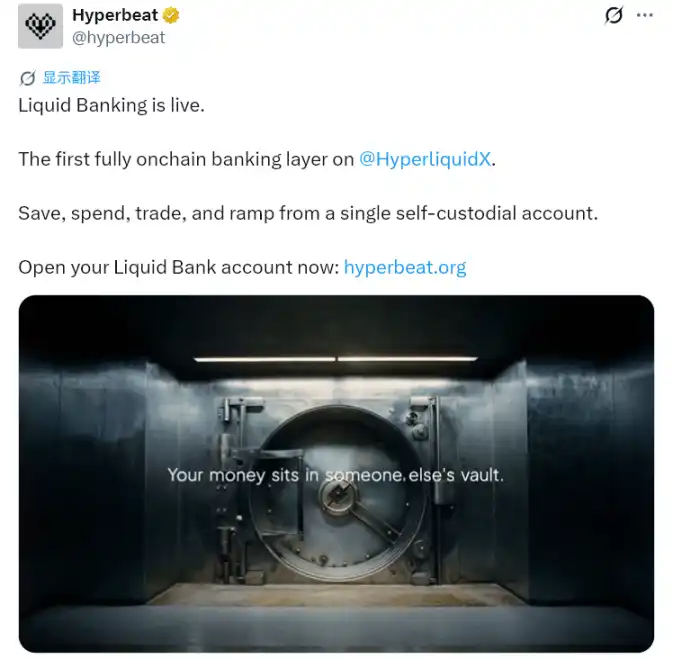
Image Source: Hyperbeat Tweet
The Hyperbeat team transitioned from the Hyperliquid testnet's initial validators, starting with only 5 members and self-raising around $200,000 to kick off. The two co-founders, Kilian Boshoff (@Fundi_Crypto) and 800.HL (@degennQuant), have kept a low profile, with the former having a background from Stellenbosch University in South Africa, and the company registered in the Cayman Islands.
In August 2025, they completed a $5.2 million seed round, led by ether.fi Ventures and Electric Capital, with participation from Coinbase Ventures, Maelstrom, Anchorage Digital, among others, valuing the company at around $40 million.
Morpho Powers the Engine, Creating a 'Bank' in Ten Months
The core selling point of Liquid Banking is Credit Mode.
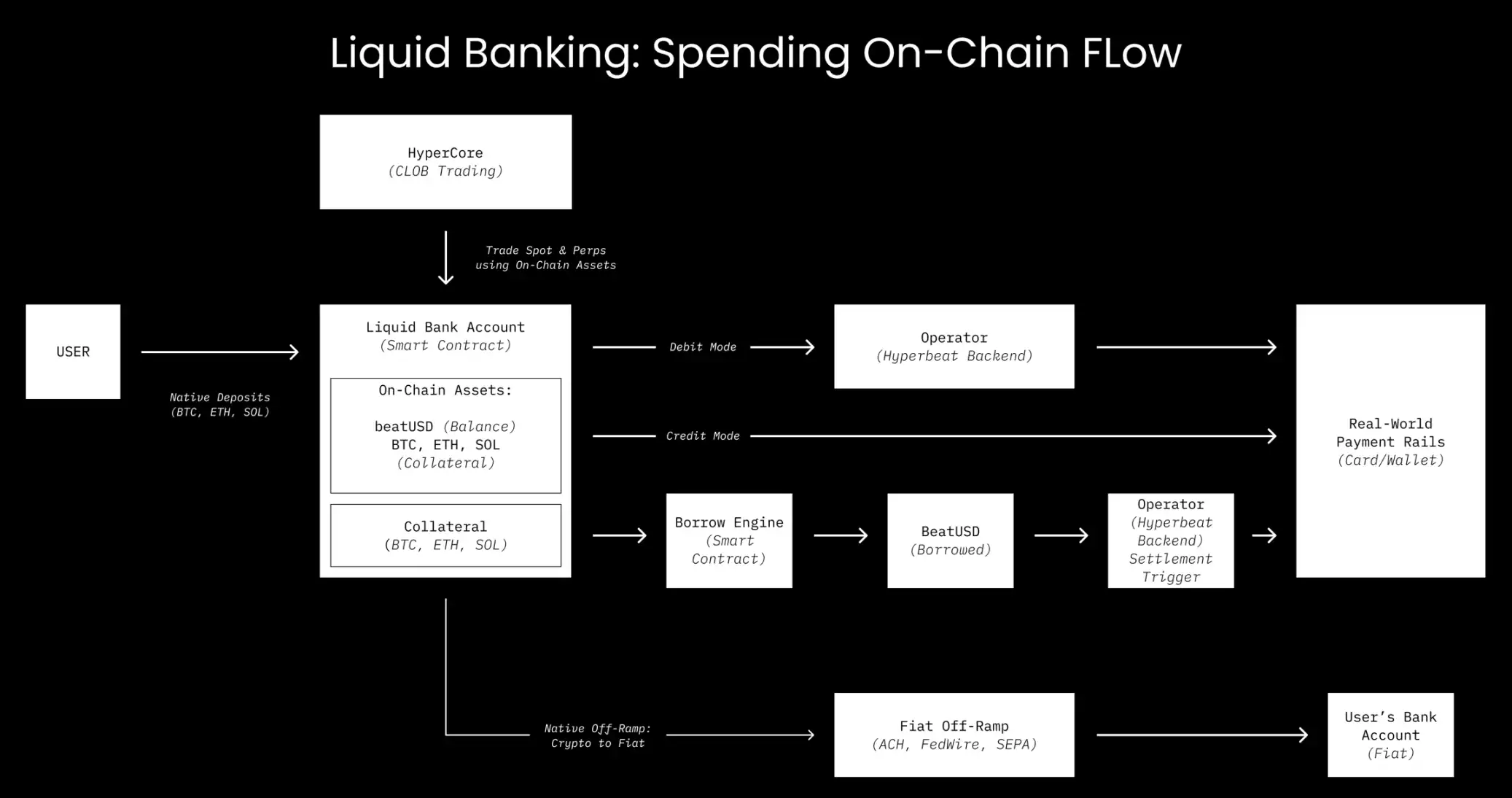
CREDIT Mode | Image Source: Hyperbeat Docs
Users deposit assets such as BTC, ETH, HYPE as collateral, and when they swipe their VISA card, the system instantly borrows stablecoins through the Morpho Blue market to complete the payment, while the collateral remains on-chain to continue earning rewards. Users never interact with a lending interface throughout the process, as the act of swiping the card itself constitutes an on-chain loan.
The underlying lending engine comes from Morpho. Hyperbeat integrates Morpho into users' smart wallets through an on-chain whitelist mechanism. Currently, Credit Mode is running on six isolated markets, with collateral including HYPE, UBTC, UETH, USOL, and even the gold token XAUT.
Hyperbeat does not touch the core lending logic, and Morpho does not touch the user interface. The former creates the "bank frontend," while the latter provides the "credit engine."
The stablecoin deposits in Liquid Banking are centered around the native stablecoin beatUSD issued in collaboration with Paxos Labs. Paxos provides the stablecoin infrastructure (based on USDG0), with reserve earnings flowing directly back into Hyperbeat's reward program and ultimately distributed to users, rather than remaining with the issuer.
The USD+ Treasury on the deposit side automatically allocates user funds to Morpho and protocols like Hypuur, Hyperlend, Felix, offering an annual percentage yield of 3%-8%.
The earnings come from real lending interest from Credit Mode consumers. The more the consumption, the higher the deposit yield. However, whether this cycle can be sustained depends on the actual consumption volume.
Non-selling coin consumption, but card swiping accrues interest
The fiat deposits and withdrawals in Liquid Banking are provided by Noah, supporting USD (ACH, FedWire) and Euro (SEPA) deposits, with each account linked to a unique IBAN.
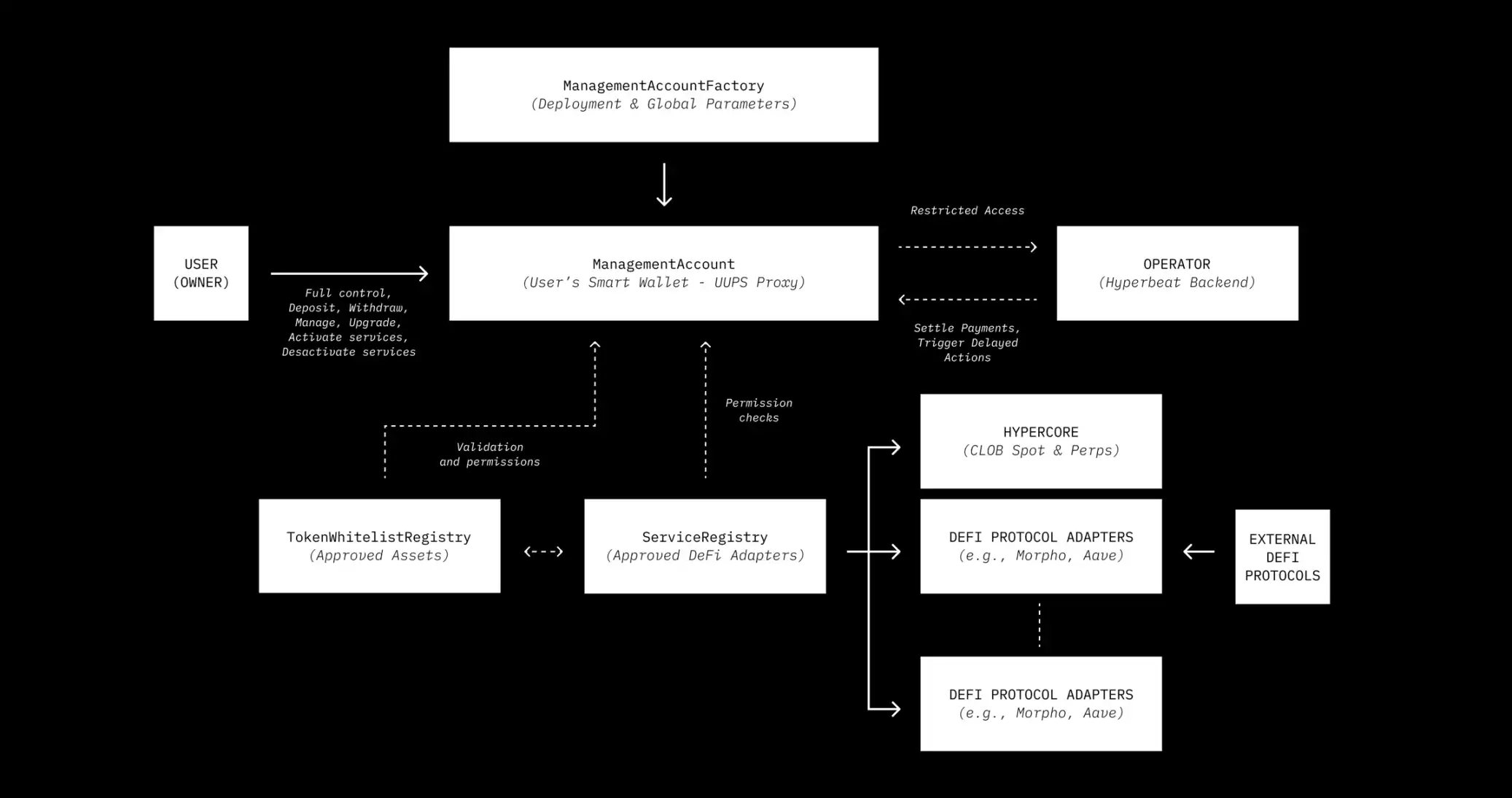
Liquid Banking Architecture | Source: Hyperbeat Docs
In March 2026, direct deposits and withdrawals for the Vietnamese Dong and Malaysian Ringgit will be further enabled, with withdrawals also covering currencies like Pound Sterling, Dirham, Baht, among a dozen others.
The VISA card is issued by Third National, with the underlying infrastructure provided by Rain, a Visa Principal Member. By early January 2026, its funding valuation had reached $1.95 billion, with an annualized processing volume exceeding $30 billion, covering over a hundred countries.
The card is classified as Visa Signature, with benefits such as airport lounge access. Foreign exchange transactions incur a 1% FX fee (based on Visa's official rate), no annual fee, no swipe fees; ATM withdrawals cost $1 + 0.65%; default monthly spending limit of $100,000.
The Credit Mode's lending interest rate fluctuates with the Morpho market utilization rate, but there is no interest-free period; interest on each "HODL & Borrow" transaction starts accruing from the moment of the transaction.
The Hyperbeat official "no hidden fees" refers to the transparency of the yield strategy, not the card fee pricing. The Credit Mode lending interest rate is dynamically determined by the Morpho market, without an interest-free period, meaning that the real-time cost of "HODL & Borrow" convenience exists and is not low.
Self-Custody Comes with a One-Day Cooling-Off Period
Unlike all centralized crypto cards, user assets always stay in their self-controlled ManagementAccount smart wallet. The Hyperbeat backend only has a limited Operator role, which can only settle within the user-set limits and cannot transfer assets to unauthorized addresses.
However, self-custody must address one issue: what if users front-run withdrawals after swiping their card? Hyperbeat has introduced an on-chain time-lock mechanism.
Settlement token withdrawals require a cooling-off period and confirmation process, collateral withdrawals require Operator approval to prevent defaults, and mode switches also have delays. The contract has been audited by Zellic and Nethermind, and key management is provided by Turnkey.
These frictions are not bugs but features. It acknowledges the speed difference between on-chain settlement and offline consumption, filling the gap with contract rules instead of "trust us." However, users must monitor their health factor themselves, as there is no customer service to help undo operational errors.
You may also like

Concerns Behind the Binance Customer Service Controversy

Mergers and acquisitions in the cryptocurrency market are exceptionally active

SpaceX Stock Prediction After the IPO: Can SPCX Reach $200 Before QQQ Inclusion?

Congratulations to Carl Moon on His Historic Ferrari Challenge Le Mans Podium Triumph
Crypto influencer and racing enthusiast Carl Moon finished third in the Ferrari Challenge Le Mans Coppa Shell class, marking his best result of the year. As his racing partner and sponsor, WEEX celebrates this remarkable achievement and continues to lead crypto’s journey beyond boundaries, uniting the innovation of digital assets with the passion of motorsport.
A16Z: The sun bears witness, SpaceX is worth 7.5 trillion

The stablecoin positioning battle escalates: When compliance is just a ticket to entry, will USD1 become the biggest winner?

Can the CLARITY Act Become Law by July 4? Everything You Need to Know About the Final Battle

How to exit after asset tokenization?

The foundation of SpaceX's trillion-dollar valuation: Who is dividing Musk's annual capital expenditure of tens of billions?

France vs Senegal World Cup 2026: Mbappe’s New Era Begins Against a Historic Rival

SharpLink CEO: How to understand that Ethereum developers have just surpassed 1 million?

Morning Report | MiCA grace period expires on July 1; Kalshi's trading volume in the first week of the World Cup breaks $5.1 billion, setting a record

What is the connection between Huang Zheng of Pinduoduo and blockchain?

Morning Report | Prediction market platforms like Kalshi and Polymarket jointly sue Kentucky over 14.25% trading tax; Bridgewater founder discusses decision-making in the AI era: principled thinking should run parallel to AI, human insight remains irre...

If the AI bubble has already burst, who will truly remain?
Paul Graham: How to Make a Billion Dollars

After 18 years, blockchain has finally started to head towards the main channel
Claude enforces "facial recognition for household registration," starting in July, no ID card means no access?
Concerns Behind the Binance Customer Service Controversy
Mergers and acquisitions in the cryptocurrency market are exceptionally active
SpaceX Stock Prediction After the IPO: Can SPCX Reach $200 Before QQQ Inclusion?
Congratulations to Carl Moon on His Historic Ferrari Challenge Le Mans Podium Triumph
Crypto influencer and racing enthusiast Carl Moon finished third in the Ferrari Challenge Le Mans Coppa Shell class, marking his best result of the year. As his racing partner and sponsor, WEEX celebrates this remarkable achievement and continues to lead crypto’s journey beyond boundaries, uniting the innovation of digital assets with the passion of motorsport.
A16Z: The sun bears witness, SpaceX is worth 7.5 trillion
The stablecoin positioning battle escalates: When compliance is just a ticket to entry, will USD1 become the biggest winner?


