
From VC Coins to the Meme Craze, the Cryptocurrency Market is Exhausted




Original Title: The People are Tired (of losing)
Original Author: francescoweb3, Head of castle labs
Original Translation: zhouzhou, BlockBeats
Editor's Note: This article delves deep into the changes in the crypto market, especially the fatigue experienced by retail users. It is easy to see the shift from a venture capitalist-dominated market at the beginning of 2024 to the meme coin frenzy. While meme coins initially provided retail investors with a more level playing field, they eventually became overly speculative, leading to a deteriorating market condition. Retail users are feeling tired due to losses, and the market has become fast-paced and competitive, emphasizing the importance of finding a new balance point and calling for more attention to projects with practical applications and fair distribution mechanisms.
The following is the original content (slightly reorganized for better comprehension):
As Kaitoai emphasized, in the last two weeks of January 2025, the word "tired" saw an uptick in mentions on Crypto Twitter.
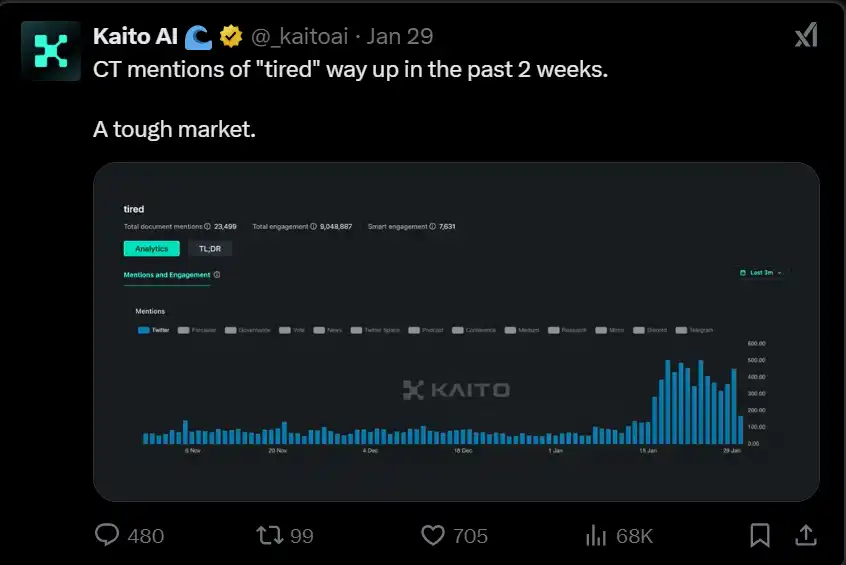
This cycle is different from others, more challenging, and even surprising traders who have been through two or three cycles before. The market is changing: the narrative shifts faster, and attention has become the scarcest currency. Last but equally important, there is increasing regulatory scrutiny and political intervention in the crypto space, bringing new variables.
Why Are People Feeling Fatigued?
Retail investors have missed out on too many opportunities, with the market dynamics changing faster each time what seems like the goal is within reach. In the 2021 cycle, we saw venture capitalists achieve exponential returns compared to retail investors without access to private investment opportunities.
All of this continued until around 2023 when projects like TIA and DYM were launched, signaling the end of retail investors' disillusionment with the technology being siphoned off to these venture capitalists.
What could be the most rational consequence of this? A movement seeking to change power dynamics.
The long-standing "Meme Coin" narrative gained more attention as venture capitalists no longer had private chips to dump on ignorant buyers in the market, benefiting retail investors who managed to find a level competitive environment. However, as the narrative became overplayed and saturated, the users' attention span further shortened. Let's look at how the market landscape has evolved and where we might be heading, attempting to explain why people are feeling fatigued.
Phase One (Early 2024) - From VC Coin to Meme Coin
It seems like a long time ago now, before the AI craze and the meme coin frenzy, there was a time when airdrops were the mainstream play for retail investors. This play was kick-started by Arbitrum and other Layer 2 airdrops. Retail users saw the potential of receiving airdrops by engaging with new protocols and chains, turning airdrops into a business, with the emergence of companies offering airdrop-as-a-service, and more.
However, the dream turned into a nightmare as these coins started to release and disclose their tokenomics, leaving users very disappointed: all that effort, and what was received through airdrops was almost nothing? One of the most controversial distributions was Scroll, which is a ZK-EVM L2.
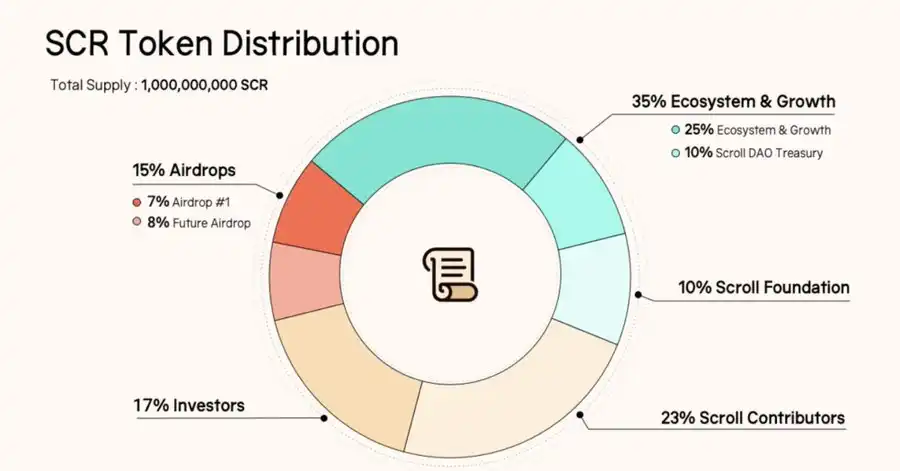
After over a year of ecosystem promotion, the Scroll airdrop was very disappointing, with a concerning 5.5% of the SCR supply allocated to Binance instead of the community.
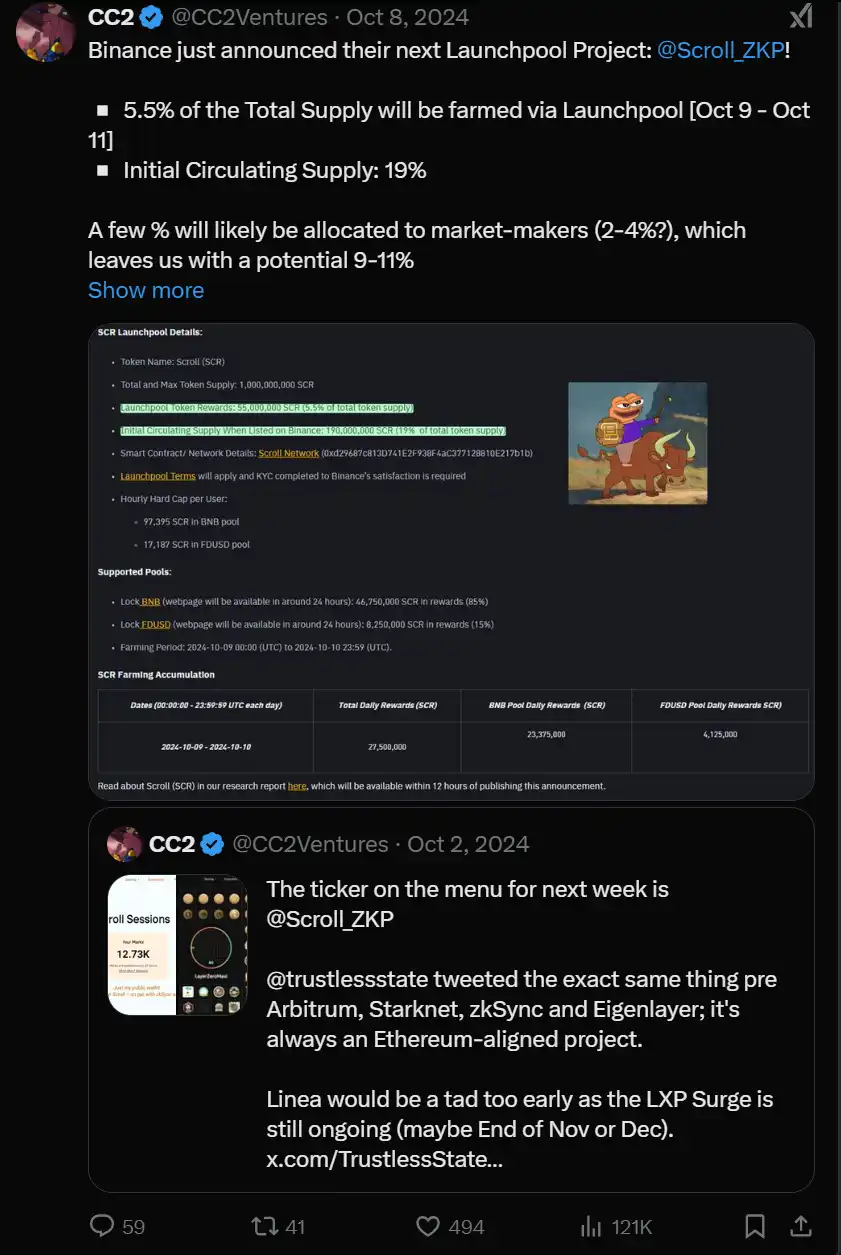
Furthermore, most of these tokens had very low circulating supplies (circulating supply/total supply), with a significant share allocated to VCs. Another topic of discussion was TIA and DYM, where at one point, these tokens' narratives on Crypto Twitter revolved around staking them in exchange for the expectation of future ecosystem project airdrops.
You guessed it: these airdrops never materialized, and the token prices only trended downwards (below is DYM's chart).
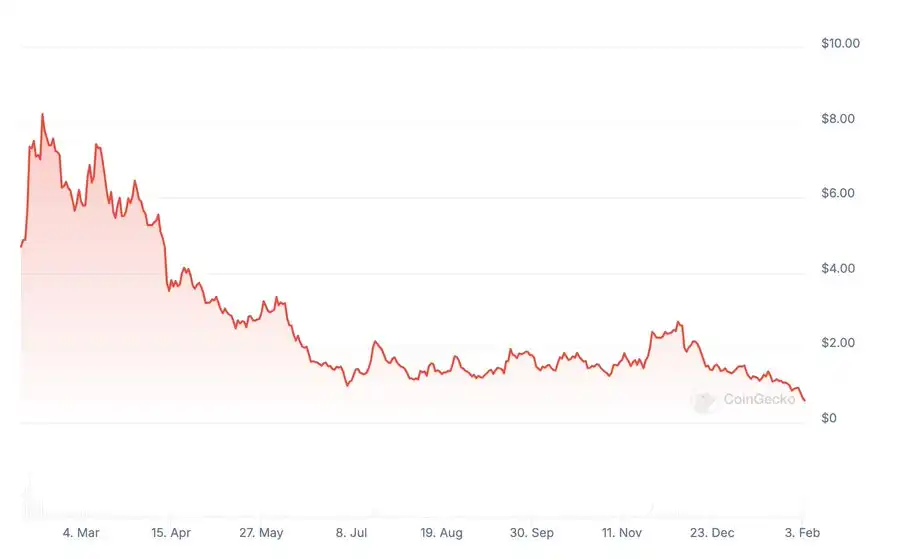
Here is an overview of the different rounds and investor unlocks for TIA:
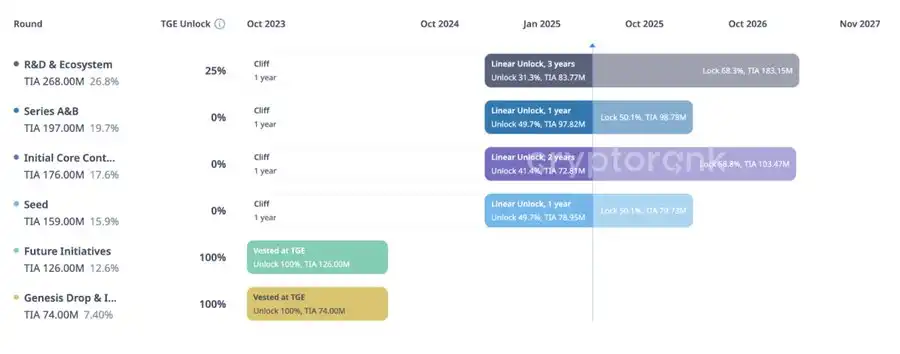
In the initial unlock, over 97.5% of TIA's circulating supply was unlocked, valued at over $1.88, with a daily unlocking rate of 10 million dollars.
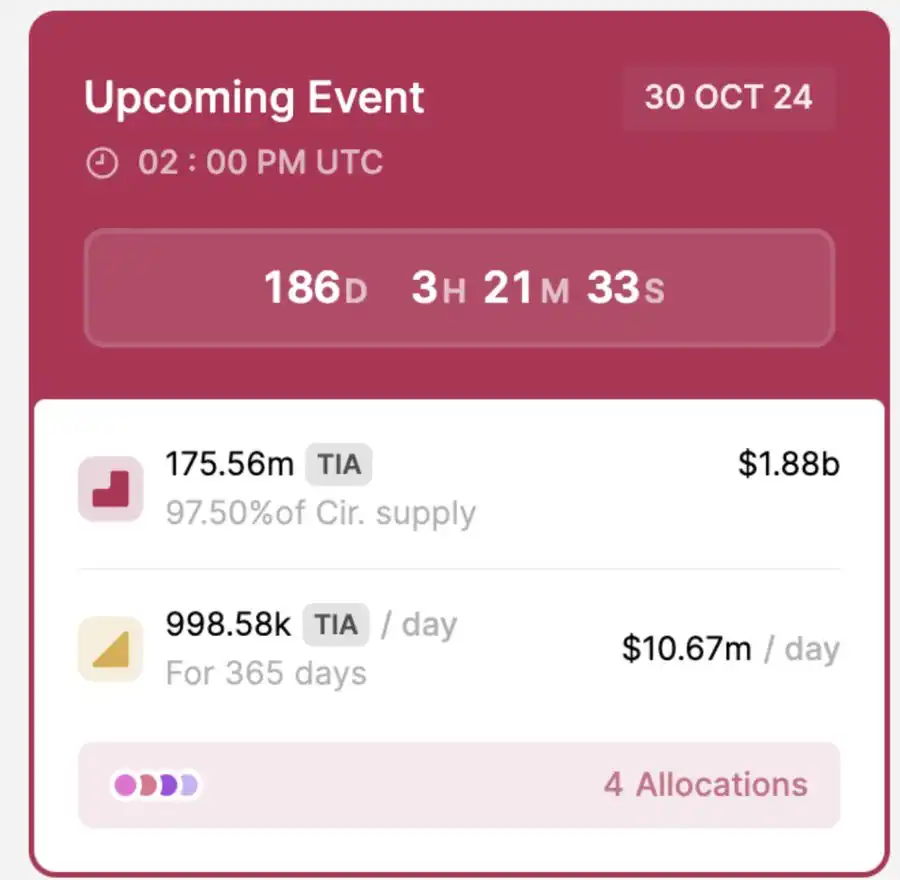
Ultimately, retail investors grew weary of these types of tokens, which meant that most tokens' issuance prices only saw a decline, eventually even dropping below their last fundraising round valuation.
This point becomes evident as we examine the dashboard provided below:
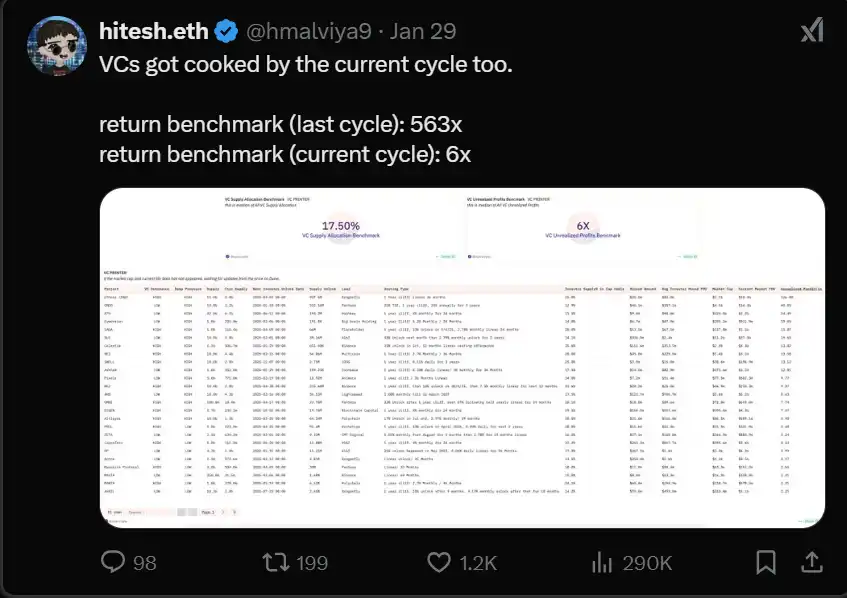
This dashboard considers the investment return of each VC's top-performing data-sample.
Venture capital returns from the previous cycle:
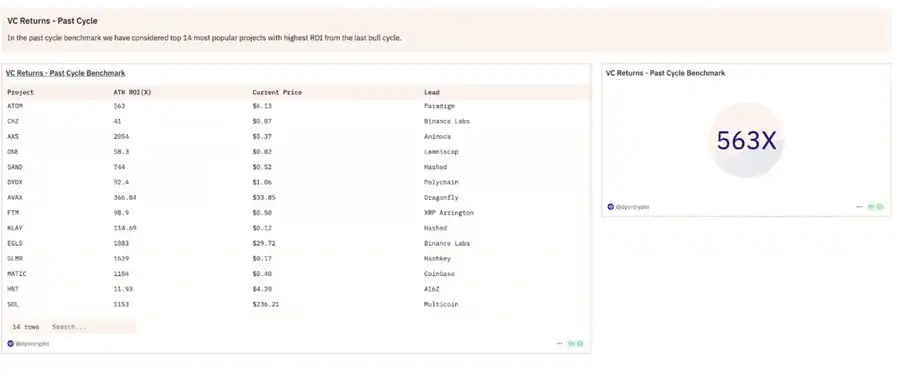
Venture capital returns from this cycle:
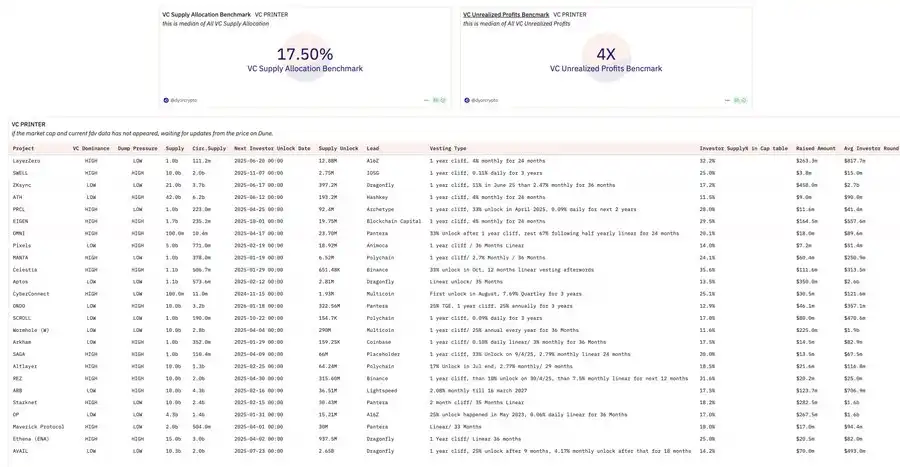
The end of the venture capital era was so apparent that even Hayes accurately pointed it out in his December 2024 article, at the end of the dark tunnel, retail investors saw a glimmer of hope: meme coins.
Tired of the venture capital-dominated conspiracy, retail investors could finally enter the permissionless market the blockchain was supposed to open up to.
That must be the way of the future, right?
Phase Two - The Meme Coin Craze

After the end of the venture capital era, users had to find a new play, and they discovered it through muststopmurad and his "meme coin supercycle."
For retail investors, meme coins seemed to be the closest thing to having an equal opportunity in the market—until they were no longer.
Prices soared, Trump was elected, and we were going to the moon.
But suddenly, the liquidity rug was pulled, and the market's attention shifted elsewhere, causing all your meme coins to collapse during market pullback.
Meanwhile, all the early insiders who had the opportunity to get in early also had the chance to offload their chips. Perhaps the situation retail investors ultimately faced was even worse than what they experienced with VC coins.
What remains now? A growing inclination towards risk-taking, a further shortening of attention spans, increased liquidity dispersion, all the while trying to understand past mistakes through more gambling disguised as "trades".
Pumpfun is just a symptom of the market's direction.
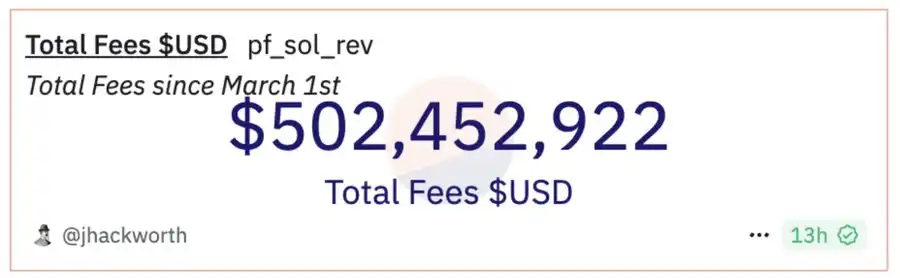
jediBlocmates highlighted the net negative issues in this ecosystem.

Among the reasons mentioned, the Pump.Fun team continues to move substantial amounts of fees out. In just last month, they moved over 880,877 SOL to Kraken, totaling 211,410,480.
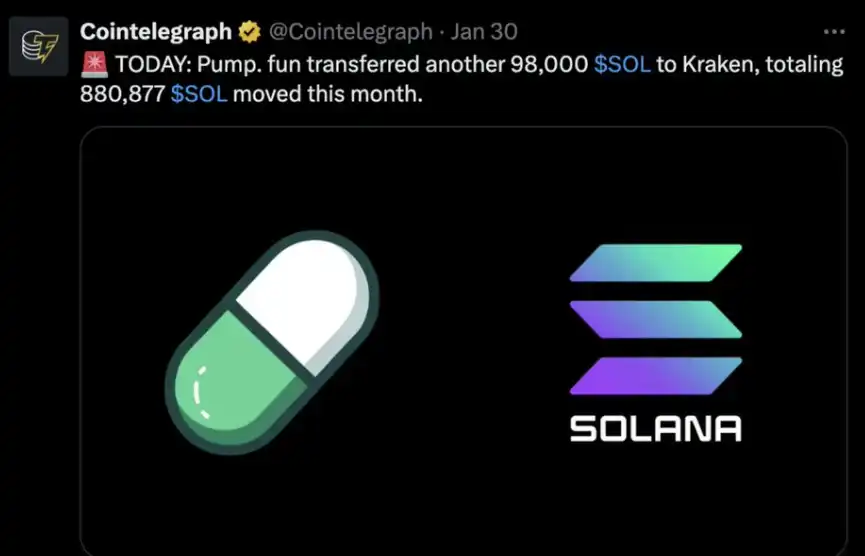
The impact of meme coins and the Pump.Fun frenzy is evident in the market changes they bring: rapid narrative shifts, an environment resembling player versus player, and a lack of trust in anything anymore.
Phase Three - Post-Traumatic Market PTSD: People Feel Exhausted
Lost in the venture capital-risked risk investors, users now carry the trauma of the Pump.Fun arena, hoping their next 100x gains will make up for previous losses. The market has now permanently changed, and the new gameplay is a reflection of this change.
Market rotations are even more fleeting and rapid, where in previous cycles, you could hold a position overnight, hold tokens for weeks, and now, at most, you can only hold for days or hours. New projects siphon all liquidity: attention is scarce, everyone is playing the same game.
The influence of politics and regulations continues to grow: this was particularly evident in TRUMP's launch, highlighting how external events can have an unprecedented impact on the market.
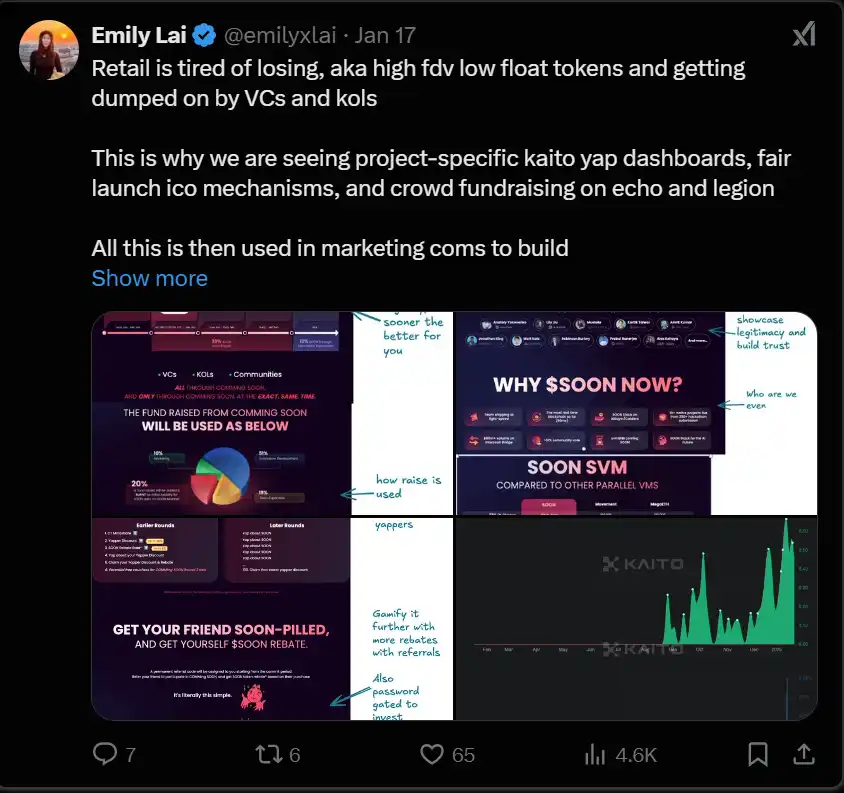
Unfortunately, once again, retail investors have lost their way in this game, with many tokens becoming like the capital extraction mechanisms they have become all too familiar with. In contrast to this trend, the launch of Hyperliquidx has drawn attention to community-led airdrops and issuance. Over 31% of the airdrop was allocated to the community, and the token price has risen by over 7 times since launch, proving that fair distribution is achievable.
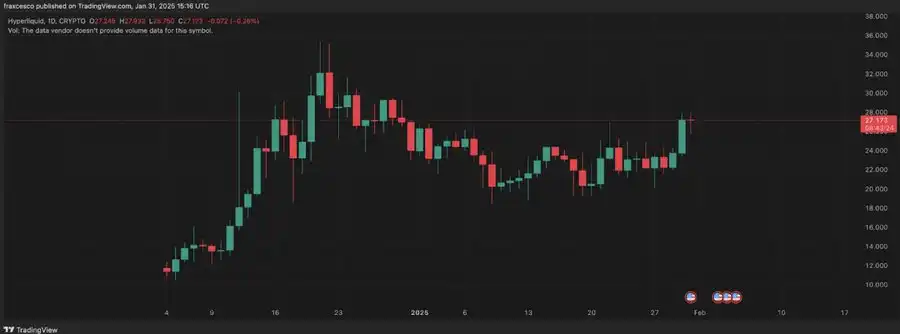
Nevertheless, it must be considered that not every project can replicate this model, as sustaining a project like Hyperliquid over a long period has already incurred tens of millions in massive expenses for the team.
Importantly, the launch of Hyperliquid has brought about a paradigm shift in the industry. Coupled with Kaito's release, the project's approach to launch strategy has also changed.
Where Does This Put Us?
These stages under consideration highlight two extremes:
1. Overwhelming power in the hands of venture capitalists: Retail investors cannot participate in private rounds and can only act as exit liquidity.
2. Unrestricted meme coin acquisition has led to a player-to-player market, deteriorating overall market conditions.
Both of these have the same consequences: retail investor dissatisfaction and a demand for balance and stability.
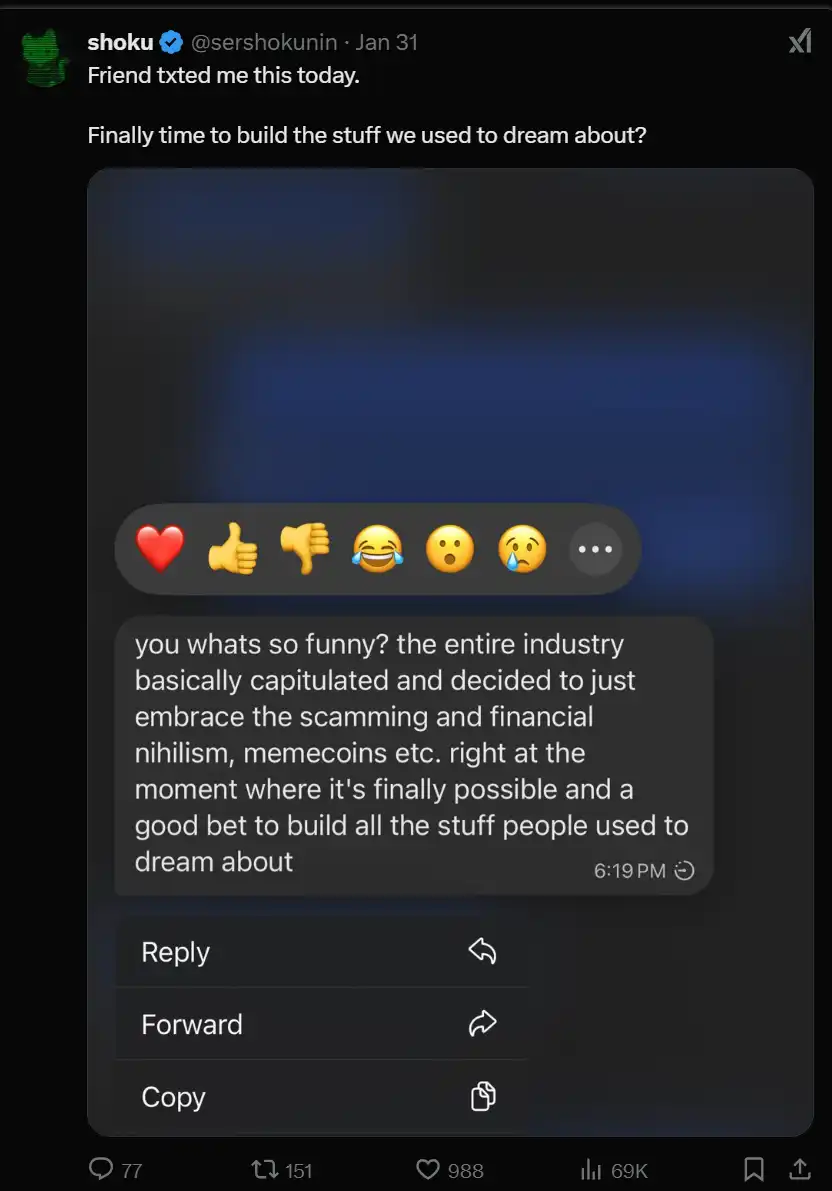
We leave some possible avenues to explore what the future might look like: a return to utility, reducing focus on meme coins, and more emphasis on practical projects.
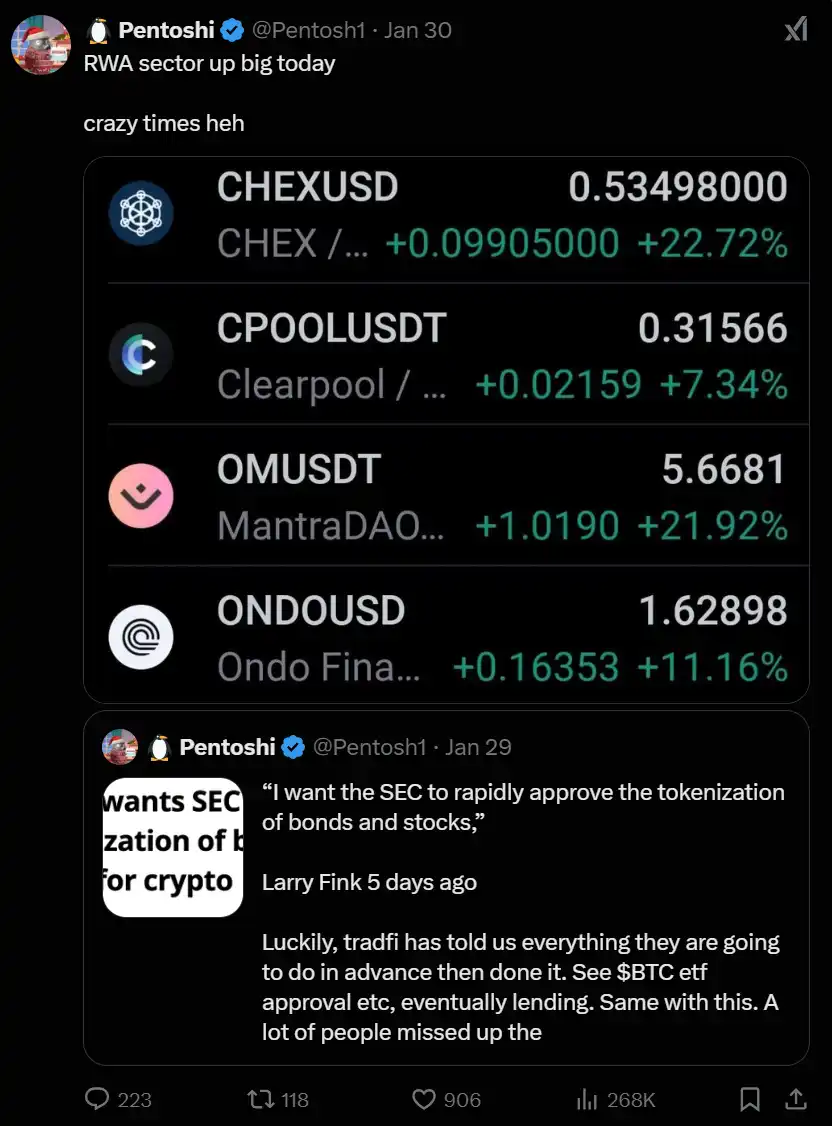
Reducing the focus on value extraction, emphasizing value creation more, and avoiding zero-sum games. Returning to fair distribution, inspired by Hyperliquid.
A fresh transformation in protocol marketing and token launch methods, leveraging tools like Kaito for marketing, growth activities, and valuing the influence of social graphs and communities.
While we all know that price is the best marketing tool and has always been a key factor in attracting talent and liquidity, it would be a great loss if, amid an impending supportive regulatory environment, the focus remains solely on value extraction.
The growth cycle of emerging markets is often full of roller-coaster-like fluctuations, but it is crucial to have a final goal and outline a viable path for the majority. That is, building something truly valuable.
You may also like

WEEX Deposit/Withdrawal Dynamic Island: Your Asset Status, Always in Sight

Scaling Crypto Derivatives: The Digital Asset Infrastructure Behind High-Volume Trading
In the fast-moving digital asset ecosystem, derivatives platforms face an extreme architectural test. High-leverage futures markets demand more than just standard security—they require absolute operational precision, zero-latency matching engines, and ironclad structural scalability, all while navigating intense market volatility.
As global platforms scale to meet these demands, the industry is shifting away from rigid, monolithic setups toward a more agile, "decoupled" infrastructure philosophy.
The Blueprint for High-Volume Copy TradingFor elite global exchanges like WEEX (founded in 2018), this architectural choice becomes critical when scaling high-volume retail features like social copy trading. When thousands of users automatically mirror the real-time strategies of elite traders simultaneously, it triggers sudden, monumental spikes in concurrent transactional volume.
To prevent execution latency or settlement bottlenecks during these peak volatility events, a platform's primary engine must remain entirely dedicated to risk management, copy-trade synchronization, and order matching.
The Architectural Rule: New-generation platforms must separate front-end user execution engines from heavy backend infrastructural overhead to eliminate operational friction.
By separating these layers, platforms can maintain complete sovereignty over their trading environments and user experiences while strategically aligning with institutional-grade infrastructure ecosystems. This strategic framework allows modern exchanges to leverage advanced Digital Asset Custody infrastructure such as Cobo’s behind the scenes, ensuring that backend wallet management scales elastically alongside trading spikes.
Capitalizing on Market Momentum and 400× LeverageIn a derivatives arena where platforms offer up to 400× leverage on perpetual contracts, capital efficiency and market agility are core business metrics. To capture market momentum, an exchange needs the ability to rapidly expand its asset offerings, supporting everything from legacy crypto assets to sudden, trending altcoins across a massive library of trading pairs.
Adopting a flexible, scalable Wallet-as-a-Service (WaaS) solution such as Cobo’s could completely rewrite the development timeline for high-growth exchanges. Instead of spending months of engineering capital building out custom backend wallet architectures for every new blockchain network, platforms can deploy localized infrastructure in days.
This agility allows platforms to instantly scale their listings to over a thousand trading pairs without compromising security or delaying time-to-market. It mirrors the exact operational advantages seen during high-velocity market events, similar to how advanced wallet infrastructure empowers platforms during sudden asset surges; allowing exchanges to pass that speed and liquidity directly to their global user base.
A Mature Foundation for GrowthThe synergy between trusted infrastructure ecosystems and global trading platforms represents the natural evolution of a maturing crypto market. As WEEX continues to scale its global spot and derivatives offerings for over 6 million users, adopting robust backend paradigms proves that platforms no longer have to compromise between cutting-edge trading velocity and uncompromised structural security.

Morning Report | BitMine increased its holdings by 126,971 ETH last week; trader Eugene announced his exit from the crypto market

Wang Chuan: How can one not feel anxious after the neighbor Old Wang made thirty times profit by investing in storage stocks? (Seven) - A quarter-century cycle

Get Paid to Onboard? Try WEEX’s New Homepage with Rewards for Registration, Deposit & Trade

WEEX Custom Layout: Build Your Perfect Trading Workspace in Seconds

See “Buy Walls” & “Sell Walls” Instantly: WEEX Launches the Depth Chart for Smarter Trades

What Is Quick Trade on WEEX? 2 Ways WEEX Ends Chart-Panel Jumping
Morning News | Five major virtual asset platforms in South Korea have experienced 57 incidents of hacking and system failures in six years; Grayscale submits registration application for Canton ETF

Should we escape the peak? The principle of the tail-end market in the stock market

RootData: May 2026 Cryptocurrency Exchange Transparency Research Report

Founder of Baixing.com: My Experience with Claude Code in Fourteen Points

Yang Ge Gary: Agent Economics and AI Microeconomics
When reasoning becomes a scarce resource, who captures its value?

Jensen Huang dramatically "rescues" the South Korean stock market

Stablecoins vs Deposit Tokens: On the surface, they seem like opposing sides, but in reality, they are interconnected

Bitcoin Crash to $50,000 or Bear Trap Before $100,000? Deep Dive for WEEX Traders
How Could the SpaceX IPO Affect Bitcoin, Altcoins season, and Crypto Liquidity?
WEEX Deposit/Withdrawal Dynamic Island: Your Asset Status, Always in Sight
Scaling Crypto Derivatives: The Digital Asset Infrastructure Behind High-Volume Trading
In the fast-moving digital asset ecosystem, derivatives platforms face an extreme architectural test. High-leverage futures markets demand more than just standard security—they require absolute operational precision, zero-latency matching engines, and ironclad structural scalability, all while navigating intense market volatility.
As global platforms scale to meet these demands, the industry is shifting away from rigid, monolithic setups toward a more agile, "decoupled" infrastructure philosophy.
The Blueprint for High-Volume Copy TradingFor elite global exchanges like WEEX (founded in 2018), this architectural choice becomes critical when scaling high-volume retail features like social copy trading. When thousands of users automatically mirror the real-time strategies of elite traders simultaneously, it triggers sudden, monumental spikes in concurrent transactional volume.
To prevent execution latency or settlement bottlenecks during these peak volatility events, a platform's primary engine must remain entirely dedicated to risk management, copy-trade synchronization, and order matching.
The Architectural Rule: New-generation platforms must separate front-end user execution engines from heavy backend infrastructural overhead to eliminate operational friction.
By separating these layers, platforms can maintain complete sovereignty over their trading environments and user experiences while strategically aligning with institutional-grade infrastructure ecosystems. This strategic framework allows modern exchanges to leverage advanced Digital Asset Custody infrastructure such as Cobo’s behind the scenes, ensuring that backend wallet management scales elastically alongside trading spikes.
Capitalizing on Market Momentum and 400× LeverageIn a derivatives arena where platforms offer up to 400× leverage on perpetual contracts, capital efficiency and market agility are core business metrics. To capture market momentum, an exchange needs the ability to rapidly expand its asset offerings, supporting everything from legacy crypto assets to sudden, trending altcoins across a massive library of trading pairs.
Adopting a flexible, scalable Wallet-as-a-Service (WaaS) solution such as Cobo’s could completely rewrite the development timeline for high-growth exchanges. Instead of spending months of engineering capital building out custom backend wallet architectures for every new blockchain network, platforms can deploy localized infrastructure in days.
This agility allows platforms to instantly scale their listings to over a thousand trading pairs without compromising security or delaying time-to-market. It mirrors the exact operational advantages seen during high-velocity market events, similar to how advanced wallet infrastructure empowers platforms during sudden asset surges; allowing exchanges to pass that speed and liquidity directly to their global user base.
A Mature Foundation for GrowthThe synergy between trusted infrastructure ecosystems and global trading platforms represents the natural evolution of a maturing crypto market. As WEEX continues to scale its global spot and derivatives offerings for over 6 million users, adopting robust backend paradigms proves that platforms no longer have to compromise between cutting-edge trading velocity and uncompromised structural security.
Morning Report | BitMine increased its holdings by 126,971 ETH last week; trader Eugene announced his exit from the crypto market
Wang Chuan: How can one not feel anxious after the neighbor Old Wang made thirty times profit by investing in storage stocks? (Seven) - A quarter-century cycle
Get Paid to Onboard? Try WEEX’s New Homepage with Rewards for Registration, Deposit & Trade
WEEX Custom Layout: Build Your Perfect Trading Workspace in Seconds


