
From Paragraph to Web3: Reimagining Ownership Balance without Custom Design


Original Title: The flawed concept of ownership in Web3
Original Author: 0xAntidote.eth
Original Translation: Zen, PANews
The recent update from Paragraph, which previously acquired the well-known Web3 content platform Mirror, brought some changes. One point that has not been widely discussed is the removal of the feature that allowed custom CSS design for blogs. The Paragraph team stated that only a few creators were using this feature, and I happened to be one of them. I had spent a lot of time carefully designing the brand's visual identity to give my blog a unique style. However, this update completely ruined those efforts—custom fonts and background colors were removed, leading to a messy overall design of the blog.
While I had plans to continue posting content on Paragraph and expanding my reader base, my blog's scale is currently not significant enough for Paragraph to lose users if I leave. Every product team's resources are limited, sometimes due to budget constraints, developer bandwidth, or differing product decision priorities. Therefore, it is impossible to meet everyone's needs.
However, I must also add that the Paragraph team has always been very friendly to me. They have selected my articles as "Editor's Picks" twice, listened carefully to my feedback, and provided professional explanations during our communications.
Although I understand their decision, I believe that the mindset behind this decision is to mimic existing Web2 content publishing platforms—enhancing centralized distribution platforms' control through standardized content appearance. I still wish the Paragraph team all the best, but for me, the current Paragraph no longer addresses a core issue worth solving, so I have decided to leave.
Paragraph's Value Proposition
From the official introduction, Paragraph's key value proposition mainly revolves around "content ownership."
In short, Paragraph is a blog/newsletter platform based on encryption technology. Articles are stored on Arweave and can be sold as digital collectibles, allowing creators to directly monetize their content. In theory, this model can strengthen a creator's ownership of their content.
However, upon careful consideration, I believe that creating content on Paragraph does not necessarily mean you truly own it.
What Is True "Ownership"?
"Ownership" has always been a key concept in the Web3 narrative. One of Ethereum's origin stories is Vitalik questioning the ownership of digital assets: What happens to your in-game items if the game developer shuts down the server?
This thinking led to the birth of Ethereum and subsequent smart contract platforms, propelling the evolution of the concept of "ownership." Today, blockchain technology enables almost all types of assets to be "owned."
But the essence of ownership is not just about possessing something; it also involves more complex aspects.
In a multi-party interactive world, ownership must have four key elements:
· Possession: Are you recognized as the owner of the asset?
· Monetization: Can you sell the asset or charge non-owners for its use?
· Appearance: Does the asset's external representation align with your expectations?
· Distribution: Can your asset be widely shared to gain recognition of your ownership?
If any of these four aspects has an issue, true ownership cannot be established.
The Flaw of Paragraph in Terms of Ownership
Blockchain has improved many aspects of ownership through decentralized ledgers and encryption technology. However, if certain key elements fail, ownership can still be eroded. For example:
If everyone mistakenly believes you own something else, are you still the true owner? If your video can only be presented with a sepia-toned filter (because YouTube or your ISP enforced the filter), is it still your content?
This is the current state in which Paragraph finds itself—it can arbitrarily change the visual presentation of a blog, and the creator has no control over it.
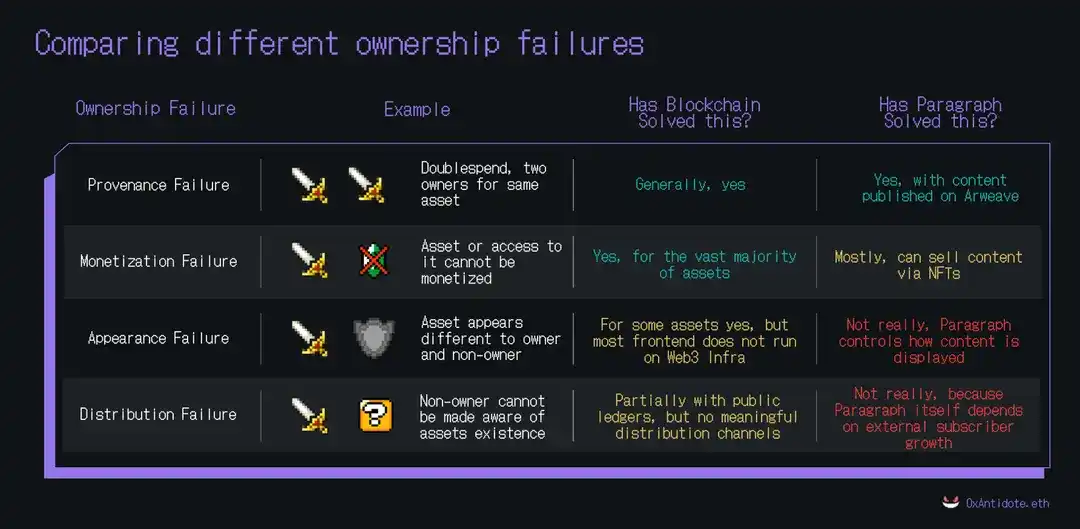
As seen in the image above, Paragraph has made improvements in the possession and monetization aspects of ownership, but its contribution to appearance and distribution is limited, or even negative.
The Compromises and Trade-offs of Ownership
Of course, perfect ownership is an ideal state that may never be fully achieved. However, we can measure whether we are progressing towards this ideal. I believe that over the past decade, we have generally been moving closer to this ideal. Blockchain has played a role in this, but other technological advancements are equally important, such as decentralized energy production (primarily renewable energy) or Starlink (which provides high-speed internet access globally).
However, in the current state, everything is more or less a compromise. The question is, in the four aspects of ownership - Possession, Monetization, Appearance, and Distribution - in which aspects are you willing to compromise?
Different assets and platforms have their own ways of compromising.
For example, for some assets like Memecoins, teams are usually willing to sacrifice "Appearance" and "Distribution" autonomy, using X (formerly Twitter) and Discord to promote their project in exchange for a larger market coverage. These projects are willing to make such compromises because the audience base of these traditional social media platforms is huge, and even though they have content restrictions, their reach still far exceeds that of smaller-scale open platforms like Farcaster or Lens that focus more on ownership. The development of Memecoins into a billion-dollar industry itself proves the effectiveness of this compromise in reality.
However, for media content, the situation is different. X will restrict external media platform link distribution, such as Substack. Writing content related to Memecoins is seen by X as content that expands the Total Addressable Market (TAM), while content linking to external media platforms is seen as content that contracts the TAM.
This is also the problem faced by many Web3 media platforms - their value gain is only evident after reaching a certain scale. Before this scale is reached, for many digital asset creators, sacrificing certain aspects of ownership in exchange for better distribution effects may make more economic sense than sticking to the ideal state of ownership.
This is particularly evident on Web3 media platforms like Paragraph. They have not fully optimized Possession, Monetization, Appearance, and Distribution, putting them in an awkward middle ground: not providing enough additional ownership control to make creators willing to sacrifice distribution advantages to use them.
What are the alternatives?
So, where will my future content be published? I believe there are several possible paths that may better align with my ownership principles.
· Transitioning to other writing platforms such as Medium, Mirror, Substack, or Ghost. These platforms each have their pros and cons, but their compromise solutions are not fundamentally superior to Paragraph. Moving to them seems more like lateral movement rather than fundamental optimization.
· Distributing on X and/or Farcaster, and hosting content elsewhere, means splitting different aspects of ownership across multiple platforms. One possible best practice is: first publish content on X/Farcaster to ensure better distribution; then archive the article on a blog with customizable CSS to ensure the look and feel of the content.
· Continuing to use Paragraph, expecting it to improve product positioning, may be a viable solution, but if future adjustments to the content's appearance are needed, it will add a lot of extra work. Therefore, I currently plan to keep the Paragraph blog but not use it as the primary publishing channel unless there are substantial product improvements.
Currently, I am more inclined towards the second option.
Especially as Farcaster provides a nice balance between different aspects of ownership. Additionally, Frames could be a solution, allowing for the publishing of long-form content with full control over appearance and monetization.
You may also like

The pricing controversy of Trade.xyz exposes the fatal weakness of Pre-IPO perpetual contracts

World Cup 2026 Coming – WEEX Celebrates with $1M Prize Pool & Michael Owen Live

Galaxy in-depth report: Is Solana still worth paying attention to?
Young people in South Korea make a "final effort" in the epic bull market

Dialogue with OmenX Founder: Why does the prediction market need an evolution from "spot" to "derivatives"?
When the P2P illicit funds from ten years ago turned into 60,000 bitcoins

Morning News | CME Group launches Nasdaq Cryptocurrency Index futures; Asset management giant Janus Henderson strategically invests in Ethena

Why did Oracle deliver the strongest financial report in history, yet its stock price fell?

Bitcoin Layer 2 Network Botanix: Why Did We Choose to Dissolve?

Morning Report | OpenAI has submitted an S-1 registration statement draft to the U.S. SEC; Morpho completes $175 million financing

Galaxy Deep Research Report: How Hyperliquid's HIP-4 Upgrade Changes the Landscape of Prediction Markets?

Latest research from 13 top universities including Cornell University: The current state, challenges, and misconceptions of the fusion of Crypto and AI
Deconstructing Anthropic: The Best AI Company, Possibly Also a Type of Organizational Invention

Every exchange is a "Universal Exchange."

The counterattack of traditional finance: Alliance chains are quietly reviving
Pantera Capital Partner: How Tokenization is Restructuring the Private Equity and Early Investment Ecosystem?

Mastercard Launches Agent Pay for AI, Plans to Record AI Agent Payment Authorizations on Polygon
Mastercard launched Agent Pay for AI, a new payment protocol designed to help AI agents make small payments such as pay-per-use access to data and APIs. The system plans to record human-granted AI agent permissions on Polygon, focusing on verifiable authorization, identity, and payment controls.

Curve Deploys Llamalend v2 on Optimism With 250,000 OP Incentives
Curve launched Llamalend v2 on Optimism with 250,000 OP incentives from the Optimism Foundation. The upgrade expands Llamalend beyond its earlier crvUSD-focused model, adding broader collateral support, LlamaRisk market reviews, and the ability to use Curve LP tokens as collateral.
The pricing controversy of Trade.xyz exposes the fatal weakness of Pre-IPO perpetual contracts
World Cup 2026 Coming – WEEX Celebrates with $1M Prize Pool & Michael Owen Live
Galaxy in-depth report: Is Solana still worth paying attention to?
Young people in South Korea make a "final effort" in the epic bull market
Dialogue with OmenX Founder: Why does the prediction market need an evolution from "spot" to "derivatives"?
When the P2P illicit funds from ten years ago turned into 60,000 bitcoins


