
ARK '2025 Vision': Governments have already started exploring cryptocurrency, and by 2030, BTC will have reached at least $300,000


Original Title: BIG IDEAS 2025
Original Source: ARK Invest
Original Translation: Nicky, Foresight News
1. Bitcoin: Maturation of the Global Monetary System and Institutionalization Process
Bitcoin reached a milestone development in 2024, with its network fundamentals and institutional adoption both significantly improved, demonstrating its long-term value as "digital gold."
1. Market Performance and Accelerated Institutionalization
· Price Performance and ETF Breakthrough: In 2024, Bitcoin price hit a historic high, surpassing $100,000, and its market dominance (percentage of total cryptocurrency market cap) exceeded 65% for the first time. Behind this growth, the launch of physically-backed Bitcoin ETFs became a key catalyst. The first U.S. physically-backed Bitcoin ETF attracted over $4 billion in inflows on its debut trading day, far surpassing the historical record of gold ETFs in September 2004. By the end of 2024, the total assets under management (AUM) of Bitcoin ETFs had surpassed $100 billion, with a significant increase in institutional investor participation. Meanwhile, Bitcoin's annual volatility dropped to historic lows, and its risk-adjusted returns continued to outperform most major asset classes.
· Halving and Scarcity: Bitcoin completed its fourth halving, bringing the annual inflation rate down to 0.9%, the first time below gold's long-term supply growth rate (approximately 1.7%), once again highlighting its deflationary nature. Its coded total supply cap of 21 million coins and mathematically enforced monetary policy further strengthened the narrative of "digital gold." On-chain data showed that long-term holders (holding for over 3 years) accounted for 45%, reaching a historical high, indicating the continued recognition of Bitcoin as a store of value.
· Corporate Holdings and Strategic Reserves: 74 publicly traded companies globally have included Bitcoin on their balance sheets, with a total holding of over 550,000 coins, valued at approximately $55 billion. MicroStrategy, as the largest holder, held 446,000 coins (2.1% of Bitcoin's circulating supply). Additionally, Pennsylvania became the first U.S. state to propose establishing a strategic Bitcoin reserve, signaling governmental exploration of cryptocurrency.
2. Technological Advancement and Network Health
· Hash Rate Hits All-Time High: Despite a halving that halved miner revenue, the network's hash rate has still hit a historical record, indicating miners' long-term confidence.
· Runes Protocol Activation: The Bitcoin-based Fungible Token protocol has driven on-chain transaction volume to surge, with daily transactions surpassing 800,000, and the ecosystem's application scenarios continue to expand.
· Holding Behavior Longevity: Over 45% of the Bitcoin supply has not moved for over 3 years, on-chain liquidity has dropped to a 14-year low, reflecting its positioning as a store of value tool.
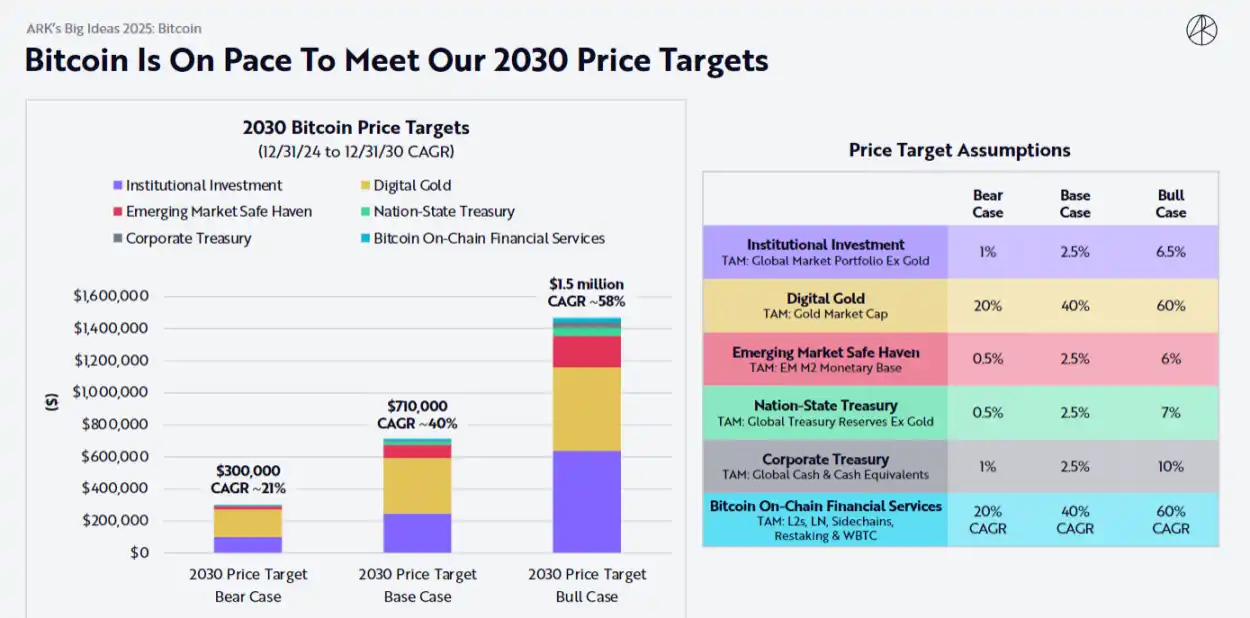
3. 2030 Price Prediction
ARK predicts Bitcoin's price outlook in 2030 to be:
· Bear Market Price: $300,000
· Neutral Price: $710,000
· Bull Market Price: $1.5 million
II. AI Agents: Rethinking Human-Machine Interaction and Business Efficiency
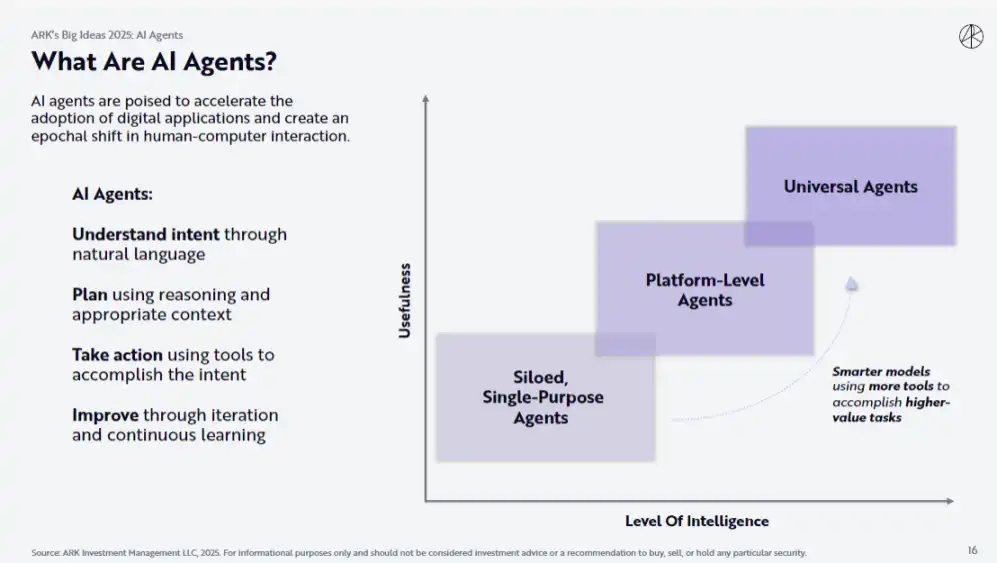
AI Agents are evolving from single-task tools to general intelligence platforms. Their core capabilities include natural language understanding, contextual reasoning, tool invocation, and continuous learning.
1. Consumer-End Transformation
· Search and Advertising Restructuring: AI-driven personalized agents will replace traditional search engines, with AI ad revenue expected to account for 54% of the digital advertising market in 2030, reaching $600 billion in size.
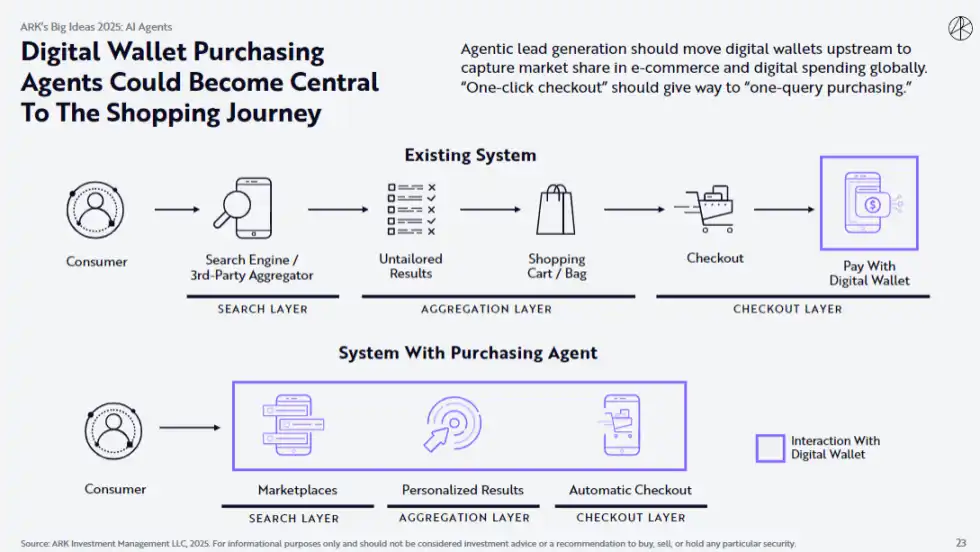
· E-commerce Revolution: AI agents deeply integrated into operating systems allow users to complete the entire process of product search, price comparison, and payment through voice or text commands. For example, a shopping agent embedded in a digital wallet can automatically select the best products and complete the checkout, driving digital wallet's share of global e-commerce transactions to 72% and creating an additional $200 billion in annual enterprise value. It is estimated that by 2030, such agents will drive $9 trillion in online consumption, accounting for 25% of global e-commerce total.
· Hardware Proliferation: After 2025, the majority of consumer electronics devices will have built-in AI agent functionality, with penetration curves surpassing or matching that of smartphones.
2. Leap in Enterprise Efficiency
· Customer Service Cost Optimization: AI customer service can reduce the cost per interaction from $1 to $0.125, handle 70% of inquiries, saving global enterprises over $500 billion in labor costs.
· Software Development Revolution: AI coding tools (such as GPT-4, Claude 3.5) can now address 70% of real tasks, reducing the software development lifecycle by 40% and driving enterprises from buying software to custom development. If AI agents automate 81% of knowledge work time, they will unlock a $117 trillion productivity dividend by 2030. The software market size may surge from the current $1.5 trillion to $13 trillion (CAGR 48%), with underlying cloud infrastructure and AI chip demand exploding simultaneously.
III. Stablecoins: Reshaping the Digital Asset Landscape
By 2024, stablecoin annualized transaction volume will reach $15.6 trillion, surpassing Visa ($13.1 trillion) and Mastercard ($7.8 trillion), becoming the fastest-growing global payment network.
1. Market Surge and Innovation
· Scale and Efficiency: Stablecoin annual settlement volume reaches $15.6 trillion, with single transaction values far exceeding credit cards, and on-chain settlements on platforms like Solana and Tron account for over 60%. In December, monthly on-chain stablecoin trading volume reached $2.7 trillion, with small-value transactions (<$100) representing over 85% on Layer 2. Users in emerging markets (Brazil, Nigeria, etc.) are using stablecoins for cross-border remittances and inflation-resistant savings, driving active address count past 23 million. Concurrently, stablecoin adoption on Layer 2 (Base, Arbitrum) and emerging public chains (TON, Celo) is surging, driving cross-chain interoperability needs.
· Rise of Yield-Generating Stablecoins: Ethena Labs' USDe provides 20%-30% yield through a Delta-neutral strategy, with $6 billion in assets locked in 12 months, elevating the share of algorithmic stablecoins with non-native collateral to 10%.
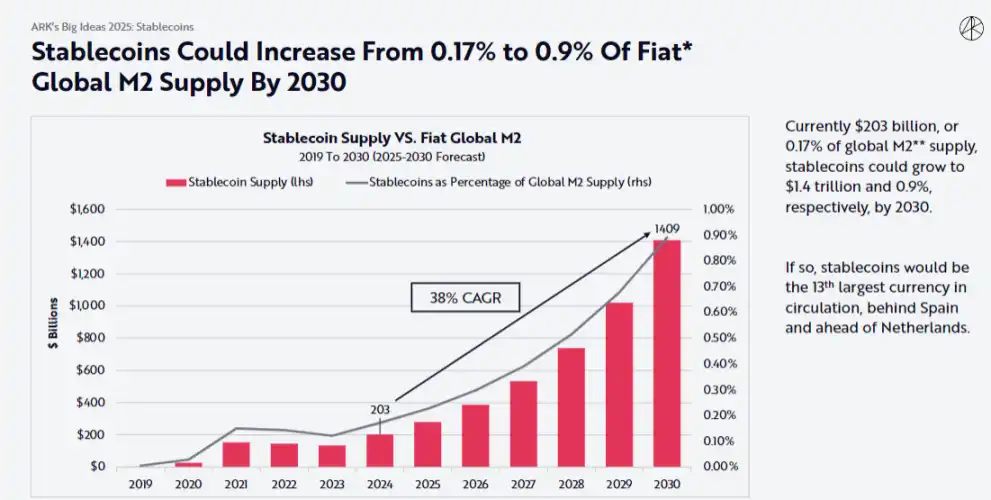
· Dollarization Trend: Despite many countries promoting de-dollarization, the share of USD stablecoins still exceeds 98%, with Tether and Circle holding U.S. debt at a scale ranking them among the top 20 global holders. Stablecoins have become a key tool for USD "digital export," especially amid the de-dollarization trend, where the demand for USD stablecoins in emerging markets has offset some countries' reduction in U.S. debt holdings. ARK predicts that by 2030, stablecoin volume will reach $14 trillion, accounting for 0.9% of global M2 money supply, becoming the 13th largest circulating currency.
2. Regulation and Challenges
· Acceleration of Compliance: The U.S. "Stablecoin Governance Act" framework has emerged, requiring a 100% reserve and audit transparency, further consolidating market share among leading issuers.
IV. Blockchain Scalability: Competition Between Layer 2 and High-Performance Public Chains
Ethereum Layer 2 and Solana lead the scalability trend, driving the smart contract ecosystem towards high throughput and low-cost evolution.
1. Ethereum Ecosystem Upgrade
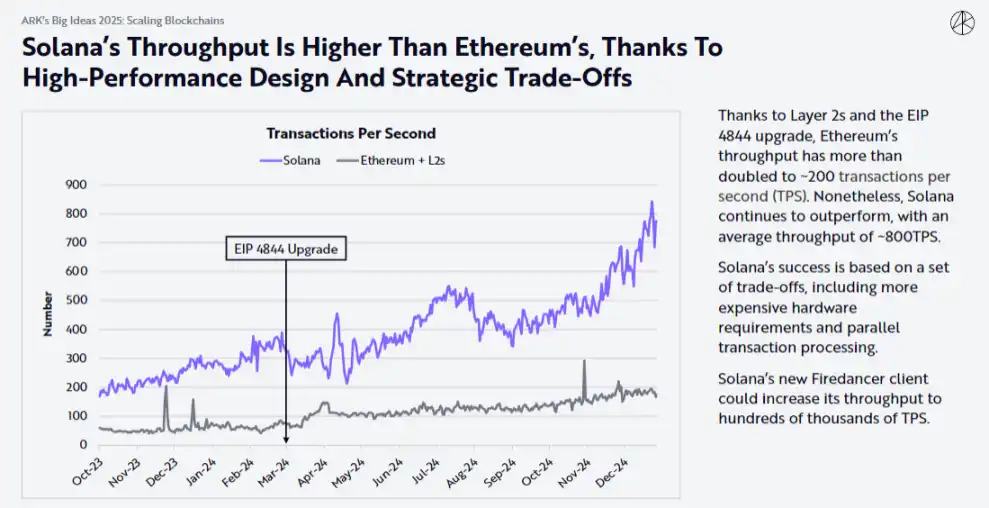
· EIP-4844 Effect: The EIP-4844 upgrade has reduced Layer 2 transaction costs from $0.5 to $0.05, with daily transaction volume surging from 3 million to 15 million.
· Rapid Growth of Base: Base Chain's DAU share reached 46%, TVL exceeded $15 billion, Coinbase's ecosystem synergy is evident, and it has driven Ethereum's shift from the settlement layer to the application layer.
2. Solana's Retail Breakthrough
· Performance Advantage: With an average of 800 TPS far exceeding the Ethereum ecosystem (200 TPS), daily active addresses surpassing 1.2 million, and on-chain fee income accounting for 22% of the cryptocurrency market. Its low fees ( $0.001 per transaction) attract a large number of retail users, with the prediction market platform Polymarket and DEX Raydium becoming benchmarks in the ecosystem. The Firedancer client is expected to increase throughput to the hundreds of thousands.
· Developer Migration: In 2024, Solana's addition of developers surpassed the Ethereum mainnet, with Memecoin and DePIN (Decentralized Physical Internet Network) becoming dual engines of ecosystem growth.
3. Application Layer Breakout
· DeFi Challenging CEX: DEX trading volume share increased from 8% to 14%, and the derivatives market grew to 8%. The efficiency of a single Uniswap employee is 200 times that of Binance.
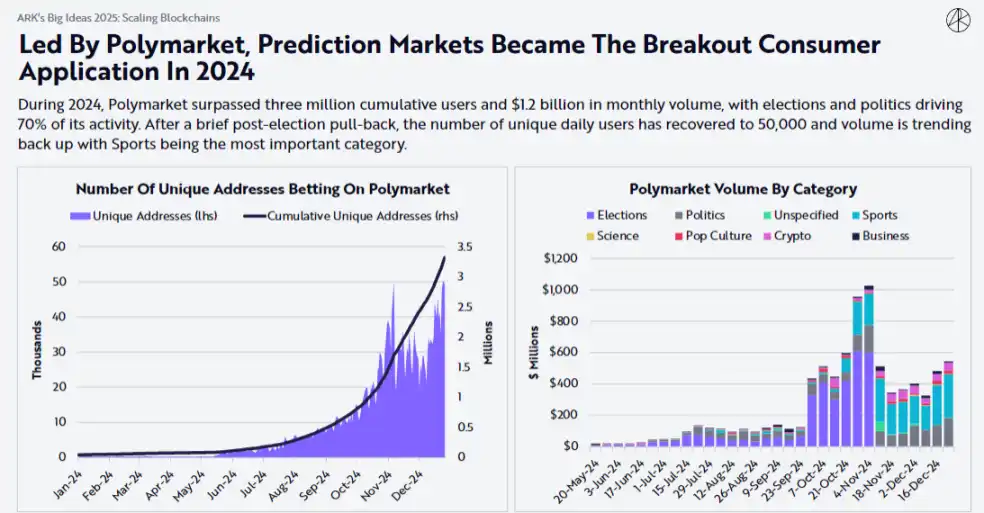
· Rise of Prediction Markets: Polymarket, with events like the U.S. election and sports betting, surpassed $1.2 billion in monthly trading volume with over 3 million users.
Further Maturation of Staking Economy: Liquidity staking protocols (such as Lido, EigenLayer) collectively manage over 5.5 million ETH (17% of the total staked ETH), driving the maturation of the staking economy.
Conclusion: The Integration and Breakthrough of Web3
By 2025, the monetary properties of Bitcoin, the productivity unleashed by AI Agents, the expansion of stablecoin payment networks, and the technological breakthroughs in blockchain scalability will collectively shape the core of ARK's "2025 Big Ideas." The convergence of these technologies will reshape the global economy: AI-driven computing demand will drive an energy revolution, stablecoins will bolster the dominance of the US dollar, and blockchain scalability will unlock the potential of decentralized applications. Web3 practitioners need to focus on the evolution of foundational protocols, grasp key tracks such as cross-chain interoperability, AI-native DApps, and compliant stablecoins in the fusion of technologies to capture value.
You may also like

Bitcoin Trading Guide 2026: Strategies for Experienced Traders

What Is XAUT and PAXG? Why Tokenized Gold Is Booming in 2026

Cryptocurrency CEXs are flocking to sell US stocks, and traditional brokerages are facing an "uninvited guest."

Will the SpaceX IPO Hurt Bitcoin? Here's What Traders Are Watching
Foreign selling in the South Korean stock market accelerates, with cumulative net sales reportedly reaching $75 billion this year
On June 9, The Kobeissi Letter, citing Goldman Sachs data, reported that global investors are selling South Korean stocks at an unusually rapid pace. In the latest trading session, foreign investors sold about $801 million worth of Kospi constituent stocks again; total foreign outflows last week reached about $10 billion, and the market has been in net foreign selling on nearly every trading day over the past month. According to the data cited in the report, foreign investors have sold about $75 billion worth of South Korean stocks so far this year. Meanwhile, South Korean retail and institutional investors together recorded roughly $69 billion in net buying over the same period, suggesting that the market’s main buying support has come from domestic capital rather than returning overseas funds. The information currently disclosed still mainly comes from The Kobeissi Letter’s retelling and Goldman Sachs data summaries, while public details on the statistical period and the specific definition of “selling” remain relatively limited.

Fortune Warns of Strategy’s Financing Structure Risks as Bitcoin Premium Narrows
Fortune warned that Strategy’s Bitcoin treasury model faces growing financing risks as MSTR’s net asset premium narrows and preferred stock dividend pressure increases.

Ferrari Challenge Le Mans: Carl Moon to Dominate in WEEX Livery

Sahara AI Responds to SAHARA’s Sharp Drop: No Contract or Product Security Issues Found, Internal Investigation Underway
Sahara AI responded to SAHARA’s 60% price drop, saying no token contract or product security issues have been found and an internal investigation is underway.

WEEX Deposit/Withdrawal Dynamic Island: Your Asset Status, Always in Sight

Scaling Crypto Derivatives: The Digital Asset Infrastructure Behind High-Volume Trading
In the fast-moving digital asset ecosystem, derivatives platforms face an extreme architectural test. High-leverage futures markets demand more than just standard security—they require absolute operational precision, zero-latency matching engines, and ironclad structural scalability, all while navigating intense market volatility.
As global platforms scale to meet these demands, the industry is shifting away from rigid, monolithic setups toward a more agile, "decoupled" infrastructure philosophy.
The Blueprint for High-Volume Copy TradingFor elite global exchanges like WEEX (founded in 2018), this architectural choice becomes critical when scaling high-volume retail features like social copy trading. When thousands of users automatically mirror the real-time strategies of elite traders simultaneously, it triggers sudden, monumental spikes in concurrent transactional volume.
To prevent execution latency or settlement bottlenecks during these peak volatility events, a platform's primary engine must remain entirely dedicated to risk management, copy-trade synchronization, and order matching.
The Architectural Rule: New-generation platforms must separate front-end user execution engines from heavy backend infrastructural overhead to eliminate operational friction.
By separating these layers, platforms can maintain complete sovereignty over their trading environments and user experiences while strategically aligning with institutional-grade infrastructure ecosystems. This strategic framework allows modern exchanges to leverage advanced Digital Asset Custody infrastructure such as Cobo’s behind the scenes, ensuring that backend wallet management scales elastically alongside trading spikes.
Capitalizing on Market Momentum and 400× LeverageIn a derivatives arena where platforms offer up to 400× leverage on perpetual contracts, capital efficiency and market agility are core business metrics. To capture market momentum, an exchange needs the ability to rapidly expand its asset offerings, supporting everything from legacy crypto assets to sudden, trending altcoins across a massive library of trading pairs.
Adopting a flexible, scalable Wallet-as-a-Service (WaaS) solution such as Cobo’s could completely rewrite the development timeline for high-growth exchanges. Instead of spending months of engineering capital building out custom backend wallet architectures for every new blockchain network, platforms can deploy localized infrastructure in days.
This agility allows platforms to instantly scale their listings to over a thousand trading pairs without compromising security or delaying time-to-market. It mirrors the exact operational advantages seen during high-velocity market events, similar to how advanced wallet infrastructure empowers platforms during sudden asset surges; allowing exchanges to pass that speed and liquidity directly to their global user base.
A Mature Foundation for GrowthThe synergy between trusted infrastructure ecosystems and global trading platforms represents the natural evolution of a maturing crypto market. As WEEX continues to scale its global spot and derivatives offerings for over 6 million users, adopting robust backend paradigms proves that platforms no longer have to compromise between cutting-edge trading velocity and uncompromised structural security.

Morning Report | BitMine increased its holdings by 126,971 ETH last week; trader Eugene announced his exit from the crypto market

Wang Chuan: How can one not feel anxious after the neighbor Old Wang made thirty times profit by investing in storage stocks? (Seven) - A quarter-century cycle

Get Paid to Onboard? Try WEEX’s New Homepage with Rewards for Registration, Deposit & Trade

WEEX Custom Layout: Build Your Perfect Trading Workspace in Seconds

See “Buy Walls” & “Sell Walls” Instantly: WEEX Launches the Depth Chart for Smarter Trades

What Is Quick Trade on WEEX? 2 Ways WEEX Ends Chart-Panel Jumping
Morning News | Five major virtual asset platforms in South Korea have experienced 57 incidents of hacking and system failures in six years; Grayscale submits registration application for Canton ETF
Should we escape the peak? The principle of the tail-end market in the stock market
Bitcoin Trading Guide 2026: Strategies for Experienced Traders
What Is XAUT and PAXG? Why Tokenized Gold Is Booming in 2026
Cryptocurrency CEXs are flocking to sell US stocks, and traditional brokerages are facing an "uninvited guest."
Will the SpaceX IPO Hurt Bitcoin? Here's What Traders Are Watching
Foreign selling in the South Korean stock market accelerates, with cumulative net sales reportedly reaching $75 billion this year
On June 9, The Kobeissi Letter, citing Goldman Sachs data, reported that global investors are selling South Korean stocks at an unusually rapid pace. In the latest trading session, foreign investors sold about $801 million worth of Kospi constituent stocks again; total foreign outflows last week reached about $10 billion, and the market has been in net foreign selling on nearly every trading day over the past month. According to the data cited in the report, foreign investors have sold about $75 billion worth of South Korean stocks so far this year. Meanwhile, South Korean retail and institutional investors together recorded roughly $69 billion in net buying over the same period, suggesting that the market’s main buying support has come from domestic capital rather than returning overseas funds. The information currently disclosed still mainly comes from The Kobeissi Letter’s retelling and Goldman Sachs data summaries, while public details on the statistical period and the specific definition of “selling” remain relatively limited.
Fortune Warns of Strategy’s Financing Structure Risks as Bitcoin Premium Narrows
Fortune warned that Strategy’s Bitcoin treasury model faces growing financing risks as MSTR’s net asset premium narrows and preferred stock dividend pressure increases.


